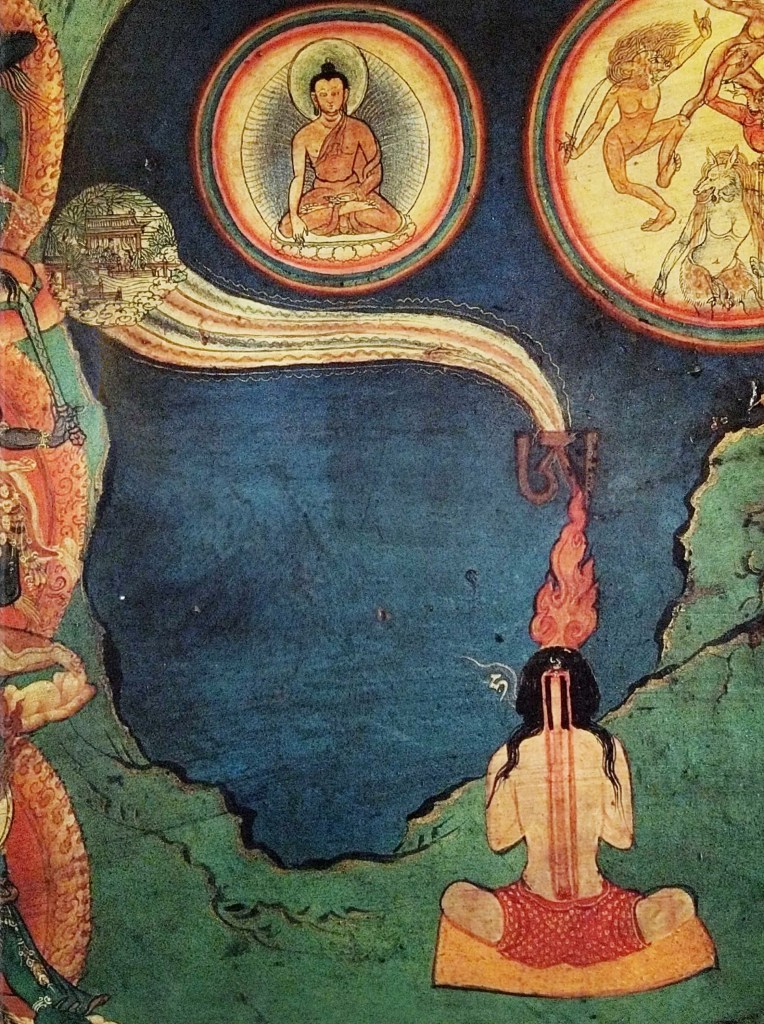
The illustration from the Northern wall mural at the Lukhang Temple, which depicts Tummo (inner fire) and Phowa (transference of consciousness), is a visual representation of two of the Six Yogas of Naropa. These practices are profound meditative techniques used to awaken inner spiritual energy and facilitate transcendence.
Interpreting the Tummo Depiction in the Mural
- The Inner Fire at the Navel:
- In the mural, the flames rising from the navel chakra (manipura) symbolize the inner fire ignited through Tummo practice.
- This fire represents both literal and metaphorical heat—literal in the sense of generating physical warmth through control of subtle energy, and metaphorical as the energy that burns away mental obscurations.
- The fire connects upward to other chakras, signifying the purification and activation of the subtle channels (nadis). This rising energy is essential for opening the central channel (sushumna), the pathway to enlightenment.
- Posture and Breath:
- The practitioner is depicted in a meditative posture, emphasizing stillness and focus. This aligns with the physical and mental control required in Tummo to direct energy effectively.
- The visualization of the fire works in tandem with controlled breathing techniques (pranayama), which regulate and enhance the flow of prana, or life force, to ignite and sustain the inner fire.
- Energy and Light:
- Surrounding the practitioner are luminous, radiating lines and symbols, suggesting the light generated through the practice of Tummo. These are not just artistic embellishments but representations of the actual inner experience of luminosity.
- This light reflects the dissolution of duality as the practitioner begins to merge their awareness with the radiant nature of consciousness, ultimately leading to the experience of Ösel (Clear Light).
Connection to Phowa in the Mural
The same mural also illustrates Phowa, the practice of transference of consciousness, where the the great insight in the essence of who you are is emerging at the moment of death to achieve liberation. This is represented by a stream of light or energy leaving the crown chakra (sahasrara). The juxtaposition of Tummo and Phowa on the same mural highlights the continuity of the phosphene work—from living practices like Tummo to the ultimate act of transference in Phowa. This is Not Esoteric, but Doable!!!
The Symbolism of Integration
The mural as a whole emphasizes integration:
- Body and Energy: Tummo demonstrates mastery over the subtle body, preparing the practitioner for the luminous realization of Ösel.
- Life and Death: The pairing of Tummo and Phowa shows how the essential insights cultivated during life becomes the key to liberation at death.
- Inner and Outer Light: The flames of Tummo and the radiant streams of Phowa underscore the non-dual relationship between the inner luminosity of consciousness and its universal expression.
Relating to the Phosphene Path of Inner Light
The depiction of Tummo’s flames and luminous radiance mirrors the experiences often reported in phosphene meditation. Practitioners observing inner lights during meditation describe dynamic patterns, rising waves, and expanding luminosity—phenomena that align closely with the rising energy and radiance depicted in the mural.
Moreover, both Tummo and phosphene practices reveal the interconnectedness of the body, mind, and light. Tummo uses visualization and breath to ignite the inner fire, while phosphene meditation naturally draws attention to the inherent luminosity of consciousness. In both practices, the light experienced within is recognized as a reflection of the ultimate, universal light.
Conclusion
The Lukhang Temple mural is not just an artistic representation; it is a meditative map, visually guiding practitioners through the stages of awakening energy and transcending ordinary consciousness. In the context of Tummo, it emphasizes the transformative power of the inner fire to purify, illuminate, and awaken. In connection with Phowa, it demonstrates how this energy continues beyond life, serving as a bridge to liberation.
By comparing the mural’s depiction with modern explorations of the phosphene path, we see a timeless, universal truth: that inner light, whether accessed through ancient yogic practices or contemporary meditative experiences, is the key to realizing the radiant essence of being.
 breath4balance