The Guhyasamāja Tantra, often translated as “The Tantra of the Secret Assembly,” is one of the most profound and influential texts in the tradition of Esoteric Buddhism (Vajrayāna). This tantra holds a place of exceptional importance within the Tibetan Buddhist canon, especially among the Gelug, Sakya, and Kagyu schools, where it is regarded as a cornerstone of the highest yoga tantra (anuttarayoga tantra) category. It is both a philosophical treatise and a practical guide to meditative practices designed to lead practitioners to the ultimate realization of enlightenment.
Historically, the Guhyasamāja Tantra is thought to have been composed in India between the 4th and 8th centuries CE, during the flourishing of Vajrayāna Buddhism. Like many tantric texts, its authorship is traditionally attributed to the Buddha in his esoteric form, teaching directly to an assembly of advanced practitioners. The tantra synthesizes the philosophical insights of Mahayana Buddhism with the ritual and meditative techniques central to the tantric path. Its transmission to Tibet, alongside other key tantras, marked a transformative period in Tibetan Buddhism as these teachings became integral to the development of the Vajrayāna tradition.
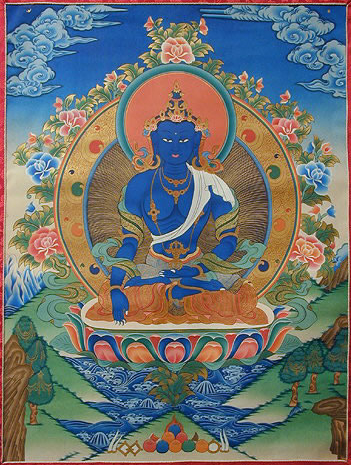
The central deity of the Guhyasamāja Tantra is Akṣobhya Vajra or Guhyasamāja Vajradhara, who represents the union of wisdom and compassion, the twin pillars of Buddhist practice. Practitioners of this tantra visualize a sacred mandala where this deity resides, symbolizing the purification of dualistic perceptions and the realization of the mind’s ultimate nature. This mandala is not merely a ritualistic construct but serves as a profound meditative tool to align the practitioner’s mind with the enlightened qualities of the deity.
Philosophically, the Guhyasamāja Tantra offers a sophisticated framework for understanding the nature of reality. It emphasizes the two truths — conventional reality and ultimate reality (śūnyatā or emptiness) — and teaches that the union of method (compassion) and wisdom (realization of emptiness) is the path to enlightenment. This union is expressed in the tantric practices of the generation stage and completion stage. During the generation stage, practitioners visualize themselves as the deity, thereby purifying ordinary perceptions and cultivating the qualities of a Buddha. In the completion stage, advanced techniques focus on working with the body’s subtle energies, channels, and winds (prāṇa), ultimately leading to the direct experience of the mind’s luminous and empty nature.
The concept of luminosity or “clear light” (od gsal in Tibetan, prabhāsvara in Sanskrit) is central to the Guhyasamāja Tantra and to Vajrayāna as a whole. This innate luminosity of mind, free from all conceptual elaboration and mental afflictions, is said to be the essence of buddha-nature. Practitioners aim to recognize and stabilize this clear light in various states, such as during meditation, deep sleep, and even the process of death. The tantra’s practices are designed to reveal the clear light as the true nature of mind, uniting the practitioner’s ordinary awareness with the ultimate state of enlightenment.
The Guhyasamāja Tantra’s influence extends far beyond its meditative practices. It has inspired numerous commentaries by Indian and Tibetan masters, each elucidating its profound teachings. Notable among these are works by Nāgārjuna, who articulated how the tantra’s methods align with the Madhyamaka view of emptiness, and Candrakīrti, whose commentary Pradīpoddyotana (Illuminating the Lamp) provides a detailed exposition of its ritual and meditative aspects. In the Tibetan context, Tsongkhapa (1357–1419), the founder of the Gelug school, placed the Guhyasamāja Tantra at the heart of his tantric system. His writings, such as the Great Exposition of Secret Mantra, synthesize the tantra’s teachings with a rigorous philosophical framework, making it accessible to generations of practitioners.
The Guhyasamāja Tantra’s structure, spanning 17 chapters, delves into advanced topics such as the stages of meditative realization, the union of bliss and emptiness, and the ethical and ritual prerequisites for tantric practice. The text’s integration of profound philosophical insights with practical meditative techniques makes it a comprehensive guide for those on the Vajrayāna path. Its emphasis on transforming ordinary experiences into vehicles for enlightenment underscores its enduring relevance.
In the broader context of Tibetan Buddhism, the Guhyasamāja Tantra is often compared to other major tantric texts, such as the Hevajra Tantra and the Kālacakra Tantra. While each tantra has its unique focus, the Guhyasamāja is particularly celebrated for its clarity and systematic presentation of tantric doctrines. Its teachings continue to inspire practitioners, scholars, and teachers, serving as a beacon of wisdom and a practical roadmap to enlightenment.
A Personal Testimony: The Union of Bliss and Emptiness

During a profound meditation on inner light, I experienced a state that I can only describe as the “union of bliss and emptiness.” It was an evening on the beach of Luz de Tavira, Portugal, where a friend and I had chosen to meditate together under the expansive sky. As we began to focus on the subtle phosphenes—those luminous impressions that arise when one gazes into light and then closes the eyes—I felt myself drawn deeper into the primary light, a radiance that seemed to arise from within and yet encompass all.
Gradually, all sense of orientation dissolved. There was no “me” and no “other”; no up or down, no past or future. It was as if I had blended completely into this pure, pervasive light. Time itself ceased to exist, and what remained was an indescribable sense of peace and clarity. The light was not separate from my awareness; rather, I recognized it as my very essence. In that moment, it became clear that this luminous presence, free from all conceptual elaboration, was what the tantric texts describe as the ultimate union of bliss and emptiness.
The experience was deeply transformative. It felt as though I had touched the essence of reality, the very foundation that the teachings of the Guhyasamāja Tantra aim to illuminate. In retrospect, this moment was a glimpse of the clear light mind, that innate purity that Tibetan Buddhism so eloquently describes as both the path and the goal of spiritual practice. Sharing this meditative journey with a friend added a unique resonance, as though our individual streams of awareness had merged into the vast ocean of luminous being. Even now, the memory of that night serves as a reminder of the boundless potential of the human mind to realize its true nature.
IS THIS A SECRET?
The central concept of the Tantras is integration: the harmonizing of conflicting elements within sentient beings, the realization of the oneness of all forms of existence, and the recognition of the identity of saṃsāra and nirvāṇa. This unity is encapsulated in the title of the Guhyasamāja Tantra, which translates as “The Secret Union” or “The Assembly of the Secret Body, Speech, and Mind of all Tathāgatas.” Here, Body, Speech, and Mind represent not only the complete spectrum of human activity and experience but also the three dimensions of enlightened reality: nirmāṇakāya (physical manifestation), saṃbhogakāya (enjoyment body), and dharmakāya (ultimate truth). These are symbolized by the Buddhas Vairocana, Amitābha, and Akṣobhya, who embody the fundamental aspects of reality and unite all living beings into the mandala of existence.
The term “secret” does not imply concealment but rather denotes the profound depth of understanding that can only be achieved through dedicated tantric practice, leading to the realization of this inseparable unity.
Therefore I insist that practicing meditation on Phosphenes is the Way to Deeply Understand these teachings!
The correct performance of the rituals and visualisation in this Tantra
produces siddhis, many of which are described in detail. Their inner
meaning is the attainment of spiritual powers and qualities,
and the fact that they may have magical correspondences in
the phenomenological world is but another expression of that action
in the relative sphere which is described as a play. Lila!
JMKH/december 2024
 breath4balance