
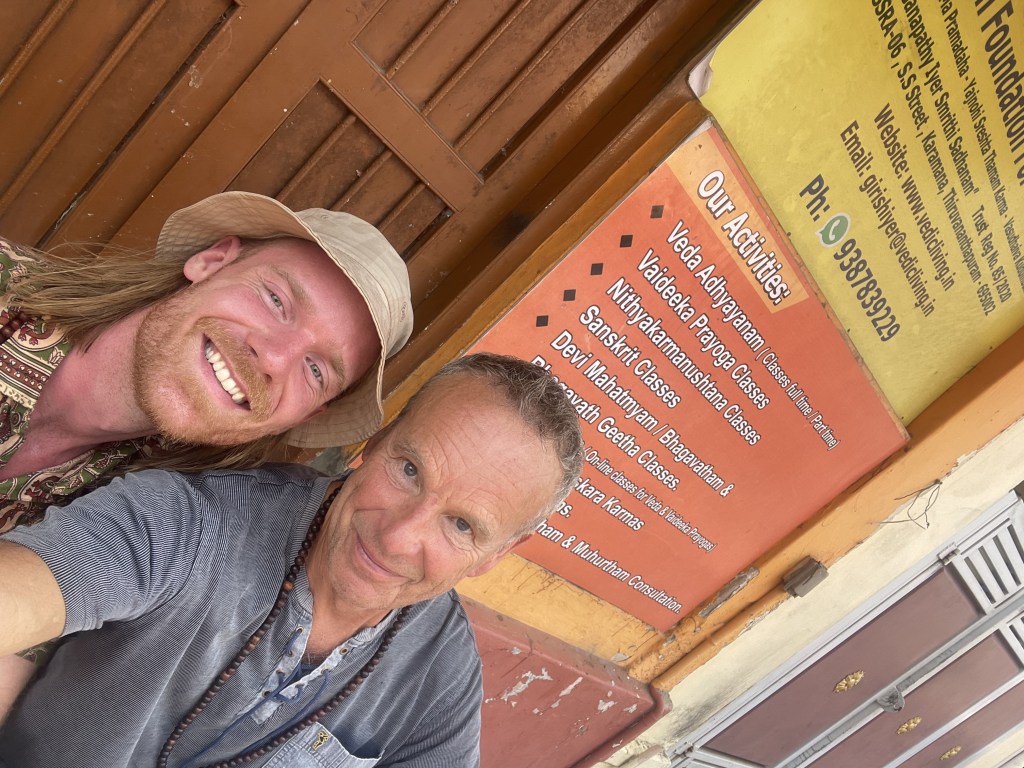
In January 2022 Victor Midborn and I were privileged to receive Vedic chanting teachings from a real Vedic master.
The first time I encountered the profound depth of Vedic chanting, I was struck by its timeless resonance. It felt as though the vibrations were not just sounds but carriers of something ancient and sacred, reaching into the very core of existence. Each note, each syllable, seemed to echo with a wisdom that transcends words—a wisdom that is felt, not merely understood.
Vedic singing is not simply a practice; it is an immersion into the essence of being. Rooted in an oral tradition that has endured for millennia, it weaves together melody, rhythm, and intention to create a bridge between the seen and unseen. When I chant, I feel a connection to something vast, an infinite presence that breathes life into all things.
The power of these sacred vibrations lies in their ability to align us with the essence of who we are. Through sound, we return to our center, discovering a harmony that extends beyond the personal into the universal. In this space, the essence of the Vedas—knowledge, truth, and cosmic order—awakens within, inviting us to remember the unity we share with all life.
We first had to learn the 1000 names of Vishnu. Don’t laugh but this is what he told us: here the first names and explanations…:
Vishnu is all but it is a bit much to learn by heart…
Vishnu, the all-pervading divine essence, is venerated through his thousand names in the Vishnu Sahasranama. Among his myriad names, he is called Vishvam, symbolizing the universe itself, and Vishnu, the one who pervades everything. Vaṣaṭkāra reflects his role in sacred rituals, while Bhūta-bhavya-bhavat-prabhu highlights his mastery over past, present, and future. He is Bhūta-kṛt, the creator of all beings, and Bhūta-bhṛt, the sustainer. As Bhāva, he embodies existence, and Bhūtātmā, the soul of all living things. Bhūta-bhāvana signifies his nurturing aspect, and Pūtātmā emphasizes his pure nature. Paramātmā, the supreme soul, resonates with his eternal and unchanging essence, while Mukta-nāma-parāyana underscores his devotion to liberating sentient beings. He is Śuddha, the pure, and Nitya, the eternal, embodying Śuddha-sattva, the essence of untainted goodness. Antaryāmī, the inner controller, and Amṛta, the immortal, describe his divine qualities, while Śāśvata points to his everlasting nature. Kṛṣṇa, the all-attractive, and Lokādhyakṣa, the overseer of the worlds, reveal his divine allure and universal governance.
Vishnu is Mahā-yogī, the great practitioner of spiritual union, and Yogīśvara, the lord of yogis. He fulfills all desires as Sarva-kāmada and pervades everywhere as Sarva-gata. Sarva-karma-kṛt reveals his role as the doer of all actions, and Sarva-dharma-vivardhana highlights his nurturing of righteousness. He brings joy to all beings as Sarva-bhūta-sukhāvaha, and ensures their welfare as Sarva-bhūta-hita. He is the remover of sins, Sarva-pāpa-hara, and embodies all divine qualities as Sarva-deva-maya. Kṣetra-jña represents his knowledge of all fields of existence, and Akṣara his indestructibility. As Kamalānātha, the lord of Lakshmi, and Maheśvara, the great lord, he commands reverence. Acyuta, the infallible, and Ananta, the infinite, describe his boundlessness. Known as Govinda, the protector of cows, and Keśava, the destroyer of demons, Vishnu manifests as Dāmodara, the one bound by love, and Vāsudeva, the son of Vasudeva. He is the radiant Pradyumna and the invincible Aniruddha, taking steps across worlds as Trivikrama and protecting as Narasiṃha. Upendra reflects his form as the younger brother of Indra, while Madhusūdana recalls his victory over the demon Madhu. Śrīdharā signifies his holding of Lakshmi, and Hṛṣīkeśa his mastery over the senses. Padmanābha refers to the lotus emanating from his navel, and Janārdana signifies his role as protector. Vishvaksena leads the cosmic army, Śāntātmā embodies peace, and Ādideva reflects his primordial nature.
We started with the first 10: Vishvam Vishnuḥ Vaṣaṭkāraḥ Bhūta-bhavya-bhavat-prabhuḥ Bhūta-kṛt Bhūta-bhṛt Bhāvaḥ Bhūtātmā Bhūta-bhāvanaḥ Pūtātmā. Quickly we understood that learning to chant 1000 names is a bit over the top…
In these sacred names, Lord Vishnu’s divine attributes unfold, offering a meditative path for devotees to connect with the infinite and all-encompassing reality of the supreme being. LOL he said. And then we said forget it, we want directly to dive in a mantra. And as he perceived we were high on the path he complied … Here the results:
You can learn how to sing vedic hymns and mantras at our medtation centre Quinta Quixote in the Algarve, Shunyam Adhibhu
 breath4balance