Celestial Harmony and Fractals resides in our Nervous System
We focus on sacredness. On consciousness. And on the Divine. Here art this intersection we find our phosphenes! The connection between Benoit Mandelbrot’s work on fractals and the phenomenon of phosphenes is clearly an interplay between mathematics, natural patterns, and human consciousness. While Mandelbrot’s fractals primarily describe geometrical structures found in nature, phosphenes—spontaneous patterns of light seen when the eyes are closed or gently pressed—offer a bridge to understanding how such patterns might manifest within the brain and visual system. And our consciousness, and what it does to us!
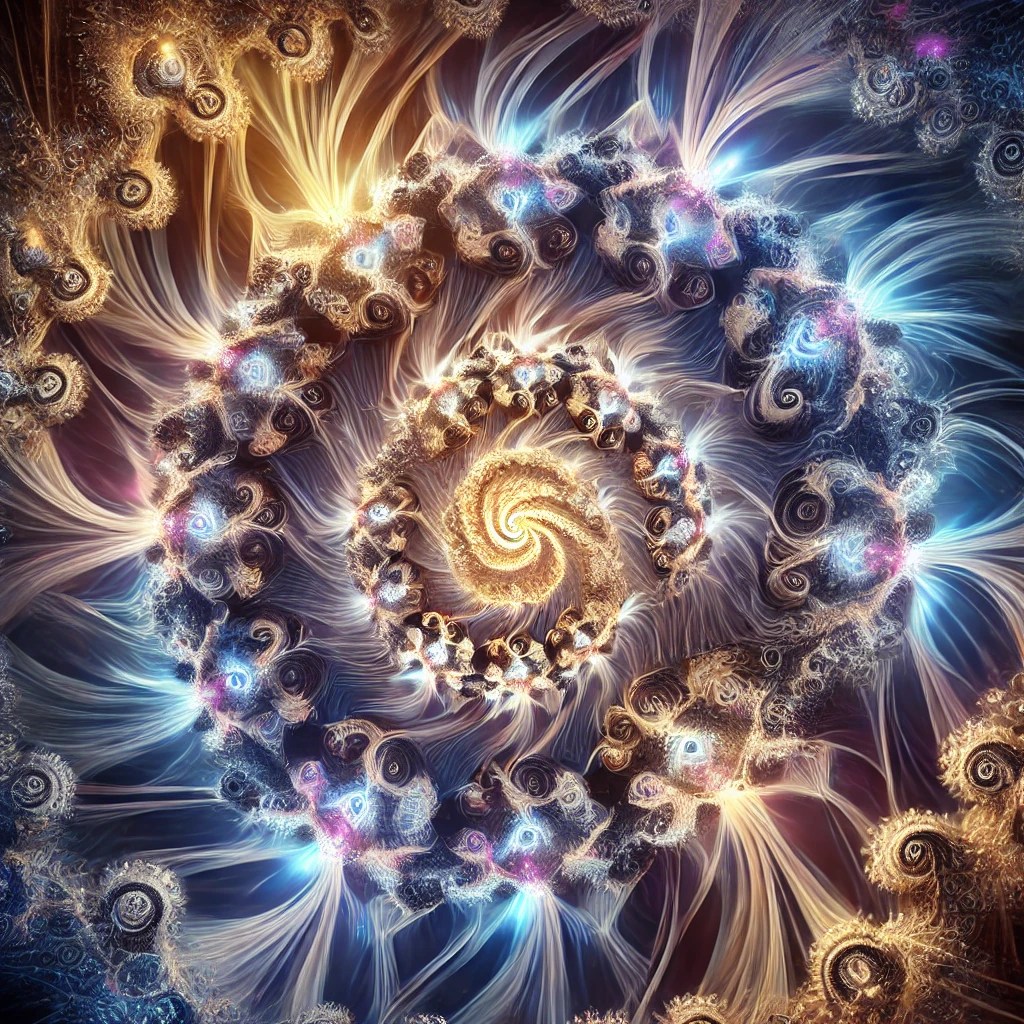
Mandelbrot and the Nature of Patterns
Mandelbrot introduced fractals to describe complex, self-similar structures that recur across different scales. These patterns are evident in natural phenomena such as:
- The branching of trees.
- Coastlines and mountains.
- The structure of lightning bolts.
Fractals reveal that nature operates on principles of recursive complexity, where patterns repeat with slight variations, creating forms that are infinitely intricate and unpredictable yet governed by simple mathematical rules. God must be a mathematician!
Phosphenes as a Manifestation of Inner Patterns
Phosphenes are subjective visual phenomena that occur due to the activity of the retina or visual cortex in the absence of external light stimuli. They often appear as:
- Geometric shapes (grids, spirals, or webs).
- Flowing patterns reminiscent of fluid dynamics.
- Recurring motifs resembling fractal designs.
The neurological basis of phosphenes may involve the brain’s inherent preference for recognizing patterns and organizing sensory input. This aligns with fractal geometry, as the brain seems predisposed to interpret and generate recursive, self-similar structures.
The Connection Between Fractals and Phosphenes
- Mathematical Similarity: Phosphenes often exhibit patterns that resemble fractals. The swirling spirals or expanding concentric shapes seen during phosphene experiences mirror fractal formations, suggesting that the brain might use similar recursive processes to process or simulate these visuals.
- Visualization and Consciousness: Both fractals and phosphenes can evoke meditative or altered states of consciousness. The visual complexity of fractals can be deeply mesmerizing, much like the inner visions induced by phosphenes. These states may reveal insights into how the mind organizes sensory information and achieves self-awareness.
- Symbolism in Spiritual Traditions: Many ancient cultures recognized the significance of geometric and fractal-like patterns. Mandalas, sacred geometries, and visionary art often include designs reminiscent of both fractals and phosphenes, suggesting a universal connection between inner experience and external representation.
Implications for Understanding Complexity and the Mind
- Neurological Models: Exploring the fractal nature of phosphenes could advance our understanding of neural dynamics, particularly in visual processing and consciousness.
- Creative Inspiration: Mandelbrot’s work and the spontaneous beauty of phosphenes inspire creativity in art, design, and architecture, reflecting the deep connection between mathematics and human perception.
- Meditative Practices: Observing phosphenes or engaging with fractal visuals might enhance meditative and contemplative practices, fostering greater awareness of inner states.
Divine Geometry manifesting in our body
Mandelbrot’s fractals and the spontaneous patterns of phosphenes highlight a shared language of complexity that bridges the external and internal worlds. They remind us of the intricate interplay between the natural universe, the structure of the brain, and the realms of human experience. Together, they offer a compelling glimpse into the mathematical and perceptual principles that underlie both nature and consciousness. It is God speaking to us in divine harmonies! Shunyam Adhibhu

 breath4balance