Gurdjieff’s so called ‘third series’.
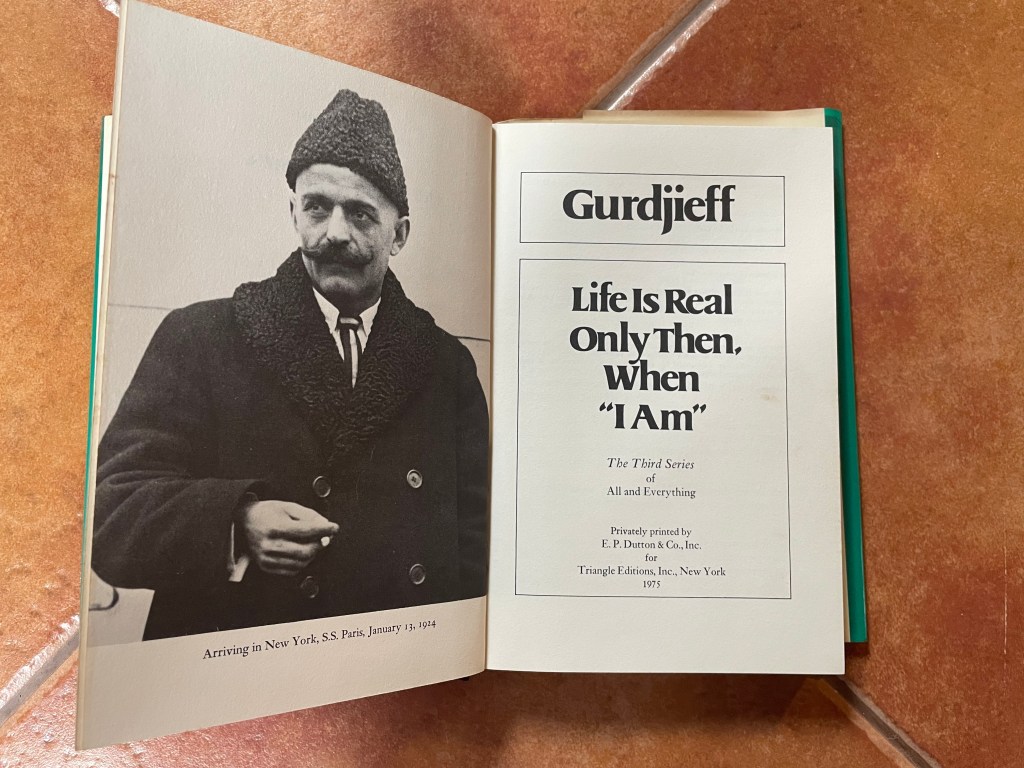
Life is Real Only Then, When “I Am”, the third and final book in G.I. Gurdjieff’s All and Everything trilogy, represents one of his most personal and enigmatic works. Written primarily in Russian and Armenian between 1930 and 1934, this text was intended to be a culmination of Gurdjieff’s teachings. However, the book remained unfinished at the time of his death in 1949 and was published posthumously in 1974.
Unlike the more allegorical Beelzebub’s Tales to His Grandson or the autobiographical Meetings with Remarkable Men, Life is Real Only Then, When “I Am” serves as a direct and introspective exploration of his spiritual philosophy, emphasizing the practical and experiential dimensions of his work. The book provides profound insights into the nature of consciousness, self-awareness, and the human condition.
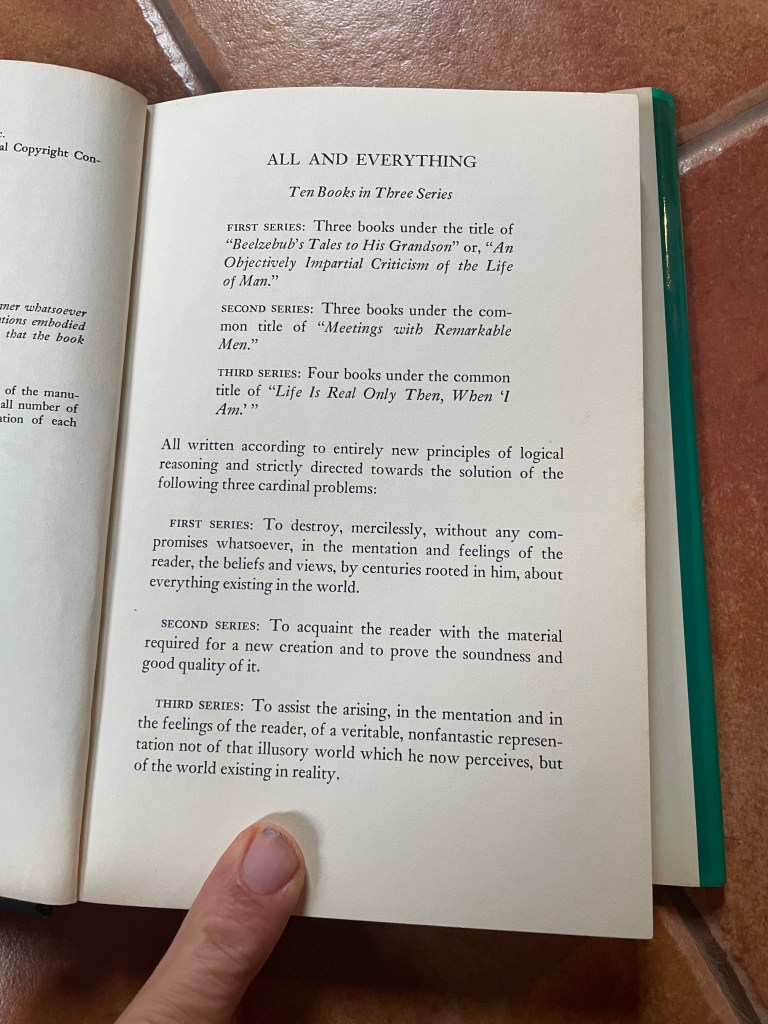
In the picture hereunder you can read how Gurdjieff defined the goal of his three major works. This last book serves to establish a crystallised pure and clear understanding of reality.
Historical Context
- Period of Writing:
- Gurdjieff wrote Life is Real Only Then, When “I Am” during a period of reflection and retreat after a near-fatal car accident in 1924. This period saw him turning inward and refining his teachings for posterity, as he faced the realization of his mortality.
- Language and Style:
- The text was otriginally composed in Russian and Armenian, like much of his other work, and later translated into English under his supervision by his pupils. Its language is dense, philosophical, and imbued with Gurdjieff’s characteristic use of neologisms and layered meaning.
- Intended Audience:
- Unlike the first two volumes, which were aimed at a broader audience, this book was written for a more intimate group of his students. It reflects Gurdjieff’s concern that his teachings be preserved accurately for future generations.
Key Themes in Gurdjieff’s work
- Introduction: The Struggle for Consciousness
- Gurdjieff opens with reflections on the nature of human life, emphasizing that most people live in a state of “waking sleep.” He asserts that only through conscious struggle and self-awareness can individuals truly exist.
- He introduces the concept of self-remembering, a foundational practice in “The Work,” which involves maintaining awareness of oneself and the present moment.
- Self-Observation and Mechanicality
- This chapter explores the human tendency toward mechanical behavior. Gurdjieff illustrates how people are driven by automatic reactions, habits, and external influences, likening them to “machines.”
- Self-observation, he argues, is the first step toward breaking free from this mechanical state. Through observing oneself without judgment, one can begin to see the patterns that govern their thoughts, emotions, and actions.
- The Central Role of “I Am”
- Gurdjieff introduces the phrase “I Am” as the key to awakening. This state of being arises from the unification of the fragmented parts of the self into a coherent whole.
- He discusses how the practice of self-remembering enables individuals to anchor themselves in their true essence, rather than being lost in the constant flux of thoughts and distractions.
- Conscious Suffering and Effort
- This chapter highlights the transformative power of conscious suffering, which involves facing one’s inner contradictions and accepting discomfort as a path to growth.
- Gurdjieff contrasts conscious suffering with the unconscious suffering that dominates most people’s lives, emphasizing that only the former leads to real change.
- Cosmic Significance of Human Life
- Drawing from his cosmological teachings, Gurdjieff positions humanity within a larger universal framework. He asserts that individuals have a unique role to play in the evolution of consciousness, both individually and collectively.
- The chapter delves into the idea that the development of self-awareness serves not only personal growth but also a greater cosmic purpose.
- The Practice of Being: Life as Real
- The final chapters are more personal and fragmented, containing Gurdjieff’s reflections on his own spiritual journey and the importance of living authentically.
- He emphasizes that life becomes “real” only when one is fully present and connected to their inner being.
Importance for Human Evolution of Consciousness
- A Manual for Awakening:
- Gurdjieff’s focus on self-remembering and self-observation provides practical tools for individuals seeking to transcend their mechanical nature. This shift from unconscious to conscious living represents a critical step in human evolution.
- Unity of Being:
- The book underscores the necessity of integrating the fragmented parts of the self—thoughts, emotions, and physical sensations—into a harmonious whole. This unification is the foundation for higher states of consciousness.
- Preparation for the Next Stage:
- By emphasizing conscious effort and suffering, Gurdjieff presents a pathway for individuals to move beyond their conditioned limitations and access higher levels of perception and understanding.
- Cosmic Perspective:
- Gurdjieff’s teachings connect individual spiritual growth with a larger cosmic process. He suggests that the evolution of human consciousness contributes to the harmony of the universe.
Legacy and Influence
Life is Real Only Then, When “I Am” remains a profound yet challenging text. Its unfinished nature mirrors the lifelong process of self-development that Gurdjieff advocated. While the book is less structured than his earlier works, it offers invaluable insights into the essence of “The Work.” I had the privilege to stay in The Work in the centre of Loenen, the Netherlands for 3 years and participate in it as well as in the magical Movements he designed. It greatly assisted my spiritual understanding and growth.
The book continues to inspire seekers on the path of self-realization, resonating with those who recognize the importance of self-awareness and the transformative power of living authentically. Through its emphasis on self-remembering, conscious suffering, and the unification of being, the text provides a timeless blueprint for awakening to the true potential of human consciousness. Shunyam Adhibhu
 breath4balance