This is an extremely important chapter in the physiology of the spirituality!
Henry Corbin (April 14, 1903 – October 7, 1978) was a French philosopher, theologian, and scholar of Islamic mysticism. His work focused on the esoteric traditions of Sufism and Persian philosophy, particularly the writings of thinkers such as Suhrawardi, Ibn Arabi, and Mulla Sadra. Corbin introduced the term mundus imaginalis, or “imaginal world,” to describe an intermediary realm between the sensory world and the spiritual plane. He sought to rehabilitate the function of imagination, arguing that it is not a mere faculty of fantasy but a means of accessing an immaterial reality that exists independently of the mind.
In a 1964 essay, Corbin emphasized that imagination should not be equated with unreality but rather understood as a cognitive function that grants access to a world as real as the world of the senses or the intellect. The mundus imaginalis is an ontological space that requires its own faculty of perception—what he called imaginative power. This capacity, he argued, is as valid as sensory perception or intellectual reasoning. Corbin was critical of modern rationalism, which tends to dismiss imagination as nothing more than fantasy, reducing visionary experience to subjective illusion.
His concept of the imaginal world has influenced later philosophers, psychologists, and mystics, particularly those interested in Jungian psychology, depth psychology, and phenomenology. Scholars such as James Hillman and Tom Cheetham have expanded on Corbin’s ideas, emphasizing that imaginal perception is a bridge between the physical world and spiritual insight. In contemporary mystical and esoteric practices, Corbin’s concept provides a framework for understanding altered states of consciousness, visionary experiences, and subtle planes of reality.
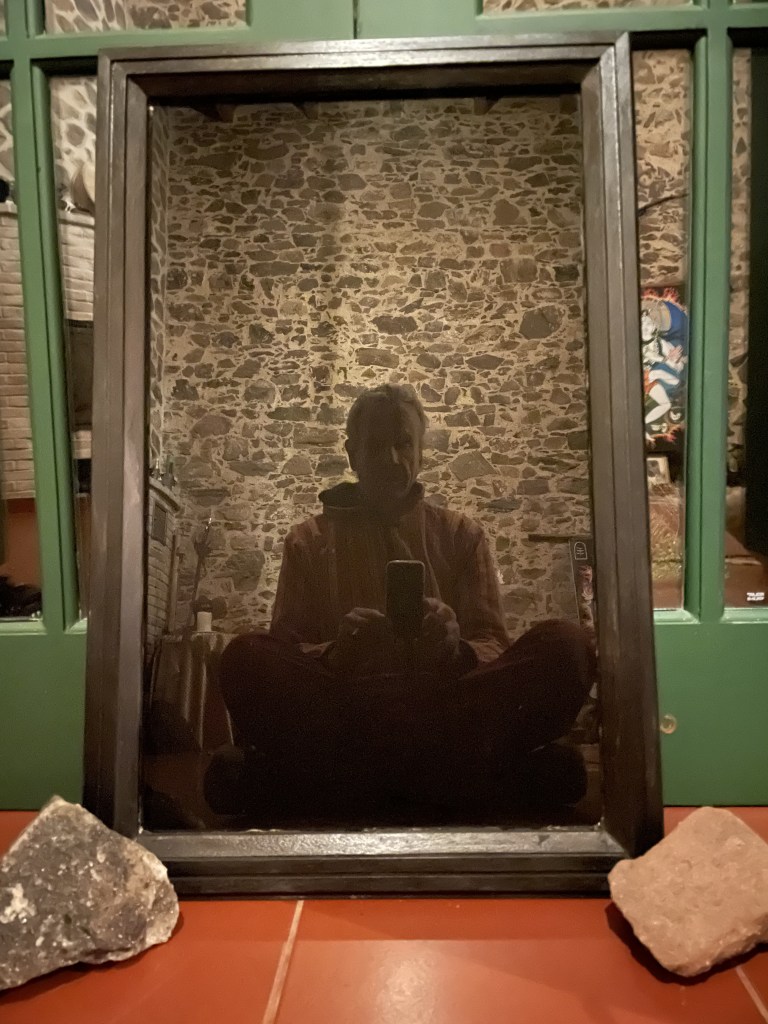
Applying mundus imaginalis to black mirror scrying, we can see how the mirror serves as a threshold between ordinary reality and the imaginal world. When gazing into a black mirror, especially while keeping the eyes still and focusing beyond the surface, the mind enters a liminal state. This state aligns with Corbin’s understanding of the imaginal world as a space that exists between perception and spirit. What emerges in the mirror—the shifting lights, faces, or apparitions—can be understood as arising not from an external supernatural source, but from the activation of the imaginal faculty. The black mirror becomes a medium for accessing the subtle realms where personal truth, archetypal visions, and insights unfold in a way that transcends conventional logic.
Corbin’s Concept and Altered States of Consciousness
Altered states of consciousness, whether induced by meditation, mystical practices, or sensory manipulation, often involve the perception of non-ordinary realities. The mundus imaginalis provides a model for these experiences, situating them in a real but intermediary realm that bridges sensory perception and the purely intellectual or spiritual domain.
One significant connection between Corbin’s ideas and visionary states is the phenomenon of phosphenes—the spontaneous light patterns perceived in darkness, deep meditation, or prolonged gaze fixation. These phenomena arise due to neurological processes involving the retina and the visual cortex but have historically been interpreted as spiritual visions.
Hildegard von Bingen, the 12th-century Christian mystic, recorded numerous visions that align with this concept. She described luminous imagery, divine light, and intricate mandala-like forms that emerged in states of deep contemplation. Though modern neuroscience might attribute such experiences to phosphenes and neurophysiological activity, Corbin’s framework suggests they belong to a distinct ontological reality—the imaginal world. Hildegard herself insisted that her visions were not fabricated by her mind but came from an external, divine source. From a Corbinian perspective, these experiences are not illusions but real encounters with a higher order of being accessed through visionary perception.
Further on Corbin’s perspective
Henry Corbin presents a three-tiered cosmology that integrates the physical world, the world of the soul, and the world of pure intellect. Each of these realms has its own governing principles and corresponding faculty of perception, forming a triadic system that structures both the universe and human development.
The first realm is the sensible world, or molk, which includes both the terrestrial world, governed by human souls, and the celestial or sidereal universe, ruled by the Souls of the Spheres. This is the world of material phenomena, where physical laws and sensory perception dominate.
The second realm is the supersensible world, or Malakût, which begins at the boundary of the ninth celestial sphere. This is the world of the Soul and Angelic Beings, where mystical cities and spiritual landscapes exist. It serves as a transitional dimension, bridging the physical and purely intellectual worlds.
The third realm is the world of pure archangelic Intelligences, inhabited by divine or transcendent intellects. This is the realm of pure knowledge and abstract reality, where intellectual intuition governs perception.
Each of these three worlds corresponds to a mode of perception and a faculty of being:
- The physical world is perceived through the senses, engaging the body
- The world of the soul is perceived through imagination, engaging the soul
- The world of pure intellect is accessed through reason, engaging the mind
This framework introduces an intermediary world—the mundus imaginalis, or ‘ālam al-mithāl—a realm of imaginal reality that is neither purely sensory nor purely abstract, but possesses ontological reality. It is the world of visions, spiritual experiences, and archetypal images. Unlike mere fantasy, Corbin argues that this imaginal realm is as real as the physical and intellectual worlds, requiring imaginative power as its mode of perception.
This perspective frees human experience from the restrictive dichotomy of materialist thought and abstract reason, positioning imagination as a cognitive faculty with noetic value, capable of revealing truths that neither sense perception nor pure intellect alone can access. This threefold structure also describes the stages of human spiritual development, from earthly existence to transformation and resurrection into the higher realms.
Black Mirror Scrying and the Imaginal World
Applying mundus imaginalis to black mirror scrying, we can see how the mirror serves as a threshold between ordinary reality and the imaginal world. When gazing into a black mirror, especially while keeping the eyes still and focusing beyond the surface, the mind enters a liminal state. This state aligns with Corbin’s understanding of the imaginal world as a space that exists between perception and spirit. What emerges in the mirror—the shifting lights, faces, or apparitions—can be understood as arising not from an external supernatural source, but from the activation of the imaginal faculty. The black mirror becomes a medium for accessing the subtle realms where personal truth, archetypal visions, and insights unfold in a way that transcends conventional logic.
The presence of phosphenes and visual distortions in mirror gazing further supports this connection. Just as Hildegard von Bingen experienced divine light through contemplation, black mirror practitioners often report luminous phenomena, shifting shapes, and perceived figures emerging from the darkness. From a neurological perspective, these arise due to sensory deprivation, neural adaptation, and attentional focus. From an imaginal perspective, they indicate the opening of a visionary portal, a means by which the mind navigates beyond the constraints of the material world into a space of meaning and revelation.
Through this perspective, black mirror scrying is not merely an optical illusion or neurological effect but a disciplined means of engaging with deeper aspects of consciousness. The visions that appear in the mirror do not have to be seen as random or purely subjective; rather, they belong to a reality that has its own ontological status, as Corbin suggested with the mundus imaginalis. This approach allows us to engage with mirror scrying as a spiritual practice, providing a bridge between personal intuition, mystical experience, and the unseen dimensions of existence. Shunyam Adhibhu
What Corbin wrote
Corbin, H. (1964). Mundus imaginalis or the imaginary and the imaginal. Eranos Yearbook.
Corbin, H. (1971). Creative imagination in the Sufism of Ibn ‘Arabi (R. Manheim, Trans.). Princeton University Press.
Corbin, H. (1977). Spiritual body and celestial earth: From Mazdean Iran to Shi‘ite Iran (N. Pearson, Trans.). Princeton University Press.
Corbin, H. (1981). The man of light in Iranian Sufism (N. Pearson, Trans.). Omega Publications.
Corbin, H. (1998). Alone with the alone: Creative imagination in the Sufism of Ibn ‘Arabi (R. Manheim, Trans.). Princeton University Press.
Corbin, H. (2006). The voyage and the messenger: Iran and philosophy (J. Morris, Trans.). North Atlantic Books.
Corbin, H. (2014). Temple and contemplation (P. Sherrard & L. Sherrard, Trans.). Routledge.
These works explore the imaginal world, esoteric philosophy, and mystical perception, forming the foundation for understanding his concept of mundus imaginalis.
 breath4balance