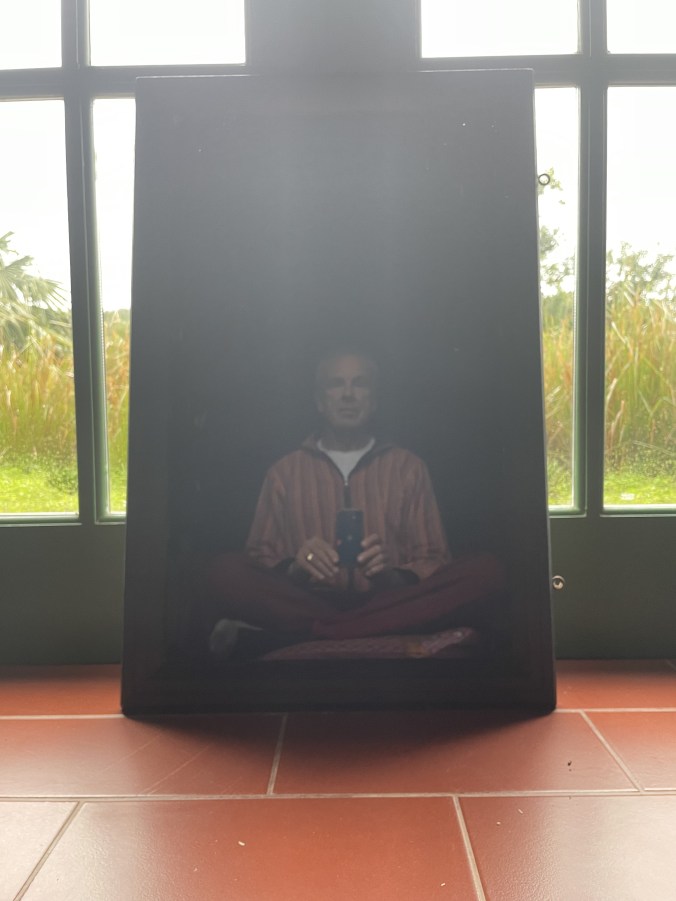
Black Mirror Scrying is a powerful tool to unlock our transpersonal insights. It can be regarded as a magick tool, or a depth-psychological tool enabling us to start reading our own subjective experiences as blots of a Rorschach test. It is the most subjective journey and the most important one. I dedicated some Blogs on this topic and quite some Youtube movies on our channel Vedicvibes.
“The Art of Black Mirror Scrying” by Rosemary Ellen Guiley serves as the only a comprehensive guide to the practice of scrying using black mirrors we have. The book delves into the historical background of black mirrors, highlighting their use by notable figures such as John Dee and Nostradamus. It provides detailed instructions on selecting, preparing, and caring for a black mirror, as well as practical guidance on using it for various purposes, including contacting the deceased, exploring the astral plane, and uncovering past lives. The author also shares personal experiences and insights, particularly her visit to a psychomanteum—a space designed for mirror gazing. Additional content includes methods to enhance scrying results, mirror-related experiments, and discussions on mirror lore and legends. Nothing however on the Black Mirror (BM) as a vehicle to gain insight in transpersonal information. That chapter you find here at this website in the other BM entries.
The Table of Contents of Black Mirror
Introduction 1 – The Magic Mirror 2 – John Dee and Nostradamus 3 – A Mysterious Force 4 – Magnetism, Scrying and Summoning the Dead 5 – The Psychomanteum 6 – My Visit to the Psychomanteum 7 – Choosing, Preparing and Caring for Your Mirror 8 – Using Your Black Scrying Mirror 9 – Evaluating Scrying Results 10 – Enhancing Scrying Results 11 – Mirror Experiments 12 – The Moon Factor Afterword Appendix A – How to Make A Black Scrying Mirror Appendix B – The Portable Altar Appendix C – Testimonials Appendix D – Mirror Lore and Legends About the Author Bibliography
I quote: “The visionary bridge Scrying, as well as other forms of divination, have had critics and opponents throughout the ages. The Bible is full of important visionary experiences that influenced the patriarchs and prophets, yet religion has opposed divination as a false and even “demonic” art. Apparently what was suitable for the patriarchs and prophets is not suitable for the masses, and probably for political reasons. If a person has direct access to the spiritual realms, the mediation of the church is not needed, and the church loses control. During the Inquisition, scrying was considered a heresy. Science has taken a dim view of divination as well, consigning it to fantasy and wish fulfillment. None of this opposition has halted people from having spontaneous and intentional visionary experiences that are interpreted as real events. Dream encounters with the dead have been recorded for millennia (see my work Dream Messages from the Afterlife) as have waking visions and visions in scrying surfaces. Mirror visions fall in between the visions of near-sleep, in the hypnagogic stage, and waking visions. They are not fantasy or “hallucinations,” but an experience that takes place in an alternate reality. Plato referred to a metaxu or “between state.” Dr. Raymond Moody terms the visionary realm the “Middle Realm.” “
Reviews of the book
While there are limited formal reviews from major publications, reader feedback offers valuable insights into the book’s reception. On Amazon, the book holds a 4.6 out of 5-star rating based on 484 global ratings. Readers have praised it as a well-written and informative resource, particularly beneficial for beginners interested in scrying. One reviewer noted, “This book presents a fascinating history of scrying… The author also provides some explanations for how scrying works and includes exercises you can do to sharpen your skills.”
Similarly, on Goodreads, the book has a rating of 4.15 out of 5, based on 80 ratings and 13 reviews. Reviewers have highlighted its comprehensive coverage of scrying history and practical advice. However, some readers expressed a desire for more in-depth methodological guidance. One reviewer mentioned, “I would have liked more methodology than history on black mirror scrying. Definitely worth reading if you’re interested in scrying.”
It is the only book there is. We need to expand it, which we will do at this website!
In summary, “The Art of Black Mirror Scrying” is regarded as a valuable resource for those interested in the spiritual practice of scrying, offering a blend of historical context and practical advice, though readers seeking extensive methodological details may find it somewhat limited in that aspect. And nothing about the essence of what it can bring in the field of meditative experiencing and the phosphene rol in all this.
Shunyam Adhibhu
 breath4balance