To fully explore the transformative and transpersonal experience of black mirror gazing, a big self-made large black mirror is essential. I work wth black mirrors since many years, and of l;ast century when I started to explore chaps magick. I think the black mirror is a crazy device.
As a neuroscientist and a Medical Doctor I feel compelled to help people out of the stupid duality of materialism and spiritualism. Do this meditation and you will forever see yourself and your place in the universe in a more extensive way…and understand that the classical division does not make sense if we enter the most subjective realm of observation ourselves via a Black Mirror. More info on Black Mirrors you find published as various posts in this week.
Create your Black Mirror
Creating one is simple: take an old glass panel, paint its back with black glass paint, and coat the wooden frame with black ink. On the second hand market you easily can buy a big frame of an existing paining behind glass. Go for Big! (see under).
How to look into the Black Mirror
Position the mirror against a window to maximize ambient light and sit in a way that allows you to see your full reflection. The practice involves maintaining a fixed gaze while shifting focus through different visual zones.
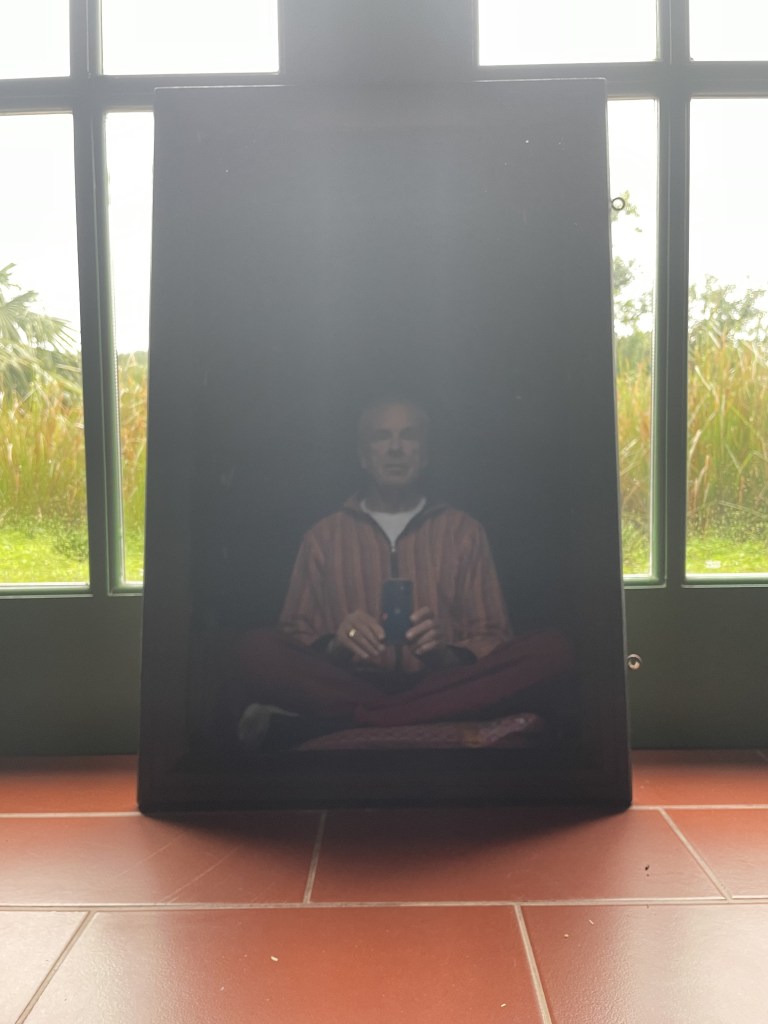
I added to each stage of this magical practice a potential neurophysiological context that offer insight into the perceptual and cognitive processes involved and make us understand how to develop ourselves as receptors of the transpersonal! So Bring your attention:
- Between the Eyes (Interocular Focus)
- Keeping focus on the space between the eyes engages the binocular rivalry process, where the brain must reconcile slightly different images from each eye. This can create a dissociative visual effect, potentially leading to perceptual distortions and heightened awareness of facial asymmetries. The prolonged focus also stimulates the superior colliculus, which plays a role in spatial attention and subconscious vision processing, allowing peripheral visual elements to become more prominent.
- The Forehead (Prefrontal Activation)
- Shifting attention to the forehead while maintaining interocular focus recruits the prefrontal cortex, the region responsible for self-awareness, imagination, and higher cognitive functions. This activation may enhance introspective experiences, making the observer more attuned to subtle facial changes or evoking a feeling of a ‘third-eye’ presence. Additionally, the reduced eye movement suppresses rapid saccadic activity, inducing a meditative state that enhances the integration of inner and outer perception. And lead to silence in the mind.
- Above the Forehead (Extended Spatial Awareness)
- By directing attention above the forehead while keeping the gaze steady, the parietal lobes, which govern spatial orientation, become more active. This can lead to an expanded sense of space and depth, creating an illusion of movement in stillness. The brain’s predictive coding mechanisms may also attempt to fill in missing visual details, leading to unexpected shapes, light fluctuations, or subtle shifts in perceived identity. Then it becomes real interesting to see how our subjective wisdom uses this space of missing visual details!!!
- The Halo Around Your Figure (Peripheral Vision Enhancement)
- Observing the ‘halo’ effect around one’s figure taps into the lateral geniculate nucleus and primary visual cortex, which process peripheral light sensitivity. Under dim lighting conditions, the brain amplifies contrast sensitivity in an effort to distinguish low-light patterns. This process is associated with Troxler’s fading, where static images in the periphery seem to dissolve or change over time. This perceptual effect might contribute to the sensation of ‘aura vision’ or luminous emanations surrounding the observer. Phosphenes start to move into this space!
- The Light Around the Mirror (Extended Light Perception and Visual Illusions)
- Gazing into the light around the mirror engages the optic tectum and extrastriate cortex, responsible for integrating motion and luminance perception. This can produce an afterimage effect or a perceptual ‘glow’ around the mirror, reinforcing the illusion of external light sources appearing within the mirror itself. The lack of direct eye movement also reduces the usual stabilization corrections performed by the retina, making visual distortions appear more pronounced over time.
By maintaining a fixed gaze on the space between the eyes and avoiding eye movement, the visual system enters a state of heightened neural adaptation. This adaptation allows unconscious visual stimuli to rise to conscious perception, leading to experiences traditionally interpreted as supernatural but deeply rooted in neurophysiological processes. The combination of optical illusions, sensory adaptation, and altered neural processing explains why black mirror gazing continues to be a powerful tool for vision expansion, introspection, and self-exploration. Now it creates a space for our complicated neural receiver to receive important messenges from beyond! And …where is beyond…..If you understand this the meditation has been valuable!
Here is the full meditation instruction:
Shunyam Adhibhu
Elevas Levi and the black mirror
History and background of the Black Mirror
There is only one book on Black Mirror Scying sadly enough and it does not cover our approach, but is more spiritualistic.
Guiley, R. E. (2016). The art of black mirror scrying. Visionary Living, Inc.
 breath4balance