The phenomenon of seeing auras, the subtle luminous fields surrounding the bodies of others, has long been associated with spiritual sensitivity, esoteric traditions, and mystical perception. While traditional interpretations explain auras as energetic or spiritual emanations visible to the attuned eye, modern neurophysiological research invites us to explore an alternative, yet deeply compatible, explanation: the role of phosphenes in subjective visual experience.
What Are Phosphenes?
Phosphenes are the light and visual impressions perceived without external light stimulus, often seen when the eyes are closed or in darkness. They can also appear spontaneously during meditative states, after rubbing the eyes, or as a result of certain patterns of neural stimulation. Importantly, phosphenes originate from within the visual system itself, involving interactions between the retina, optic nerve, thalamus, and visual cortex.
These inner lights and forms often appear as halos, radiant shapes, shimmering outlines, or pulsating fields. In spiritual contexts, they are frequently interpreted as evidence of energy or spiritual presence. However, they may also reflect the visual system’s ability to generate complex light impressions internally, especially when activated by heightened inner states. One needs to understand the difference between optic after effect phosphenes and spontaneous phosphenes. The after effects can lead into the realm of spontanious phosphenes. These happen in our ultrasubjective hyperspace (USH) and the viewer of aura’s should understand the immense difference between these two. The first can be seen around artificial objects too and is a physical phenomena. The second is a spontaneous happening in our visual-optic-cortical system and happens in our USH. It needs a meditative mind to enter the second phase. I will expand on this a bit more.
Optic After-Effects and Spontaneous Phosphenes: Understanding the Path to Aura Perception
In our exploration of aura perception through the lens of neurophysiology and the inner light, it is crucial to introduce an essential distinction: the difference between optic after-effect phosphenes and spontaneous phosphenes. This nuance is foundational in separating basic visual phenomena from the deeper visionary experiences that occur in the Ultrasubjective Hyperspace (USH).
Optic After-Effect Phosphenes
Optic after-effects are well-known physical phenomena. They occur when we gaze at a strong visual stimulus—such as a bright light or a high-contrast image—and then look away. The overstimulated retinal cells temporarily alter our visual field, creating residual luminous shapes or outlines. These are known as after-effect phosphenes. They can appear around any object, animate or inanimate, and they fade with time.
This type of phosphene is entirely rooted in retinal adaptation and basic optic nerve activity. It is reproducible, predictable, and does not require any altered state of consciousness. For example, staring at a lamp and then shifting your gaze to a wall may reveal a luminous halo or colored imprint—but this is not the perception of an aura in the spiritual or transpersonal sense. It is an external effect from a physiological cause.
Spontaneous Phosphenes and the Ultrasubjective Hyperspace
In contrast, spontaneous phosphenes arise without any external visual stimulus. These luminous phenomena emerge from within the visual-optic-cortical system, often during meditation, deep relaxation, or periods of heightened inner awareness. They can appear as:
- Luminous halos around people
- Subtle radiant fields
- Flowing or pulsating energy forms
Unlike optic after-effects, spontaneous phosphenes are a product of the ultrasubjective hyperspace (USH). They represent the visual language of inner consciousness, often accompanying moments of insight, resonance, or deep empathy. These perceptual events are not caused by light but by a deeper activation of the visual brain under altered states of presence.
This form of phosphene perception requires a meditative mind, trained awareness, and often an emotionally open or spiritually attuned state. It is more likely to occur during interpersonal connection, sacred ritual, or contemplative stillness. Crucially, these experiences cannot be forced or artificially reproduced—they emerge spontaneously from within the deep layers of the nervous system.
Recognizing the Difference
Anyone exploring aura perception must develop the discernment to recognize these two very different experiences:
- Optic after-effects are residual, predictable, and fade quickly.
- Spontaneous phosphenes are emergent, subtle, and often spiritually meaningful.
Confusing the two can lead to misunderstanding the nature of aura perception. One can see “halos” around a person and believe it to be a spiritual phenomenon, when it might merely be a retinal adaptation. On the other hand, spontaneous aura perception through USH is an inner event, revealing the luminous resonance between observer and observed!
A Path of Subtle Cultivation
Developing the capacity to witness spontaneous phosphenes is not about effort or force, but about refinement of perception. Practices such as phosphene meditation, third-eye gazing, breath awareness, and intentional presence gradually open the door to deeper perceptual states. Through this inner cultivation, the practitioner moves from seeing light through the eyes to witnessing light through consciousness itself.
Understanding this distinction not only sharpens one’s insight into the nature of vision and aura, but also honors the sacred depth of what it means to truly see. In this way, the luminous field around others is not a trick of light, but a quiet miracle unfolding in the shared field of inner space.
Phosphenes and Aura Perception
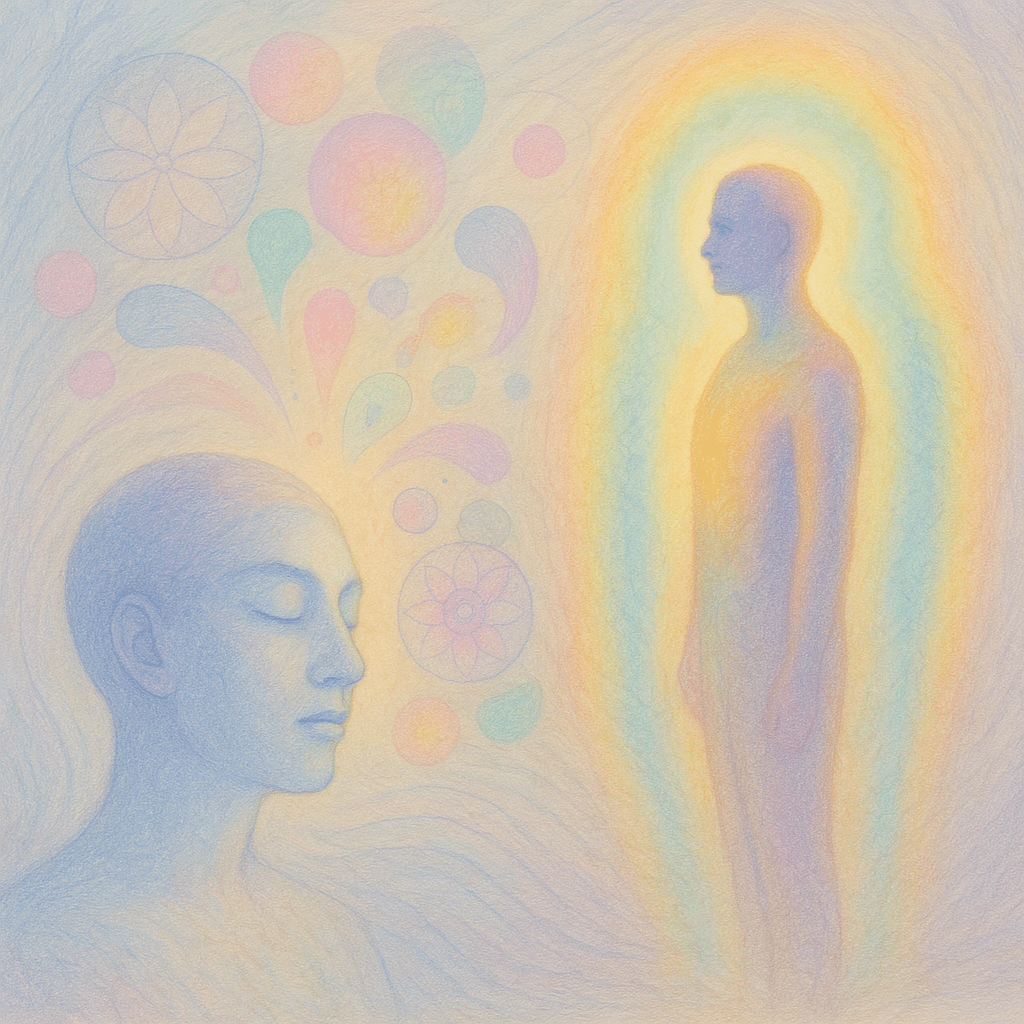
When someone reports seeing an aura around another person, especially during moments of emotional intensity, meditation, or sacred ritual, it’s possible that the perception is not external in origin, but rather a projection of enhanced inner visual activity influenced by phosphenes. The brain, especially when in altered or highly focused states, may overlay phosphene-generated light patterns onto the perceived figure of another person.
This overlay can appear as:
- A luminous glow around the head or body.
- Radiating color fields that shift with mood or movement.
- Halo-like effects that seem to reflect a person’s emotional or spiritual state.
In this interpretation, the aura is not a static external object, but a dynamic visual interaction between the observer’s inner visual field and the external world !
Subjectivity and the Inner Light
This model does not invalidate the spiritual interpretation of aura perception; on the contrary, it underscores that such visions arise from a deep ultrasubjective layer of perception. Rather than requiring an objective energy field to exist around the body, it recognizes that the human nervous system is a luminous generator capable of perceiving subtle realities through its own internal light.
Phosphene-enhanced states can be intentionally cultivated through practices like:
- Gazing into the darkness with relaxed attention.
- Alternating light exposure and closed-eye rest.
- Meditation focused on the Ajna chakra or third eye region.
- Conscious breathing with inner visual focus.
In such states, the perceptual boundary between inner and outer blurs. Light perceived around others may well be the echo of our own neural radiance, projected into the interpersonal space and interpreted as aura.
A Bridge Between Science and Spirituality
Understanding auras through the lens of phosphenes offers a bridge between scientific insight and spiritual experience. It does not seek to reduce the sacred to mere biology, but to illuminate the neurophysiological poetry of spiritual vision.
In this light, seeing auras may be a refined capacity to perceive subtle aspects of reality through an awakened visual system. It is less about “seeing” with the eyes, and more about “knowing” through light, an inner knowing that uses the body’s own radiance to recognize beauty, energy, and presence in the other.
Seeing into the inner realm of wisdom
The perception of auras can be understood as a natural consequence of heightened inner visual activity, where the presence of another triggers luminous overlays from our own nervous system. Phosphenes, as manifestations of the inner light, may thus be responsible for much of what is traditionally seen as the aura. This does not diminish the experience, it deepens it, rooting it in the miraculous potential of our own being, which serves as both receiver and projector of light.
In understanding this, we come to honor the union of physiology and spirit, of brain and being, and the radiant mystery of how we truly see. Shunyam Adhibhu
 breath4balance