Both Éliphas Lévi and Aleister Crowley explored the concept of inner visionary realms, often encountered with closed eyes, where divine, demonic, and geometric forms manifest. While they didn’t use the term “phosphenes,” bcause that term was not known at that time, their descriptions align with experiences of inner light phenomena and with the path of the inner light Yoga.
Éliphas Lévi and the Astral Light
Lévi introduced the concept of the Astral Light, a subtle, luminous medium permeating the universe. He described it as the “universal agent” through which all magical operations occur, influenced by will and imagination. This medium reflects the images and symbols projected by the mind, which can include sacred geometry, divine forms, or demonic figures.
Lévi warned that without proper balance and understanding, engaging with the Astral Light could lead to confusion or madness, as it might reflect the practitioner’s inner chaos. He emphasized the importance of aligning one’s will and imagination to navigate these inner visions safely.
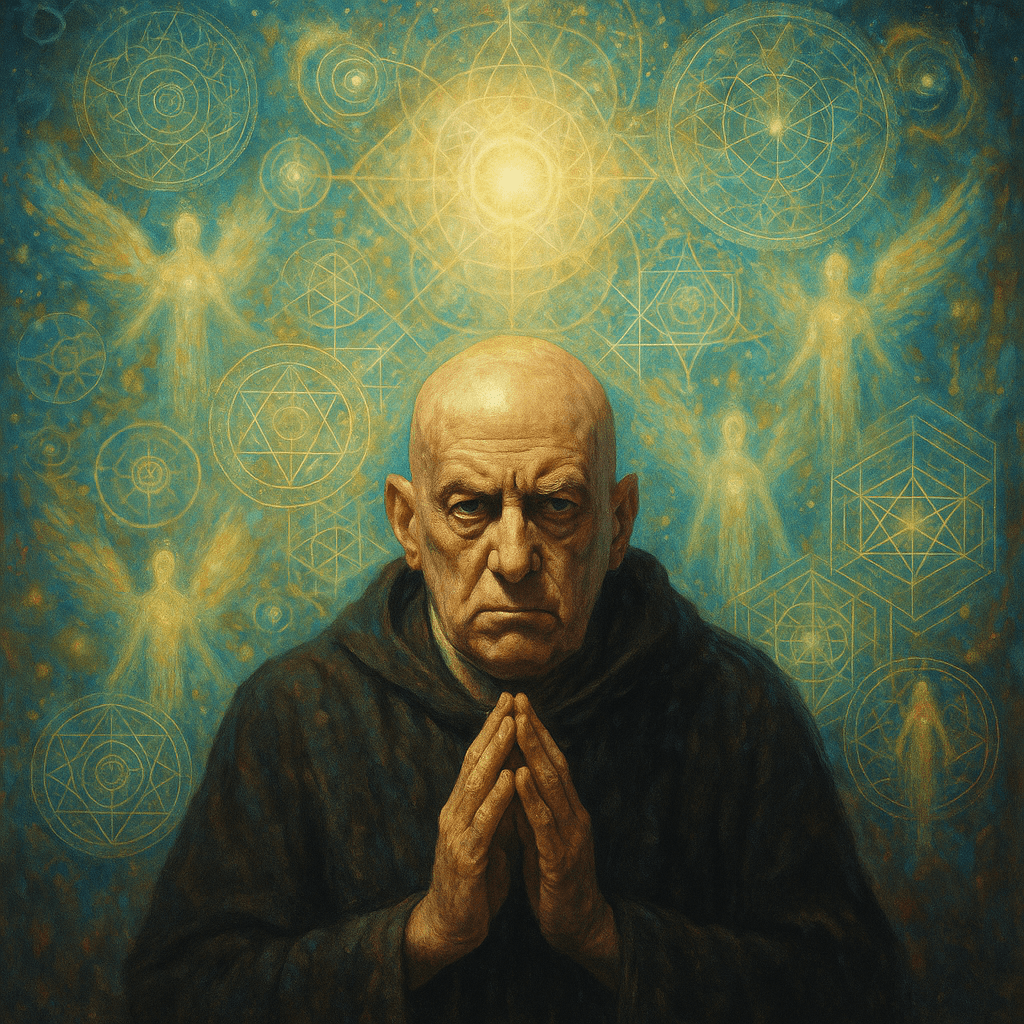
Aleister Crowley and the Body of Light
Crowley expanded on Lévi’s ideas, introducing the concept of the Body of Light, a subtle body developed through imagination and ritual. This body serves as a vehicle for exploring inner realms, where practitioners might encounter complex visions, including fractal patterns, divine beings, and demonic entities.
In The Vision and the Voice, Crowley detailed his experiences traversing the 30 Enochian Aethyrs, encountering various entities and symbolic visions. He described these experiences as deeply transformative, revealing aspects of the self and the universe.
Crowley also discussed the concept of the Abyss, a metaphysical chasm representing the boundary between the individual self and the universal consciousness. Crossing the Abyss involves confronting and integrating the shadow aspects of the psyche, often personified as demonic figures, to achieve spiritual enlightenment.
Aleister Crowley’s visionary journey through the so called Enochian realms unfolds as a phosphene passage through inner worlds of light and shadow. He begins seeing himself in a luminous crystal structure, watched over by four archangels cloaked in silence in a realm where thought begins to dissolve and presence takes hold. As his visions deepen, he enters the mystical City of the Pyramids and at the heart of his journey, he confronts Choronzon, the demon of dispersion, embodiment of chaos and fragmentation. In the final movement of this odyssey, all form and thought evaporate into a field of peace and absolute unity. Crowley does not describe ecstasy but something more subtle, a reality so pure it lies beyond sensation, beyond even being. This journey through the Aethyrs reveals a path where sacred geometry, divine beings, and demonic tests are all expressions of the same Light, manifesting according to the depth of one’s inward gaze. I think he was doing an intense phosphene meditation.
Magicians used phosphenes
Both Lévi and Crowley recognized that inner visionary experiences, manifesting as light patterns, sacred geometries, or encounters with divine and demonic forms, are integral to spiritual development. They emphasized the importance of preparation, balance, and the alignment of will and imagination to navigate these experiences safely and meaningfully. Shunyam Adhibhu
 breath4balance