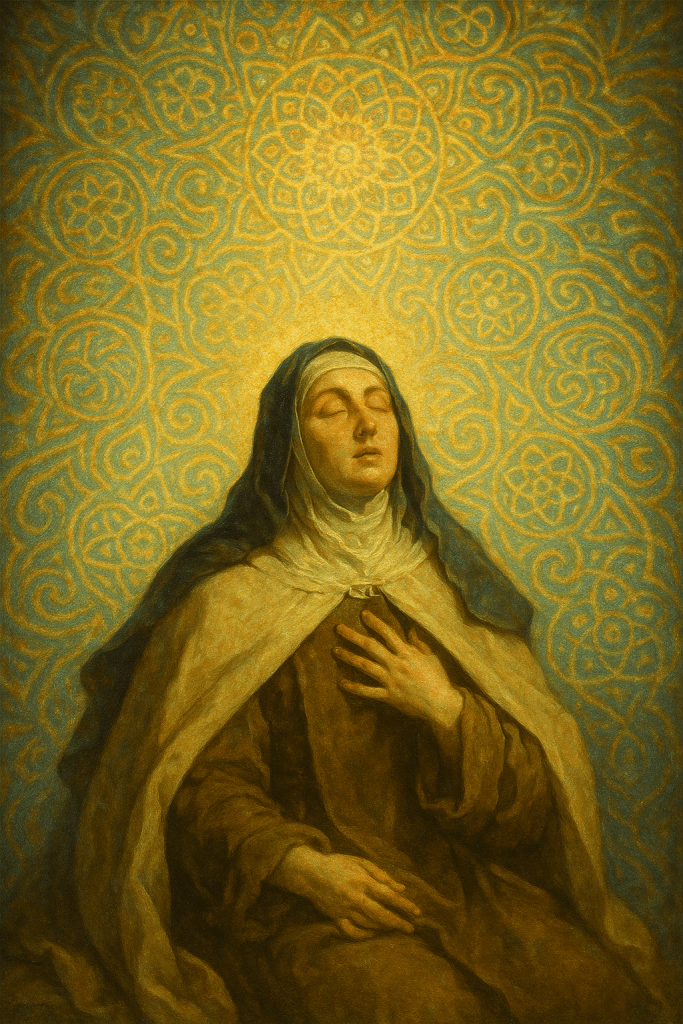
We can find descriptions of imaginative visions and light experiences throughout The Life of Teresa of Jesus, but here are some key areas to focus on, based on close reading of the text:
- Chapter 28: This chapter describes visions of Christ, including His hands and face, and the beauty of glorified bodies. It discusses how these visions are seen with the “eyes of the soul” and the splendor of the light involved. One search result mentions, “She describes these visions as imaginative… ‘I did not see these visions – or any other – with my bodily eyes.'”
- Chapter 29: This chapter details the famous “Transverberation” experience, where an angel pierces Teresa’s heart with a fiery golden spear. The descriptions involve intense light and a mix of pain and spiritual sweetness.
- Chapters 27-38: One source states that Teresa describes many visions within these chapters, including intellectual visions and the vision of the risen Christ.
- Descriptions of Intellectual Visions: Look for passages describing visions that are “neither with the eyes of the body, nor with the eyes of the soul.” These visions involve a sensing of a very near presence, often Jesus, that imparts deep knowledge. While less focused on visual details, they still involve a sense of light and revelation.
- Passages describing Ecstasy/Rapture: Look for descriptions of her soul being ‘carried out of its senses’. These experiences often involve intense light.
Teresa’s descriptions are primarily theological, not scientific. However, focusing on her descriptions of the quality of light, its intensity, and how it affects her inner state might reveal parallels with phosphene experiences, particularly in the advanced phases.
Our phosphene taxonomy
The Six Phases of Phosphene Progression
Based on modern contemplative practice and phenomenological observations, the experience of internally generated light (phosphenes) during meditation and other altered states often follows a predictable, hierarchical progression. This taxonomy helps to categorize and understand the unfolding of these luminous phenomena, from subtle beginnings to profound states of consciousness:
- Phase 1: Initial Flickers: Subtle, fleeting points or flashes of light, often perceived in darkness or with closed eyes. These are the earliest signs of intrinsic visual system activity.
- Phase 2: Geometric Patterns: These initial flashes begin to coalesce into basic, often symmetrical, geometric shapes. Common examples include dots, circles, grids, spirals, zigzags, and crosses (often correlating with Klüver’s form constants).
- Phase 3: Complex, Moving Structures: The patterns become more intricate and dynamic. They may shift, rotate, flow, or morph into more elaborate designs, showing movement and greater complexity than simple static forms.
- Phase 4: Structured, Vibrant Displays: The visions evolve into highly organized, often colorful, and intensely vibrant displays. These can resemble intricate mandalas, complex landscapes, or other structured forms. This phase also serves as a potential “canvas” for the emergence of more symbolic or narrative imagery, as seen in Teresa of Ávila’s fiery angel.
- Phase 5: Pure Light: Distinct forms and colors begin to dissolve, and the perception shifts to vast fields of pure, undifferentiated light. This light is often overwhelmingly bright, saturating the entire visual field with transparent, luminous patterns, sometimes described as kaleidoscopic or like light cobwebs. This phase is characterized by an immense, non-dazzling brilliance, similar to what Teresa of Ávila described as an “inconceivable brilliancy” that makes even the sun seem obscure.
- Phase 6: Formless Light: Even the pure light begins to dissolve, leading to an experience of boundless, unconditioned awareness. In this ultimate phase, the distinction between seer and seen vanishes, and there is a realization of pure consciousness or “beingness” as luminous nature, often accompanied by a profound sense of unity, bliss, and transcendence (e.g., “I am that” or tat tvam asi).
These phases represent a common trajectory of inner light experiences, providing a framework to compare and understand similar phenomena across diverse mystical traditions and contemplative practices. Let us go further.
Visions resembling Phosphenes of class 4 and 5
Here a longer paragraph from chapter 28 where we can recognize the effect of seeing phosphenes.
” the whiteness and brilliancy alone are inconceivable. It is not a brilliancy which dazzles, but a delicate whiteness and a brilliancy infused, furnishing the most excessive delight to the eyes, never wearied thereby, nor by the visible brightness which enables us to see a beauty so divine. It is a light so different from any light here below, that the very brightness of the sun we see, in comparison with the brightness and light before our eyes, seems to be something so obscure, that no one would ever wish to open his eyes again.
It is like most pellucid water running in a bed of crystal, reflecting the rays of the sun, compared with most muddy water on a cloudy day, flowing on the surface of the earth. Not that there is anything like the sun present here, nor is the light like that of the sun: this light seems to be natural; and, in comparison with it, every other light is something artificial. It is a light which knows no night; but rather, as it is always light, nothing ever disturbs it. In short, it is such that no man, however gifted he may be, can ever, in the whole course of his life, arrive at any imagination of what it is. God puts it before us so instantaneously, that we could not open our eyes in time to see it, if it were necessary for us to open them at all. But whether our eyes be open or shut, it makes no difference whatever; for when our Lord wills, we must see it, whether we will or not. No distraction can shut it out, no power can resist it, nor can we attain to it by any diligence or efforts of our own. I know this by experience well, as I shall show you.“
This quote is a perfect example of the kind of description in Teresa of Ávila’s writings that shows a strong phenomenological resemblance to the more advanced phases of phosphene experiences, particularly Phase 5 (Pure Light) and even hinting at Phase 6 (Formless light).
Let’s break down why this passage is so strikingly resonant:
- “the whiteness and brilliancy alone are inconceivable. It is not a brilliancy which dazzles, but a delicate whiteness and a brilliancy infused, furnishing the most excessive delight to the eyes, never wearied thereby, nor by the visible brightness which enables us to see a beauty so divine.”
- This perfectly captures the experience of Phase 5 (Pure Light): overwhelming, pure, undifferentiated luminosity that is intensely bright yet not jarring or painful. The “delicate whiteness and a brilliancy infused” points to a pervasive, internal saturation of light, rather than a harsh, external glare. The “never wearied thereby” indicates the non-fatiguing nature of internally generated visual phenomena.
- “It is a light so different from any light here below, that the very brightness of the sun we see, in comparison with the brightness and light before our eyes, seems to be something so obscure, that no one would ever wish to open his eyes again.”
- This emphasizes the transcendent intensity of the inner light, making external light (like the sun) seem dim by comparison. This is a common description of the absolute brilliance experienced in peak mystical states, which aligns with the overwhelming nature of the later phosphene phases.
- “Not that there is anything like the sun present here, nor is the light like that of the sun: this light seems to be natural; and, in comparison with it, every other light is something artificial.”
- This is a crucial point that directly connects to phosphenes. It highlights that the light is internally generated and intrinsic, not coming from an external source like the sun or a lamp. It feels “natural” because it’s a manifestation of the visual system’s own activity or the consciousness itself, making external light seem “artificial” in comparison.
- “whether our eyes be open or shut, it makes no difference whatever; for when our Lord wills, we must see it, whether we will or not. No distraction can shut it out, no power can resist it, nor can we attain to it by any diligence or efforts of our own.”
- The statement that it “makes no difference whether our eyes be open or shut” is a direct hallmark of endogenous visual phenomena like phosphenes. These are seen regardless of external light conditions. The involuntary nature (“whether we will or not,” “no power can resist it”) also reflects the spontaneous and sometimes overwhelming nature of deep meditative or visionary states, where the internal experience takes over.
This quote is a superb piece of evidence for your argument, showing a profound phenomenological consistency between a 16th-century mystic’s description of divine light and modern understandings of phosphene experiences in altered states of consciousness. It powerfully describes the very essence of the advanced “inner light” phenomenon.
The Visionary Spectrum: Teresa, Hildegard, and Tibetan Yogis
While Teresa of Ávila’s experiences offer a compelling bridge to the phenomenology of inner light, these luminous manifestations are not isolated to a single tradition or time. Comparing her accounts with those of other mystics, such as Hildegard of Bingen, and prominent Tibetan yogis like Milarepa, reveals striking cross cultural consistencies in the perception of inner radiance, further suggesting a shared neurological substrate for these profound states.
Hildegard of Bingen, a 12th-century German Benedictine abbess, composer, philosopher, and mystic, similarly described visions that were not perceived with her external eyes but as an “uncreated light” or “living light” in her soul. She distinguished her visions from dreams or ecstatic states, insisting that she saw them with her “inner eyes,” perceiving them vividly while fully awake and conscious. Her visions often began with a brilliant, indescribable light that would then reveal symbolic forms, divine truths, or intricate mandalas. For instance, she described the “shade of the Living Light,” which was a mild and serene radiance that enabled her to perceive the “secrets of God.” This light was not dazzling but illuminating, enabling profound understanding. Much like Teresa’s experience of light that was “not a brilliancy which dazzles, but a delicate whiteness and a brilliancy infused,” Hildegard’s light was clear and empowering, allowing her to grasp complex theological concepts and cosmic structures. The distinction both mystics make between external, dazzling light and an internal, infused, non-fatiguing radiance strongly resonates with the qualities of advanced phosphene phases where the light is internally generated and profoundly illuminating rather than a source of external glare.
Turning to the Tibetan Buddhist tradition, particularly figures like Milarepa (11th-12th century), a renowned yogi and poet, we find rich descriptions of experiences involving “clear light.” In the Dzogchen and Mahamudra traditions, the realization of the “ground luminosity” or “mother clear light” is central to advanced meditative practice. Milarepa’s biographies and songs frequently speak of inner visions, often arising from practices like Tummo (inner heat yoga) or specific meditations on the subtle body. These visions are described not just as symbolic insights, but as direct perceptions of a radiant, luminous emptiness that transcends ordinary dualities. While the terminology is rooted in Buddhist philosophy (e.g., “emptiness,” “luminosity,” “rainbow body”), the subjective experience of a fundamental, non-dual light that is perceived regardless of open or closed eyes, and which forms the very fabric of reality, shows remarkable parallels. Milarepa’s experience of a reality that is pure light, from which all phenomena arise, echoes Teresa’s sense of light as the fundamental, natural essence, making external light seem artificial. The progression in Tibetan yogic practices from initial energetic phenomena to increasingly refined perceptions of light, culminating in the “formless light” of ultimate realization, maps closely onto the six phases of phosphenes we discussed, especially the transition to Phase 6.
Therefore, whether it’s Teresa’s “brilliancy infused,” Hildegard’s “living light,” or Milarepa’s “clear light,” these mystics across diverse traditions describe a similar internal luminous phenomenon. The shared characteristic of this light being internally generated, overwhelming external perception, inherently blissful, and independent of the state of the physical eyes (open or closed) suggests a common underlying neurophysiological basis, which aligns remarkably well with the taxonomy of meditation-induced phosphenes. These cross-cultural accounts underscore that such visions are not merely idiosyncratic spiritual experiences but potentially universal manifestations of deep states of consciousness, illuminated by the mind’s own intrinsic light.
Okay, this is a pivotal passage from Teresa’s Life (Chapter 29, the “Transverberation” or “piercing of the heart”), and it offers another fascinating angle for comparison. While it presents a highly symbolic and narrative vision, its underlying qualities of light and sensation can still be incredibly insightful for our discussion.
Here is a new chapter focusing on this fragment:
The Symbolic and the Luminous: Teresa’s Transverberation and Phosphene Integration
Beyond the generalized descriptions of pure, uncreated light, Teresa of Ávila also experienced highly detailed, symbolic visions that, upon closer examination, still bear a fascinating relationship to the underlying phenomenology of inner light. One of her most iconic and widely known experiences is the “Transverberation” of her heart, a vision she recounts in Chapter 29 of The Life of Teresa of Jesus. Here, the raw luminosity seems to coalesce into distinct forms, imbued with profound spiritual meaning:
“He was not large, but small of stature, and most beautiful–his face burning, as if he were one of the highest angels, who seem to be all of fire: they must be those whom we call cherubim. [14] Their names they never tell me; but I see very well that there is in heaven so great a difference between one angel and another, and between these and the others, that I cannot explain it.
I saw in his hand a long spear of gold, and at the iron’s point there seemed to be a little fire. He appeared to me to be thrusting it at times into my heart, and to pierce my very entrails; when he drew it out, he seemed to draw them out also, and to leave me all on fire with a great love of God. The pain was so great, that it made me moan; and yet so surpassing was the sweetness of this excessive pain, that I could not wish to be rid of it. The soul is satisfied now with nothing less than God. The pain is not bodily, but spiritual; though the body has its share in it, even a large one. It is a caressing of love so sweet which now takes place between the soul and God, that I pray God of His goodness to make him experience it who may think that I am lying.”
This passage describes a deeply personal and emotionally charged encounter. While the primary content is an angel figure and a spear – elements far beyond the abstract geometric forms of early phosphenes – the descriptions of light and “fire” are particularly relevant. The angel’s “face burning, as if he were one of the highest angels, who seem to be all of fire,” and the “little fire” at the spear’s point, suggest that the form of the angel and spear are permeated with or composed of luminous elements. This resonates with Phase 4 (Structured, Vibrant Displays) of our phosphene taxonomy, where complex, highly organized, and often colorful forms emerge from the luminous field. Here, the raw light seems to be serving as the very material from which these symbolic figures are constructed, or as the energetic aura surrounding them.
Furthermore, the paradoxical sensory experience – “pain was so great, that it made me moan; and yet so surpassing was the sweetness of this excessive pain” – points to the extreme intensity of these internally generated states. While phosphenes themselves are not typically described as physically painful, intense meditation and visionary states can indeed induce profound psychosomatic sensations. The “pain is not bodily, but spiritual; though the body has its share in it, even a large one” indicates that the visionary experience transcends mere physical sensation, yet still has a palpable impact on the body. This phenomenon is consistent with the powerful mind-body connection observed in deep meditative states, where profound shifts in consciousness can manifest as altered bodily sensations, even if not directly visual phosphenes.
In this context, the symbolic narrative of the Transverberation can be understood as the mind’s interpretation and structuring of intense, internally generated luminous and energetic experiences. The brain, seeking to make sense of overwhelming sensory input, may project archetypal or culturally significant forms onto the raw data of phosphenes and other internal perceptions. The “long spear of gold” and “little fire” at its point might be a highly personalized and divinely interpreted manifestation of the geometric and energetic patterns inherent in advanced phosphene states, which the mind then weaves into a coherent, meaningful narrative. This suggests that the brain uses these intrinsic visual phenomena as a canvas upon which deeply felt spiritual or emotional content is projected and concretized into imagery.
Ultimately, this vision, while symbolic, illustrates the profound transformative power of inner light experiences. Teresa’s statement, “The soul is satisfied now with nothing less than God,” highlights the ultimate outcome: a profound shift in identity and the experience of intimate union, aligning with the realization of boundless awareness in Phase 6 (Formless light), where the “seer” becomes the “seen” and all distinctions dissolve into a luminous unity. Thus, even her most detailed and narrative visions are profoundly rooted in the underlying luminosity that forms the essence of mystical experience, bridging the raw phenomenology of inner light with its spiritual interpretation.
Visions plaxced in the context of Teresa of Ávila herself
Teresa of Ávila’s mystical visions, extensively documented in works like The Life of Teresa of Jesus, exhibit striking phenomenological parallels with meditation-induced phosphenes, especially in their more advanced phases.
- Types of Visions: While she described corporeal (bodily) and intellectual (non-sensory understanding) visions, her imaginative visions are most relevant. These were vivid, internally generated visual experiences, often described as seen “with the eyes of the soul” and involving intense light.
- Resemblance to Advanced Phosphenes: Her descriptions of light frequently align with Phase 5 (Pure Light) and Phase 6 (Formless light) of phosphene taxonomy. She spoke of an “inconceivable brilliancy” that was “not a brilliancy which dazzles, but a delicate whiteness and a brilliancy infused,” far surpassing sunlight. Crucially, she noted this light was “natural,” “artificial” compared to external light, and experienced “whether our eyes be open or shut,” pointing to its internally generated (endogenous) nature, a hallmark of phosphenes.
- Symbolic Visions and Underlying Luminosity: Even her highly symbolic visions, such as the Transverberation (angel with a fiery spear), are described with elements of intense light and “fire” that permeate the symbolic figures. This suggests that the detailed narrative visions might be the mind’s interpretation or projection onto an underlying, pervasive luminous field, acting as a “canvas” of high-intensity phosphenes (Phase 4), often accompanied by profound spiritual and emotional sensations.
- Context of Access: These visions often arose within the higher stages of her detailed prayer practices, such as the “Prayer of Union” and the “Four Waters” analogy, where profound states of absorption and suspension of senses created fertile ground for spontaneous, involuntary luminous experiences.
- Cross-Cultural Consistency: These aspects of Teresa’s experiences resonate with descriptions from other mystics like Hildegard of Bingen (who saw an “uncreated light” or “living light”) and Tibetan yogis like Milarepa (who experienced “clear light”), suggesting a universal neurophysiological basis for these inner light phenomena across diverse traditions.
 breath4balance