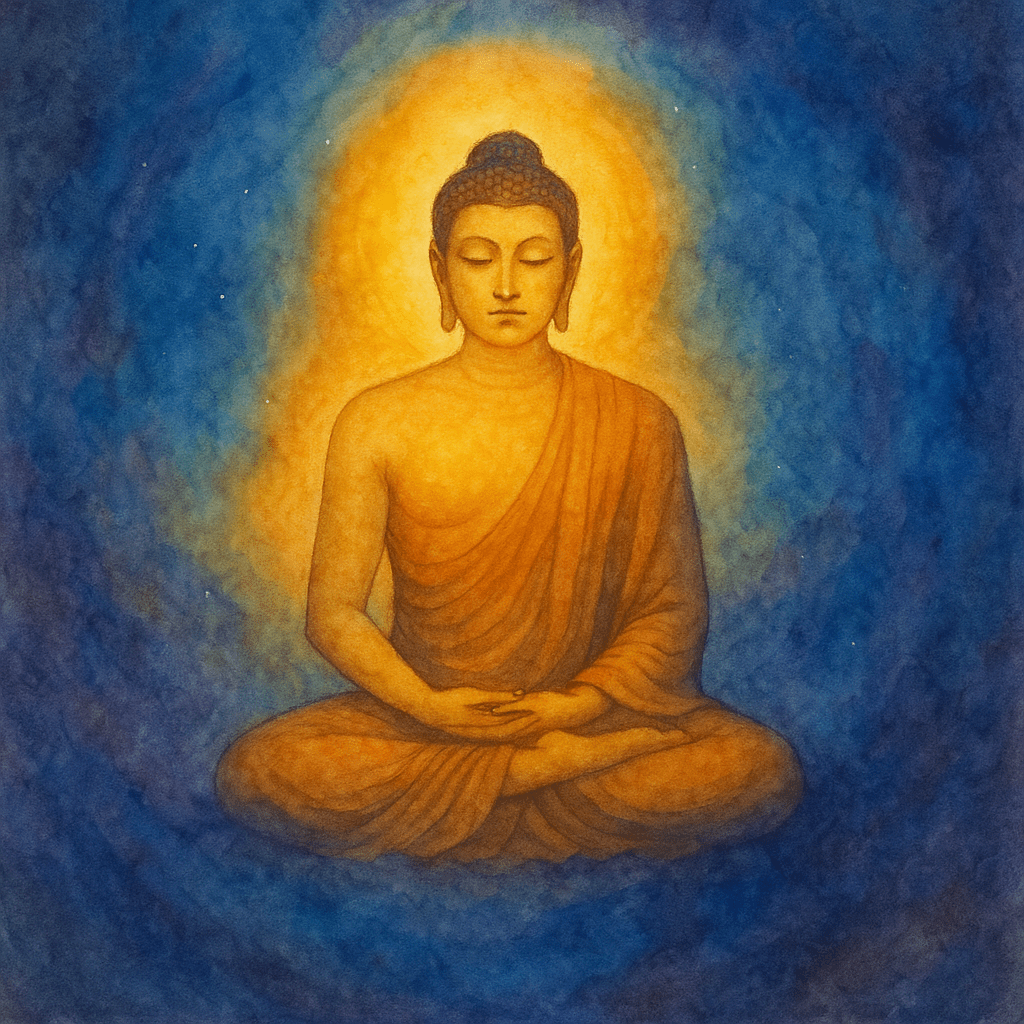
Few figures are as luminous and evocative as Amitābha, the Buddha of Infinite Light. Revered in the Mahāyāna and Pure Land traditions, Amitābha is not simply a symbol of divine compassion, but an embodiment of boundless radiance, a presence that transcends form and emerges in the very depths of inner silence.
In the path we call the Yoga of the Inner Light, where we work directly with phosphenes and explore the subtle architecture of inner vision, Amitābha takes on a striking new resonance. He is not merely a devotional image or esoteric deity, but a phenomenon of consciousness, a spontaneous vision-form that arises within what we have called the ultrasubjective hyperspace.
The Birth of Inner Light
Phosphenes, the light phenomena that appear behind closed eyes, are known to science as entoptic phenomena. But in deep meditation, they become much more: they unfold as gateways to inner perception, revealing luminous geometries, pulsations, and eventually, radiant fields that defy rational explanation.
As we develop clarity and steadiness in this space, the phosphenes may stabilize into so called nimitta: bright, coherent inner forms that feel alive, intelligent, and sacred. In the silence of sustained attention, light begins to articulate itself, not as random neural firing, but as a language of the soul.
And in this emerging field of inner luminosity, Amitābha may appear.
The Archetype of Infinite Light
The name Amitābha means “infinite light” in Sanskrit. Descriptions of him from classical texts often speak of a light brighter than a thousand suns, reaching all worlds, and illuminating the ten directions without obstruction. These phrases, once viewed as poetic metaphors, now reveal their direct phenomenological relevance to the meditator engaged in the Yoga of Inner Light.
Within the ultrasubjective hyperspace, our term for the expanded and highly personal visionary field in advanced meditation, Amitābha appears as a stabilized, archetypal figure of light-consciousness. He is not “imagined” in the ordinary sense. Rather, his form emerges organically from the visionary dynamics of the inner field, much as a mandala may arise naturally within a deep phosphene vision.
We might say:
Amitābha is the luminous center of our inner cosmos, crystallized into form through devotion, concentration, and the natural unfolding of the inner light itself.
From Flicker to Radiance
In this context, Amitābha represents the third stage of inner light perception, a form-stable, radiant presence within the field of formless phosphene activity. What begins as a subtle flicker behind the eyes gradually deepens into a sense of entering light, then resting in light, and finally becoming one with that light. It is here that Amitābha may appear, not as an “other,” but as an expression of our own deepest awareness.
In this sense, Amitābha is not the destination of the path but a mirror along the way. He reminds us that what we are seeing is not fantasy, but the sacred dimension of vision itself—the light-consciousness that permeates all existence, and which we access directly through our own perception when the mind is silent.
Toward a New Understanding of the Sacred
The reappearance of ancient spiritual figures in modern inner vision work is not a regression into mythology, but a sign of integration. The Yoga of the Inner Light does not ask us to believe in deities, but to experience the forms that consciousness may take when it reveals itself fully. In this light, Amitābha becomes a phenomenological reality, a perceptual event, a mystical resonance, and a deeply moving expression of the inner radiance that has never left us.
He is the Buddha of Inner Light, not as dogma, but as direct inner vision.
 breath4balance