Illumination is the experience of realizing that the very essence of our consciousness is made of pure, transcendental light — Urlicht — a luminosity beyond all physical light. This light sometimes reveals itself through sacred geometric patterns in radiant colors, unfolding across multiple dimensions. It evokes both awe and a deep recognition: we are not only the witness to this light, but also its very source: the essence of consciousness itself revealed as light.
This experience can occur during phosphene meditation, particularly when levels 4, 5, or 6 manifest. At these stages, light beings may emerge from kaleidoscopic fractals, rising from luminous tunnels or descending upon us, though in truth, there is neither above nor below, as the spatial coordinates of consciousness dissolve into dimensionless awareness.
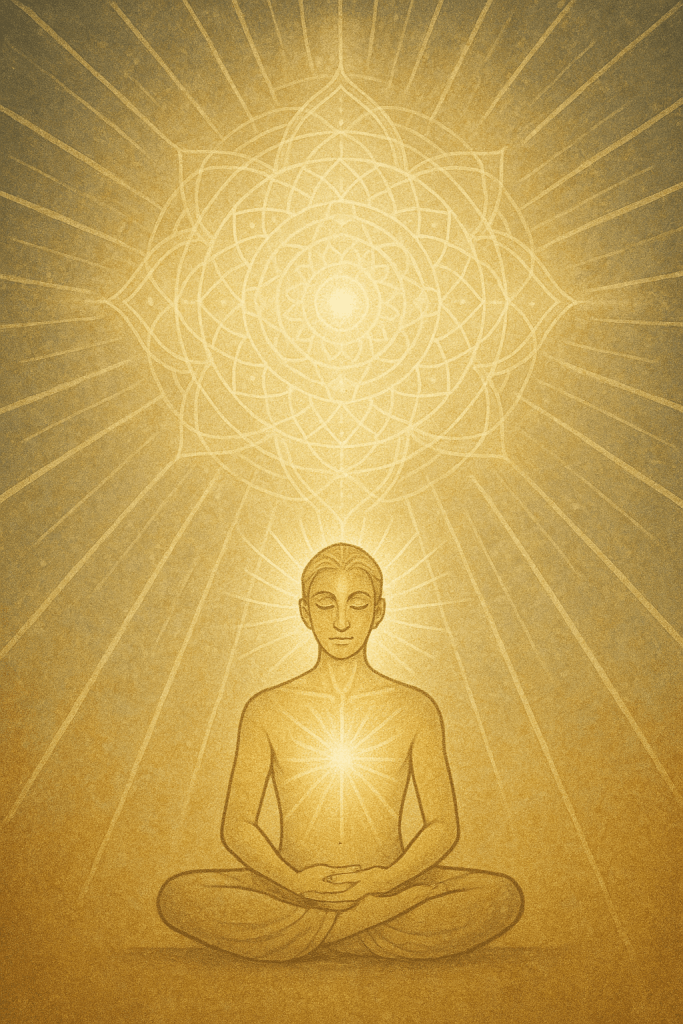
Illumination is the experiential recognition that the essence of our consciousness is composed of pure, transcendental light — Urlicht — a luminous presence beyond physical perception. This light often appears adorned with sacred geometric forms, radiant colors, and multi-dimensional movements. In its presence, a sense of awe arises, accompanied by a clear inner knowing: we are both the witness of this light and its origin — consciousness recognizing itself as light.
During phosphene meditation, especially when deeper levels of perception (Levels 4, 5, or 6) unfold, this illumination may manifest as light beings emerging from kaleidoscopic tunnels or descending into our field of awareness. Yet, notions like “above” and “below” dissolve, for the dimensional framework of ordinary space melts into a non-local, timeless awareness.
But illumination is not merely a mystical state or a peak experience, it is a turning point and a point of metamorphosis. In the moment of illumination, all doubts, self-judgments, and fragmented identifications with the ego soften or vanish. One understands, not intellectually but existentially, that the core of our beingness is not broken, lacking, or separate, it is light itself. This understanding remains, subtly or powerfully, even after the luminous vision fades. It permeates daily life, alters the texture of thought, and loosens the grip of habitual suffering.
Illumination does not add something to us. It reveals what was always already present — the light-being at the heart of awareness.
Enlightenment can be seen as the stabilization of illumination, a lasting shift in the structure of consciousness wherein the light that was once glimpsed becomes the ground of one’s identity and perception.
While illumination is a revelatory moment, a sudden, profound experience in which one perceives the essence of consciousness as pure, transcendental light, enlightenment is what happens when that light is no longer seen as other, fleeting, or exceptional. It becomes integrated, embodied, and expressed through every thought, action, and perception.
Enlightenment is not a fixed state of perfection, but a reorientation of awareness. The witness and the witnessed, the inner light and the outer world, are no longer experienced as separate. The self is no longer defined by psychological patterns or social narratives, but by a deep and quiet knowing of its true nature — spacious, luminous, compassionate.
In this sense:
- Illumination is the threshold, a momentary burning away of the veil.
- Enlightenment is the way of being that arises when that veil does not return, or when, having returned, it is no longer believed in nor act-upon.
Enlightenment may emerge gradually through repeated illuminations, or it may follow a single, life-altering phosphene or mystical experience. But it always involves the disidentification from egoic constructs and the realization that one is not merely a self having light, but light expressing itself as a self.
Enlightenment is not escape from the world, it is returning to it, lit from within and always in the moment.
Shunyam Adhibhu
Follows our work in this field to introduce meditators into a new realm beyond normal meditation: The ancient path of the Yoga of the Inner Light:
References
Keppel Hesselink, J. M. (2025). From Flickers to Formless: Mapping Phosphene Trajectories in Tibetan Dzogchen, Christian Mysticism, and Contemporary Meditation. PsyArXiv.
→ A cross-cultural comparative phenomenology of phosphene experiences in mystical traditions and modern practices.
Keppel Hesselink, J. M. (2025). From Point to Eternity: A Hierarchical Taxonomy and Phenomenology of Meditation-Induced Phosphenes and Luminous Light Experiences. PsyArXiv.
→ Proposes a structured taxonomy of inner light visions, grounded in meditation reports and form constants.
Keppel Hesselink, J. M. (2025). Inner Light and the Eyes of the Soul: A Phenomenological Analysis of Teresa of Ávila’s Visions through the Lens of Phosphene Taxonomy. PsyArXiv.
→ Reinterprets Teresa’s mystical visions as structured inner light experiences resembling entoptic phenomena.
Keppel Hesselink, J. M. (2025). Inner Light, Inner Seeing: A Phenomenological Inquiry into Phosphene Meditation and the Structure of Mystical Perception. PsyArXiv.
→ Explores the structure of perception in phosphene meditation, linking it to visionary and mystical cognition.
Keppel Hesselink, J. M. (2025). Phosphenes as the Ground of Visionary Light: A Phenomenological Inquiry into the Tibetan Book of the Dead. PsyArXiv.
→ Analyzes death-related light visions in the Bardo Thödol through a phosphene phenomenological lens.
Keppel Hesselink, J. M. (2025). The Rainbow Body’s Inner Cinema: Phosphenes, Ultrasubjective Hyperspace, and a Neurophenomenological Framework for Tibetan Mystical Experience. PsyArXiv.
→ Proposes a model linking Tibetan rainbow body practice with phosphene imagery and conscious space.
Keppel Hesselink, J. M. (2025). The Ultrasubjective Hyperspace: A Unified Model of Consciousness and Reality. PsyArXiv.
→ Introduces the “ultrasubjective hyperspace” as a metaphysical and phenomenological foundation tied to phosphene states.
Keppel Hesselink, J. M. (2025). Demystifying the Golden Flower: Taoist Vision and the Yoga of Inner Light. PsyArXiv.
→ Reinterprets The Secret of the Golden Flower as a practical manual for phosphene-based meditation and visionary awareness.
 breath4balance