In the sacred world of ancient Egypt, symmetry was far more than an aesthetic principle, it was a divine law you see working everywhere. Known through the guiding presence of Ma’at, the goddess who personified cosmic balance, order, and truth, symmetry permeated every aspect of Egyptian life. From the perfectly aligned pyramids to the mirrored reliefs on temple walls, this profound sense of equilibrium extended into religious rituals, symbolic postures, and likely into what we now call Ra Yoga: the meditative embodiment of adoration toward the Sun God Ra through precise, symmetrical gestures.

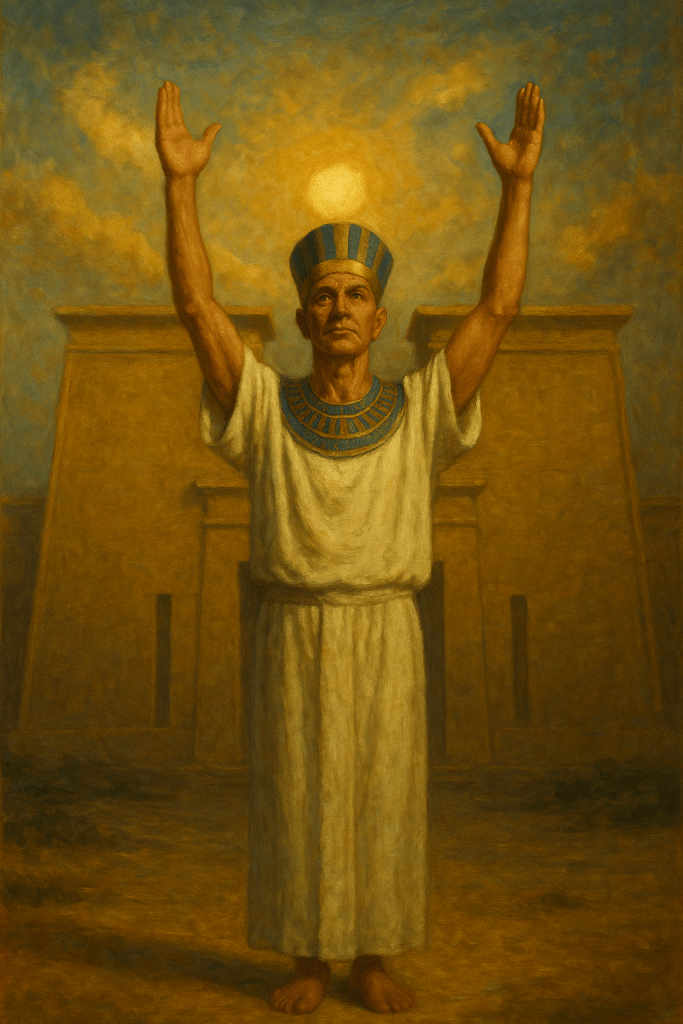

Ra Yoga, though reconstructed from fragments of iconography, temple liturgies, and movement inscriptions, reflects a deeper cultural truth: that the body itself was a microcosm of the universe, and its postures could express harmony with the divine order. Each gesture, each stance, each open palm raised to the sky was an act of alignment with the cosmos. It is no coincidence that the figures depicted in Egyptian temples stand in symmetrical poses, often facing directly forward, feet parallel, hands evenly positioned. This posture was not static; it was dynamic stillness, a silent invocation of balance and eternity. So you can move slow from one gesture towards another, or stay in the gestures and transit quickly. It is exactly how you feel what is at this moment the best way!


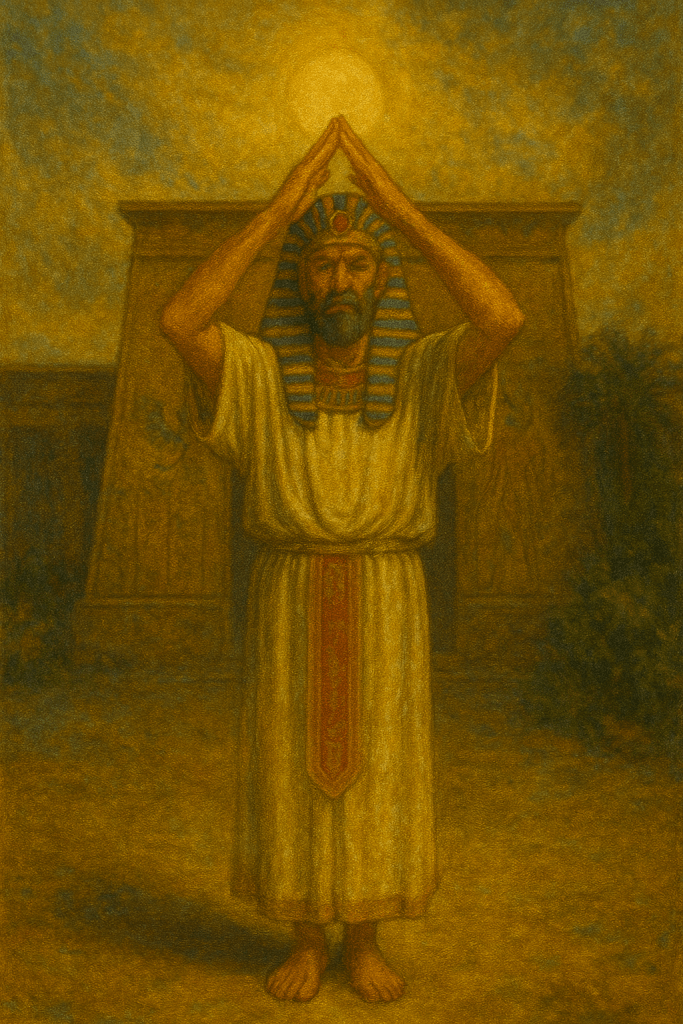
The gestures of Ra Yoga, such as The Lotus Rising, The Ka Invocation, and Offering the Horizon, are modeled after the sacred art and ritual of ancient temple priests. These were not arbitrary movements but intentional embodiments of spiritual principles. The rising lotus, performed with both hands slowly opening at the centerline, echoed the sun’s birth from the primordial waters. The Ka Invocation, with arms lifted evenly at 45 degrees, mirrored the standard pose of divine invocation found in countless tombs and temple reliefs. “Offering the Horizon,” in which the practitioner extends both arms horizontally outward while slightly bowing, re-enacts the sacred moment of offering creation back to the solar principle.
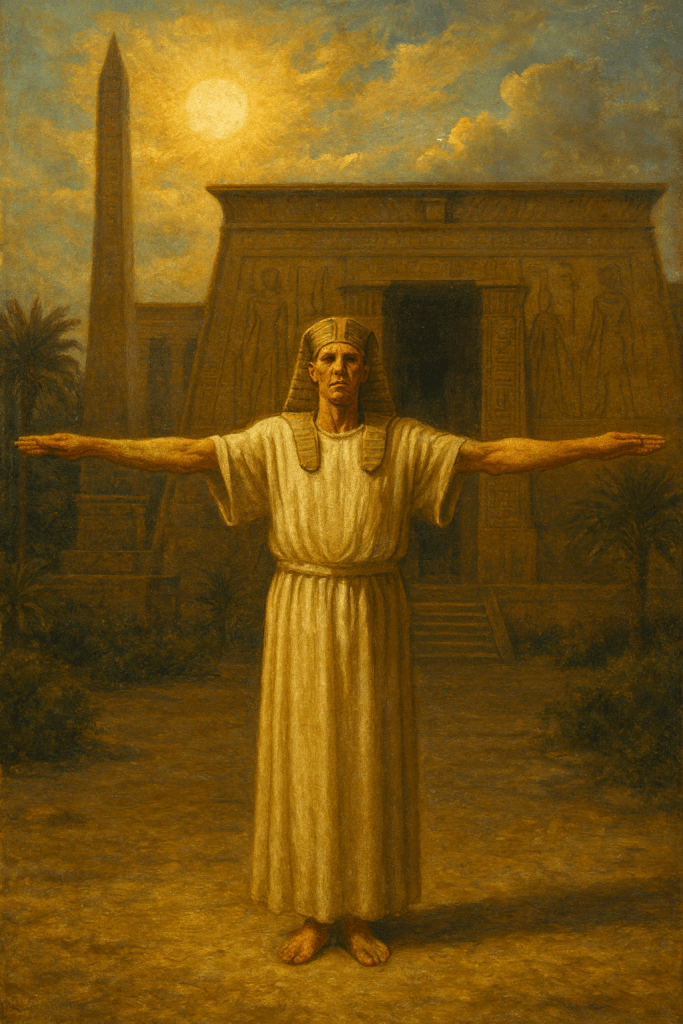


The centrality of symmetry in these gestures points to their plausibility as a form of sacred yoga. While the Egyptians may not have named these sequences as “yoga” in the Indic sense, they engaged in ritualized body practices that had identical aims: union with the divine, embodiment of cosmic principles, and transformation of the self through form and breath. That these movements are symmetrical is not a coincidence but a necessity, a reflection of their highest theological value: to live, move, and pray in accordance with Ma’at. We would call it go with the Flow!
In reviving this ancient spiritual movement discipline, we do not merely imitate history. This you ill learn and experience: that through symmetry, the body becomes a temple, you will feel and sense the sacredness of the positions, the gesture becomes therefore more, something like a hymn, and the you can become a living invocation of the Sun. So you can shape your own ultrasubjective hyperspace.

What exactly is Ra Yoga?
At the beginning of the 20th century, some scholars suggested that ancient Near Eastern gestures were originally part of an extensive system like the mudra (other models included Masonic ritual and the nonverbal signs of Chinese secret societies). According to this point of view, gestures that originally functioned as part of an extensive system in temple rites have gradually been reduced in number and used in less sacred contexts. More recent scholarship on Near Eastern gestures has taken a nearly opposite view: the ritual gestures are thought to be few in number and to have derived their meanings from mundane contexts. For example, raising both hands with the palms upward was thought to have begun as a simple begging gesture and to have become a prayer gesture when transferred to a temple context.
What this debate highlights for Ra Yoga is not the origin of the gestures, but the quality of their performance. The most essential aspect of Ra Yoga is the experience of the body itself entering a symmetrical position: to sense the articulation of joints, the resonance of breath, the rising of subtle thoughts and emotions in parallel. It is not about achieving a finished shape or ideal form. As in classical Hatha Yoga, the transformation arises not from the end posture, but from witnessing the unfolding of the gesture. The act of becoming symmetrical is itself the invocation. The path, not the pose, is the enfolding prayer, it sounds a bt heavy but you will see if I am correct here.
The Inner Meaning of the Gesture: Interpreting Ra Yoga Through Direct Experience
One of the most fascinating aspects of studying ancient Egyptian gesture traditions—and the broader Near Eastern ritual lexicon, is the extraordinary variety of interpretations that have been proposed by scholars. A single gesture, such as raising one hand with the palm outward, can carry a dozen plausible meanings. Is it an act of adoration, a greeting, a blessing, an oath, an apotropaic warding off of evil, a declaration of purity or non-treachery? All of these have been proposed, and many of them remain valid depending on context, form, and cultural framing.
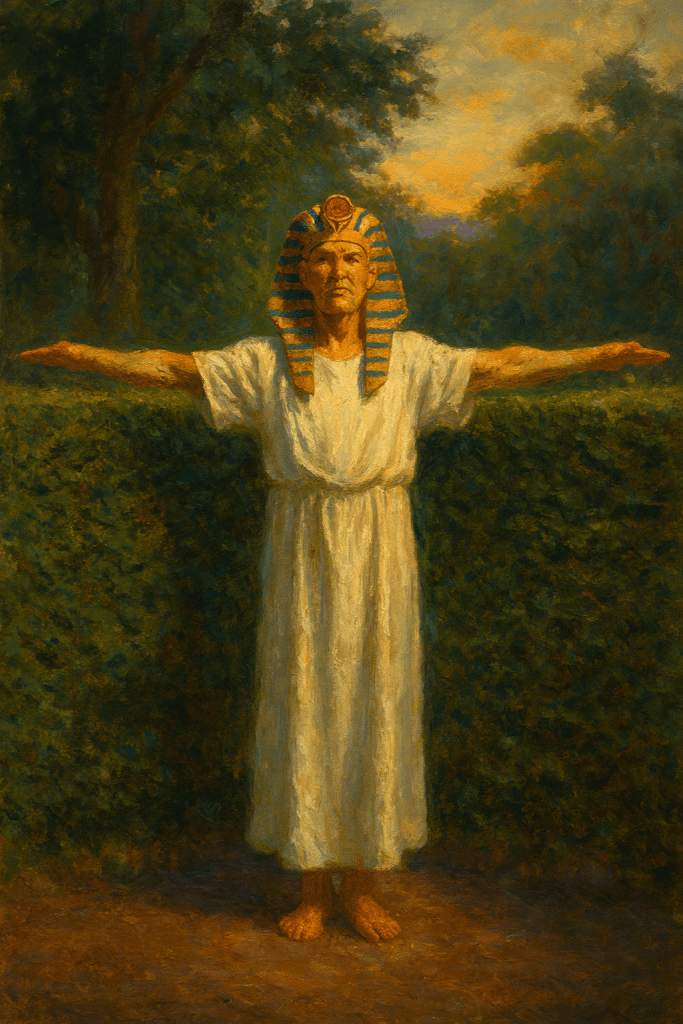
This ambiguity is not a weakness of gesture; it is its richness. The multiplicity of meaning does not dilute the gesture’s power but amplifies its resonance across different layers of reality: social, spiritual, emotional, and symbolic. Gestures, like dreams, do not exist in a one-to-one relationship with fixed meanings. They are open fields, containers, and catalysts.
Scholars have suggested that meaning may be narrowed by two primary criteria: the form of the gesture and the ritual context in which it is performed. For example, a hand raised with the palm outward toward the addressee might suggest honesty, offering, or openness. A clenched fist raised high may evoke power or aggression. Contextual clues such as accompanying speech or objects held further shape interpretation. And yet, even with such criteria applied, many gestures remain polyvalent.
This opens an important door for Ra Yoga. In the absence of fixed ritual codes or preserved manuals, we are invited not only to reconstruct gestures based on visual evidence but to investigate their inner reality through direct bodily experience. Since there is no single correct interpretation, the certainty we can seek is experiential: What does a gesture do within us when we perform it with mindfulness, slowness, and awareness?
This experiential inquiry transforms the practice of Ra Yoga into a phenomenological path. We perform a gesture not to express a predetermined meaning but to uncover what meaning arises through the act itself. When the hands rise, how does the breath change? When the body comes into symmetrical balance, what emotions surface? When one opens the palms outward, what energetic sensation occurs? These are not symbolic speculations—they are observable, intimate realities.
Thus, in Ra Yoga, we do not teach the meaning of each gesture as if it were fixed. Instead, we teach practitioners to enter the gesture as a field of inquiry. The gesture is a living ritual, and its truth is not inherited but discovered. Slowness, fluency, and silence become our tools. The gesture is not the end; it is the path. Watching is everything. In this sense, Ra Yoga is not only a revival of ancient forms but a return to embodied wisdom. The ancient priest and the modern practitioner meet in the same sacred space: the body as temple, gesture as invocation, and awareness as the light that reveals the hidden truth. We Re-Create Ra-worship and presence in our own ultrasubjective hyperspace. AH – How cool is that!
Shunyam Adhibhu

 breath4balance