Among the many mysteries of human perception, synaesthesia is quite interesting. Crossing of the senses where sound becomes colour, where touch radiates as light, or where vision itself resonates like a musical chord.
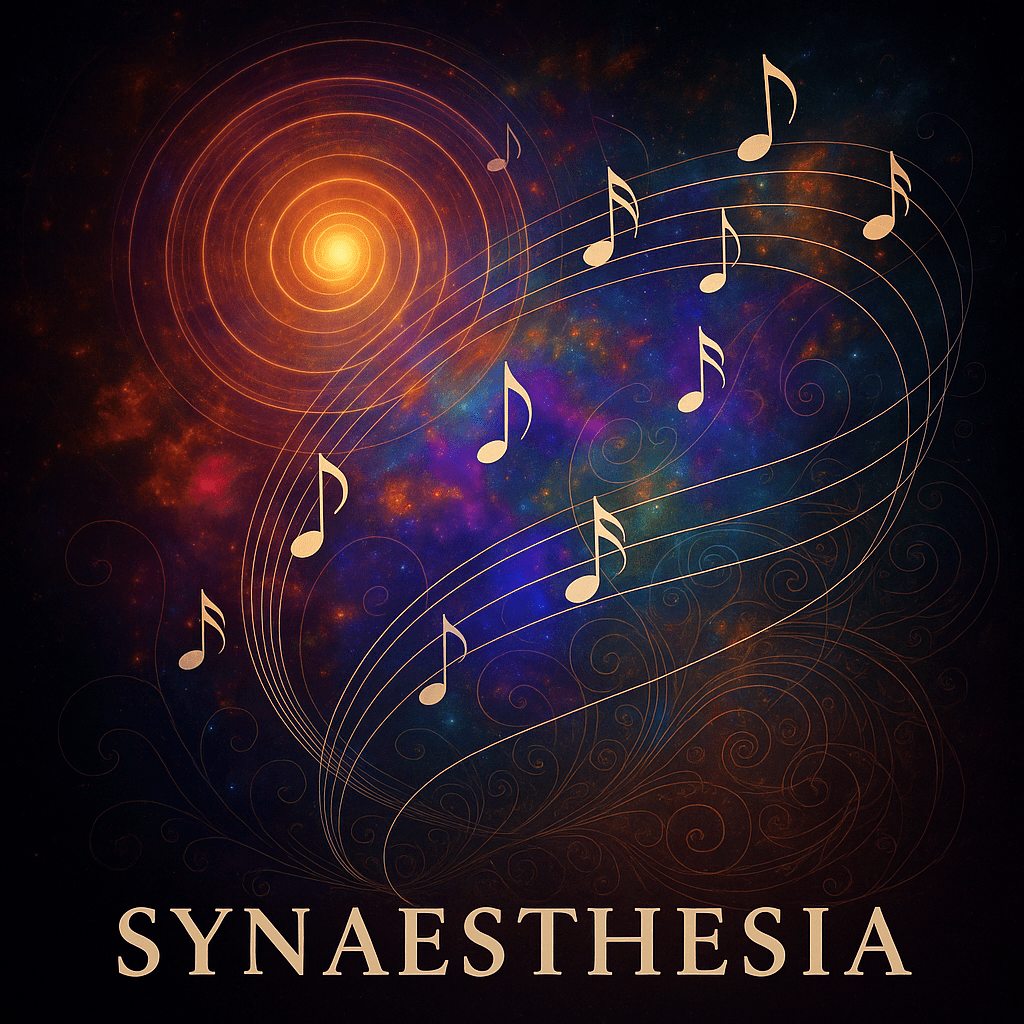
In early mescaline research, such synaesthetic states were already frequently documented. Investigators noticed that the excitation of one sensory organ would spill into another, giving rise not just to vague associations but to vividly defined images or hallucinatory landscapes.
One subject described how the audible stroke of a pendulum became an explosion of colour. Others found that the beat of a drum magnified the beauty and intensity of their visions, each percussive strike rippling through the inner cosmos. Rouhier noted how the low notes of a piano evoked violet hues, while high notes gave rise to rose and white. Whole harmonies did not just move the ear—they blossomed into grand architectural forms: basilicas, courts, statues glowing in spectral light.
Dixon’s testimony reads like an initiation into an inner cathedral:
“The effect of the sound of the piano was most curious and delightful, the whole air being filled with music, each note of which seemed to arrange around itself a medley of other notes, which appeared to me to be surrounded by a halo of colour pulsating to the music.”
Such experiences resonate with reports from cannabis intoxication, as described by Gautier and Baudelaire, where colours and sounds entwine in luminous symphonies.
But one need not rely on pharmacological catalysts to encounter such interweaving of the senses. In the Yoga of the Inner Light, the spontaneous arising of phosphenes: those luminous forms and afterimages that appear behind closed eyes, can act as a bridge into precisely these kinds of synaesthetic states. When one sits in silence, immersed in the dancing sparks of phosphenes, it often happens that a tone or rhythm seems to set them pulsing, swirling, or morphing into colour-fields.
This is not simply a coincidence. Phosphenes are shaped by the brain’s visual system, which shares deep cross-modal connections with auditory and tactile networks. Sound can ignite visual cascades, just as touch or movement can leave shimmering imprints in the inner field of light. The brain, when released from its ordinary gating, reveals itself as a synaesthetic organ: an instrument whose strings are not separate senses but resonant dimensions of one awareness.
In this way, the synaesthetic visions of mescaline echo what contemplatives have known for centuries: that light and sound, form and rhythm, emerge from the same luminous ground of consciousness. Whether through a drumbeat evoking waves of colour or a phosphene spiraling to the hum of a mantra, the senses converge in a deeper field of unity.
Philosophically, this collapse of sensory boundaries is more than curiosity—it is a kind of therapy of perception. The rigid partitions of the self are softened, categories dissolve, and what remains is a synaesthetic freedom: seeing sound, hearing light, touching colour. In this state, the world and the self no longer appear as fixed domains, but as fluid resonances within the vast, luminous cosmos of consciousness. That is what you are.
 breath4balance