Recent research proposes that consciousness may arise not from neurons firing, but from rhythmic waves resonating together to form stable patterns, like music made of light.
In the ancient Yoga of the Inner Light, this same resonance is experienced directly as phosphenes: luminous fields appearing behind closed eyes when awareness turns inward.
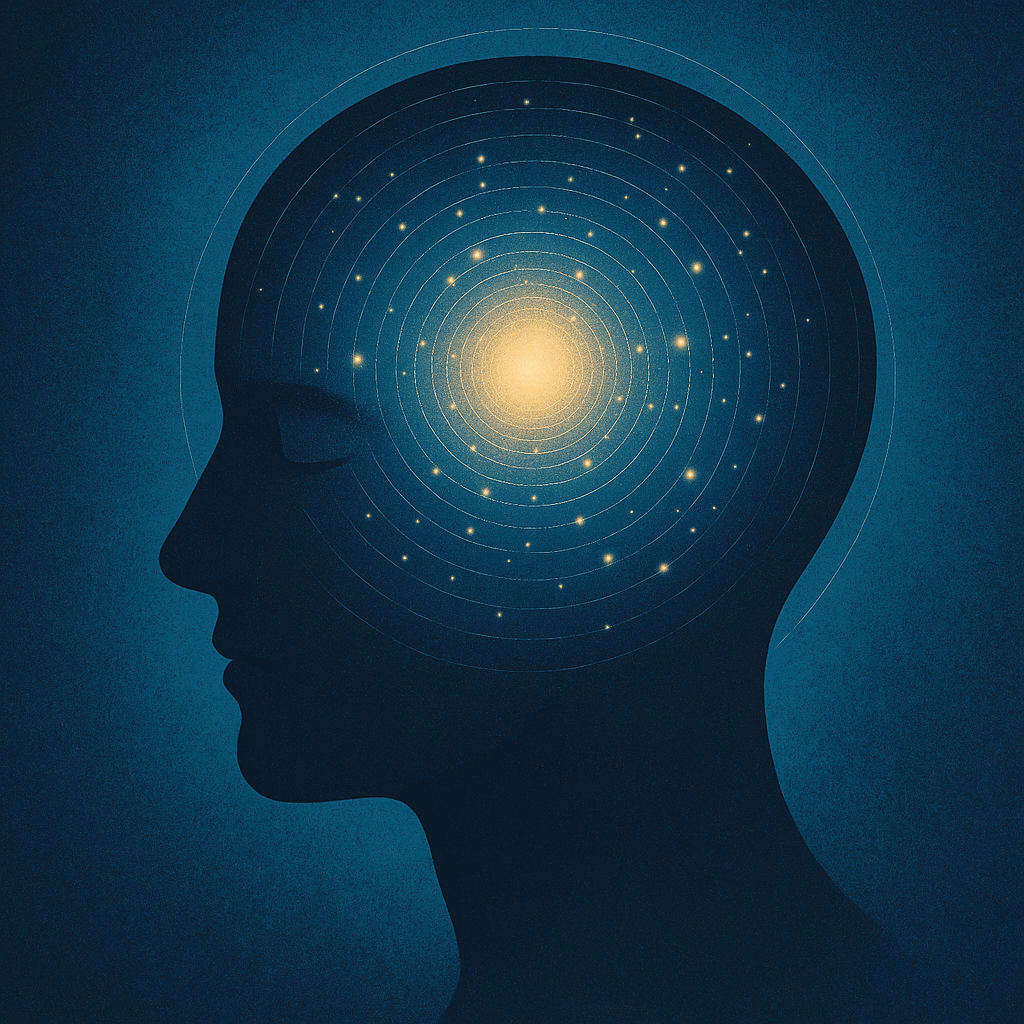
When we close our eyes, most of us see a quiet shimmer, faint patterns of light that drift and pulse behind the eyelids. Many dismiss this as “visual noise,” a meaningless remnant of neural activity. Yet in the ancient traditions of inner yoga, that faint luminosity has always been recognized as something sacred: the first visible trace of consciousness turning toward itself.
In recent years, a new scientific model is emerging that echoes this contemplative insight. Resonance Complexity Theory, developed by Michael Arnold Bruna, suggests that consciousness may not be produced by neurons as discrete switches, but by the way vast networks of electrical waves resonate together in the brain. Awareness, in this view, is not a computation but a field phenomenon, the harmonious interference of billions of oscillations creating stable patterns of experience.
When these waves align and reinforce each other, they form what Bruna calls resonant attractors, self-sustaining patterns that persist long enough to become the living geometry of awareness. Each moment of consciousness corresponds to one of these stable patterns, like a holographic shape of vibrating energy. We don’t simply have a field of awareness, we are that field, viewed from within.
The brain as a resonant field
In traditional neuroscience, the mind is often imagined as a computer made of cells and chemicals. But from a resonance perspective, the brain behaves more like a musical instrument. Its neurons are the strings; its rhythms, the melodies; its harmonics, the mind’s luminous overtones. Every sensation, thought, or feeling is a pattern of vibration shaped by the interplay of these waves.
Consciousness arises when the orchestra of the brain begins to play in synchrony, when oscillations across different frequencies and regions become coherent, forming a unified song. The self is that song heard from the inside. In Bruna’s model, awareness intensifies as this resonance becomes more stable, integrated, and self-reflective.
Seeing the resonance from within
This is where the Yoga of the Inner Light enters the picture.
Through disciplined inner attention, practitioners can watch this resonant field directly, as it gradually organizes itself into light.
At first, one sees random flickers, spontaneous interference of oscillations still seeking coherence. Then waves begin to pulse rhythmically, giving rise to simple phosphenes: dots, spirals, or faint geometric lattices. As focus deepens, the luminous field stabilizes and expands, until one perceives a steady, radiant glow.
In the later stages, perception itself begins to dissolve. The light seems to look back. It becomes awareness aware of its own vibration. Finally, at the culmination, nothing remains but pure luminosity, no object, no space, only light.
This is not hallucination; it is consciousness perceiving its own resonance.
Where Bruna’s equations describe the physics of coherence, the Yoga of the Inner Light describes its phenomenology. Both point to the same transition: from scattered neural activity to a unified field of awareness.
The six stages of inner luminosity
In our ongoing research on phosphenes — the inner light patterns seen during deep meditation, we describe six progressive stages that mirror the resonance process Bruna models mathematically:
- Flicker – Spontaneous interference of local oscillations
- Pulsation – Rhythmic coherence emerging in the field
- Geometry – Standing wave structures and symmetric phosphenes
- Radiance – Stabilized global resonance; steady luminous field
- Reflexivity – Awareness observing its own coherence
- Transluminal phase – Pure light; consciousness without object
These stages correspond closely to Bruna’s idea of the Complexity Index, a measure of how coherent and enduring the resonance has become.
As coherence, gain, and dwell time increase, the field crosses a threshold where self-awareness emerges. In meditative language, the light that once appeared “outside” becomes identical with the awareness that perceives it.
Consciousness as resonance aware of itself
The convergence between Resonance Complexity Theory and the Phosphene Yoga of the Inner Light suggests something profound: that inner light experiences are not mere artifacts of the retina, but direct glimpses of the resonant architecture of consciousness.
When the senses quiet down, the brain’s oscillatory field continues to vibrate — now unobstructed, self-referential, luminous. The practitioner’s experience of inner light is the subjective view of this coherence from within.
At its core, both approaches share one hypothesis:
Consciousness is resonance aware of itself.
The phosphenes are its visible echo, a holographic shimmer of the self-sensing field.
A bridge between science and contemplative practice
What emerges from this synthesis is not mysticism disguised as science, nor science stripped of mystery, but a genuine bridge. Resonance models give language to the physics of awareness, while inner light practice provides direct experiential access to it.
Meditation becomes, in this sense, a form of living research, an experiment in field coherence. As the inner oscillations synchronize, the practitioner witnesses the self-organizing nature of consciousness. The light that appears is not symbolic; it is the geometry of awareness, unfolding in real time.
The path of the Yoga of the Inner Light reveals what Bruna’s equations describe: when coherence becomes complete, the field of consciousness turns transparent. The observer and the observed merge, and the final perception is of light, not physical, but existential, the radiant essence we are.
References
Bruna, M. A. (2025). Resonance Complexity Theory and the Architecture of Consciousness. arXiv:2505.20580.
Buzsáki, G. (2006). Rhythms of the Brain. Oxford University Press.
Varela, F. J., Thompson, E., & Rosch, E. (1991). The Embodied Mind: Cognitive Science and Human Experience. MIT Press.
Keppel Hesselink, J. M. (2025). The Yoga of the Inner Light: A Phenomenology of Subtle Somatic Signs and Vibratory Consciousness.
 breath4balance