A Jungian and Phosphenic Reading of Denis Villeneuve’s Enemy
Cinema sometimes becomes more than a story, it turns into a mirror of the mind itself. Denis Villeneuve’s Enemy (2013) is such a film: mysterious, slow, and haunting. Beneath its thriller surface lies a meditation on consciousness, identity, and the strange geometry of fear. The film can be read not just psychologically, but as a kind of modern visionary text: an accidental map of the inner light and shadow that shape human awareness.
Denis Villeneuve’s Enemy (2013) is not a thriller about doubles (I thought first it was…), but a meditation on the architecture of the mind. What appears as a story of two identical men, one academic and withdrawn, the other impulsive and sensual, is in fact a cinematic study of the split between the conscious self and the shadow. The film’s most enigmatic image, the recurring spider, points toward something deeper than psychology: it reveals the geometry of inner vision itself.
Enemy is a modern, postmodern psychological reworking of Dr. Jekyll and Mr. Hyde: the double becomes not a product of science, but of the psyche.
In Jungian language, the spider represents both the Great Mother and the devouring web of the unconscious. It is creative and destructive at once. The spider weaves the world and consumes it. For Adam, the film’s protagonist, this figure appears as the embodiment of his fear of intimacy, the archetype of entrapment. His encounters with women, his mother, his mistress, his wife, trigger subtle flashes of arachnid imagery, culminating in the final, unforgettable moment when his wife appears as a giant, cowering spider in the bedroom.
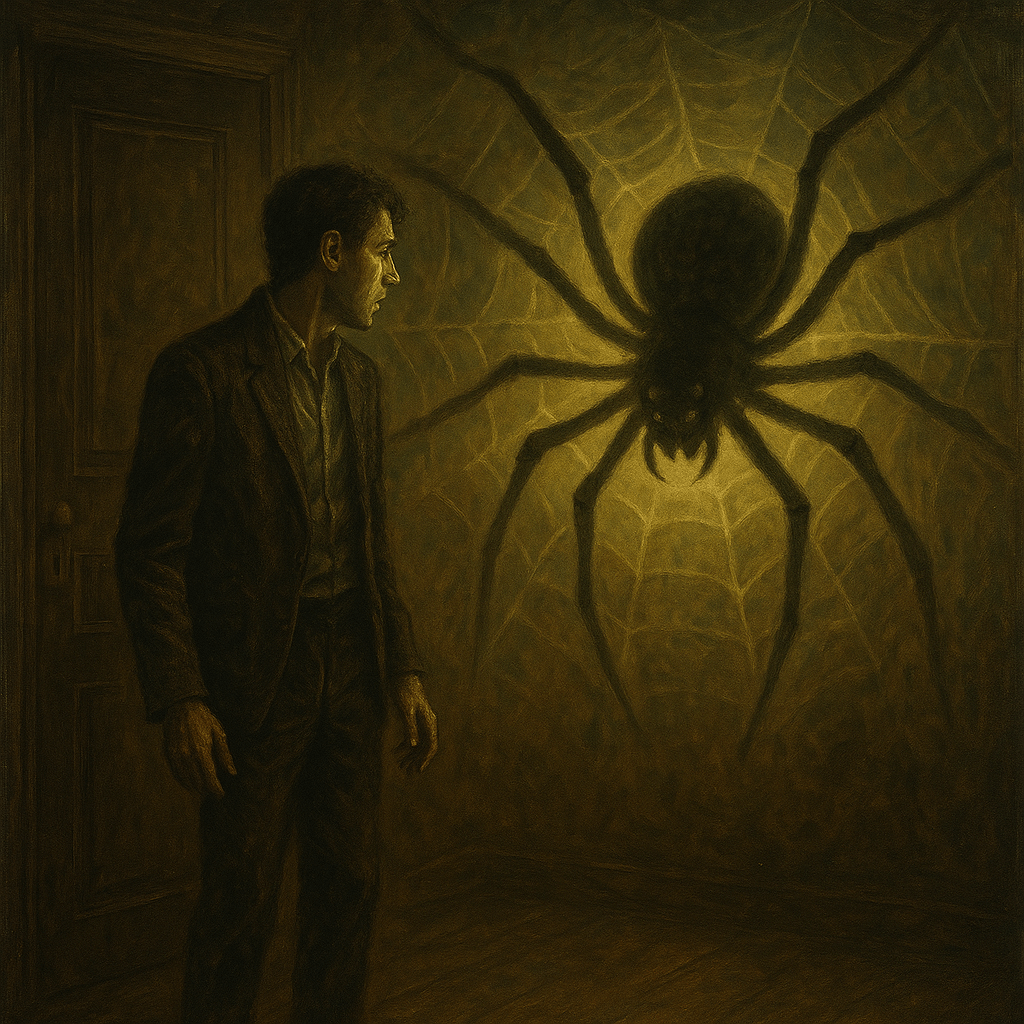
This image is not meant to horrify; it is meant to illuminate. It marks the instant when the psyche, overexposed to its own depths, projects its hidden contents into vision. In meditative experience, such transformations occur as luminous geometries or “phosphenes” ; self-generated fields of light that mirror the structures of consciousness. Enemy can be read as a failed initiation into the Yoga of the Inner Light. Adam glimpses his inner double (the subtle self) but resists integration. The light turns to web; the mandala collapses into the trap.
In the language of the Yoga of the Inner Light, the spider represents a dark phosphene, a complex energetic formation arising when awareness touches a repressed affect without full acceptance. Its form , radial, symmetrical, pulsating, mirrors the nervous system’s own geometry. Each thread of the web is a thought-loop, a karmic link, a habitual pathway of perception. The spider at the center is the ego, feeding on its own projections.
The ending of Enemy is, therefore, not tragic but diagnostic. Adam at the end of the movie stands before the spider, before the vast, luminous fear at the heart of his being, and he sighs. He does not flee, nor does he transcend. He recognizes the pattern but cannot dissolve it. The film closes not in terror, but in quiet recognition of the endless web of self and shadow.
Villeneuve’s work here approaches what ancient Dzogchen texts described as the play of light within the mind, the field where forms arise from luminosity itself. Enemy translates that metaphysical insight into modern language: the psyche as cinema, the unconscious as phosphene, the human being as both the spider and the web.
Perhaps that is why the film feels so unsettling. It touches the boundary where art and inner light converge, where we see that the monsters we fear are not outside, but woven from our own radiance.
From Shadow to Light
In the Yoga of the Inner Light, every vision, however frightening, is a reflection of consciousness attempting to recognize itself. The spider, the double, the web, all emerge from the same luminous field. When seen without resistance, these dark phosphenes begin to dissolve, revealing the clear light beneath or byond. Enemy ends where illumination begins: at the threshold where fear and light meet. In this sense, Villeneuve’s film is not only a study of division, but a hidden initiation, a cinematic mirror of the human journey from fragmentation toward inner radiance.
 breath4balance