In 2026 VedicVibes go on a 5-weeks Inida trip visiting many meditation and yoga masters in Kerala. Why India? Because the ancient word for India is Bharata. And that makes a lot of sence. The Sanskrit word for India, ‘Bharata’, stems from the root “bhaya ratam iti bharatam.” BHA signifies ‘light’ – knowledge, wisdom, and personal enlightenment. A Bharatiya is one who relentlessly pursues this inner light. A society founded on this principle of seeking inner light flourishes, becoming rich not just materially, but also culturally and spiritually.

In our new designed ancient Yoga of the Inner Light, India is not approached primarily as a geography or a civilisation, but also as a direction of consciousness. In that sense, the ancient name Bharata can be read not merely and only as a historical designation, but as a symbolic statement about what it means to live from and out of inner luminosity.
In traditional contemplative interpretations, Bharata is sometimes explained as bhā ratam iti bhāratam, “that which is devoted to bhā,” where bhā points to light, radiance, illumination, knowing. Whether or not this reflects strict philology is less important than what it reveals experientially: India always understood itself as a culture oriented toward inner light rather than external domination.
Within the Yoga of the Inner Light, bhā is not metaphorical. It refers to a directly perceivable phenomenon. When attention withdraws from compulsive thought and rests steadily in awareness, inner luminosity arises on its own. Sometimes as subtle brightness, sometimes as diffuse radiance, sometimes as structured inner forms. This light is not imagined. It appears spontaneously, with closed eyes, as a function of consciousness recognising itself.
A Bhāratīya, in this contemplative sense, is not someone born in a particular land, but someone who is devoted to this inner illumination. A sanyassin. One who turns repeatedly toward the source of seeing rather than toward the objects of sight. One who understands knowledge not primarily as accumulation, but as recognition.
A society oriented toward inner light develops a very specific character. Its richness is not measured first in material output, but in symbolic depth, ritual precision, philosophical subtlety, music, mantra, and contemplative practice. This explains why Indian civilisation, even under conditions of material scarcity or political instability, produced an extraordinary density of inner technologies: yoga, mantra, darśana, tantra, meditation, and refined phenomenologies of consciousness.
In the Yoga of the Inner Light, this orientation is not romanticised. Inner light is not treated as mystical belief or spiritual decoration. It is treated as a trainable, observable dimension of human experience, one that has direct consequences for perception, self identity, and ethical orientation.
When inner light is known directly, the sense of separation softens. Identity expands beyond the contracted ego. This is why classical statements such as aham viśvaṃ aham brahma arise naturally from practice, not as metaphysics but as lived insight. Inner luminosity dissolves the sharp boundary between inner and outer, personal and cosmic.
In this way, Bharata becomes less a name for a nation and more a gesture of orientation. Toward illumination we move together!
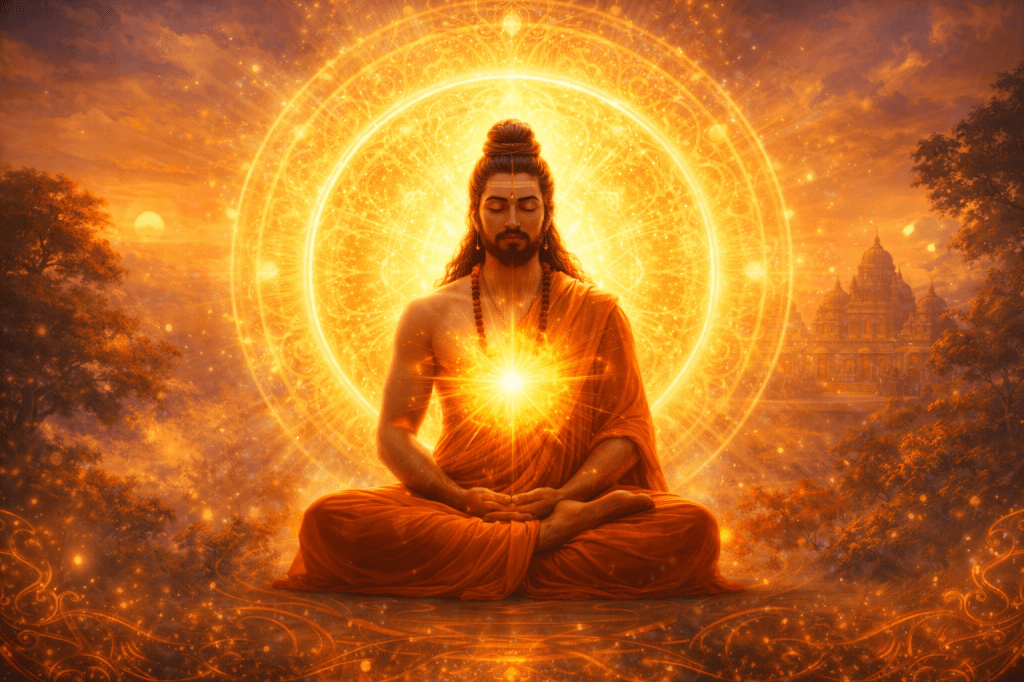
Not to escape the world, but to see it clearly in full awareness. For that you only need to be persent in the now. So simple. Shunyam Adhibhu
 breath4balance