A good friend of mine sent me for Xmas one page from an unknown source. The page was intriguing to me. I print the page here. Why was it so intriguing? Because the last sentences resonated a lot.
I subsequently learned the page is from a book by a pupil of my esteemed master, G.I. Gurdjieff. A rare jewel in the field of the transformation of consciousness. I was extremely lucky to become part of the ‘work’ already in my 20s and am still immensely grateful that Hans Groen, my friend, pointed out the 4rd way to me.
Jeanne de Salzmann’s The Reality of Being is not simply another reflective spiritual memoir. It is a record of rigorous inner practice carried out over decades, written by a woman who stood at the center of one of the 20th century’s most demanding spiritual traditions: Gurdjieff’s Fourth Way. She became 101, born in 1889 and died on 24 May 1990.
Only in the state of presence can something higher appear
The book reads less like philosophy and more like a notebook from an inner laboratory. Every page speaks to the discipline of watching oneself, recognizing illusions, and discovering what it actually means to be present in life. At the core of her writing is one fundamental discovery: the human being develops only when two movements meet within us, something higher descends, and something conscious rises to meet it.

The first movement begins in silence. De Salzmann repeatedly describes moments when a finer energy enters, not as imagination, not as emotion, but as a living, tangible presence. The breath slows. The body is felt more clearly. Thought continues but loses its authority. A deeper awareness appears that is simultaneously peaceful and alert. She does not treat this as mystical fantasy. She insists it is lawful, almost mechanical: when the noise of inner identification weakens, a higher level of awareness can reach us.
This descending presence does not remove our problems. Instead, it introduces a greater clarity about them. We see more objectively the tensions, fears, habits, and mechanical reactions that normally dominate our lives. In this sense, awakening is not escape; it is a more exact participation in reality.
But de Salzmann is adamant that the descending movement is not enough. If we simply enjoy the stillness, it fades. Something in us must answer. This is the second movement, the deliberate choice to remain present. It is subtle effort, not strain: a steady returning to the sensation of the body, to the fact of being here, to the awareness that sees. This effort is not moralizing self-control. Nor is it spiritual ambition. It is the acceptance of responsibility for attention itself. When that upward effort meets the downward presence, a new quality appears, a quiet, grounded consciousness that feels both intimate and impersonal. For brief moments we sense that “I” am not the center of the universe, yet I am fully included in a larger order.
From this experience emerges one of de Salzmann’s strongest ideas: awakening is not for personal satisfaction. She speaks of a “cosmic need,” a larger purpose that requires conscious human participation. The human being, she suggests, exists as a bridge between different levels of reality. When we become present, we allow finer energies to pass into life. This is what she calls “inner service.” It is not servitude. It is dignity, the dignity of being available to something greater than our personal story. Seen in this light, spiritual practice is no longer self-improvement. It is collaboration. It is when we really inhabit our own sultrasubjective hyperspace.
What makes de Salzmann’s perspective compelling is its practicality. Her path does not require monasteries, isolation, or withdrawal from responsibility. Work is done in the middle of ordinary life: in conflict with others, while working, while waiting, while listening, while feeling impatience rise. Each situation becomes material for the two movements, allowing something higher, and answering with conscious presence. This is the essence of the Fourth Way: transformation not through belief or ritual, but through continual awareness in the conditions life already provides.
The psychological honesty of The Reality of Being also sets it apart. De Salzmann acknowledges fatigue, resistance, disappointment, and illusion. She describes the self that constantly tries to claim the work for its own glory, the ego that wants to be “advanced.” She warns that without humility, inner work degenerates into spiritual narcissism. The real task, she insists, is to recognize one’s own fragmentation and still remain present to it without condemnation. Only then does something deeper appear that is not merely psychological but ontological, a different level of being.
The book’s most striking implication is that consciousness is not purely personal. De Salzmann writes as though attention, rightly directed, participates in the maintenance of the world itself. It is as if the universe needs aware human beings in order to complete something unfinished. Whether one accepts this metaphysical view or reads it symbolically, the effect is ethically transformative. We begin to understand that how we live inwardly matters, not just to us, but to the very structure of life.
In an era crowded with quick-fix spirituality and positive-thinking slogans, The Reality of Being stands as a sober counterpoint. It does not flatter. It does not promise enlightenment in ten steps. It invites discipline, sensitivity, and patience. It describes awakening not as achievement but as relationship, relationship between the human and the greater, between effort and grace, between our limited self and the unknown presence that quietly calls us.
Perhaps this is Jeanne de Salzmann’s greatest contribution: she restores seriousness to the question of consciousness without turning it into dogma. Her language is precise yet compassionate, demanding yet deeply humane. In reading her, one senses that awakening is not a mystical specialty reserved for the few, but a responsibility offered to anyone willing to observe, to receive, and to respond.
In the end, the message of The Reality of Being could be summarized simply: something higher is always approaching us. Our task is to learn how to be there when it arrives.
Who was she? Jeanne de Salzmann (1889–1990)
Jeanne de Salzmann (1889–1990) was a French-Swiss dancer, musician, and spiritual teacher best known as the principal transmitter of the teaching of G. I. Gurdjieff. Born Jeanne-Marie Allemand on 26 January 1889 in Reims, France, she initially trained in music and later studied modern movement and dance. Her meeting with Gurdjieff in 1919 fundamentally changed the direction of her life. Over the following decades she worked closely with him, helping to develop and transmit both his practical psychological teaching and the Gurdjieff Movements, a demanding form of meditative dance and attention training.
After Gurdjieff’s death in 1949, de Salzmann was entrusted, both by legacy and by the informal recognition of his students, with safeguarding and continuing the Work. She coordinated the international network of Gurdjieff groups, fostered training in the Movements, and maintained the discipline of inner practice while avoiding the creation of a rigid sect. Her guidance emphasized lived presence rather than dogma: attention in the body, conscious effort balanced by receptivity to a higher influence, and inner responsibility expressed in ordinary life.
The Reality of Being, compiled posthumously from her notebooks and teaching notes, offers perhaps the clearest window into the depth and subtlety of her understanding. The reflections gathered there map the daily practice of conscious presence and the “double ”movement”, the descent of a higher awareness and the human effort to respond to it.
Jeanne de Salzmann died on 24 May 1990, at the age of 101. Her long life allowed the Fourth Way to pass safely from its first generation into the contemporary world. Today, most serious Gurdjieff work worldwide traces some aspect of its lineage, discipline, and ethos back to her steady guidance.
Gurdjieff brought us a knowledge of consciousness, a science that shows what we are and our potential capacity, what needs to be developed. He came to bring a teaching, show a way toward consciousness.”
Jeanne de Salzmann
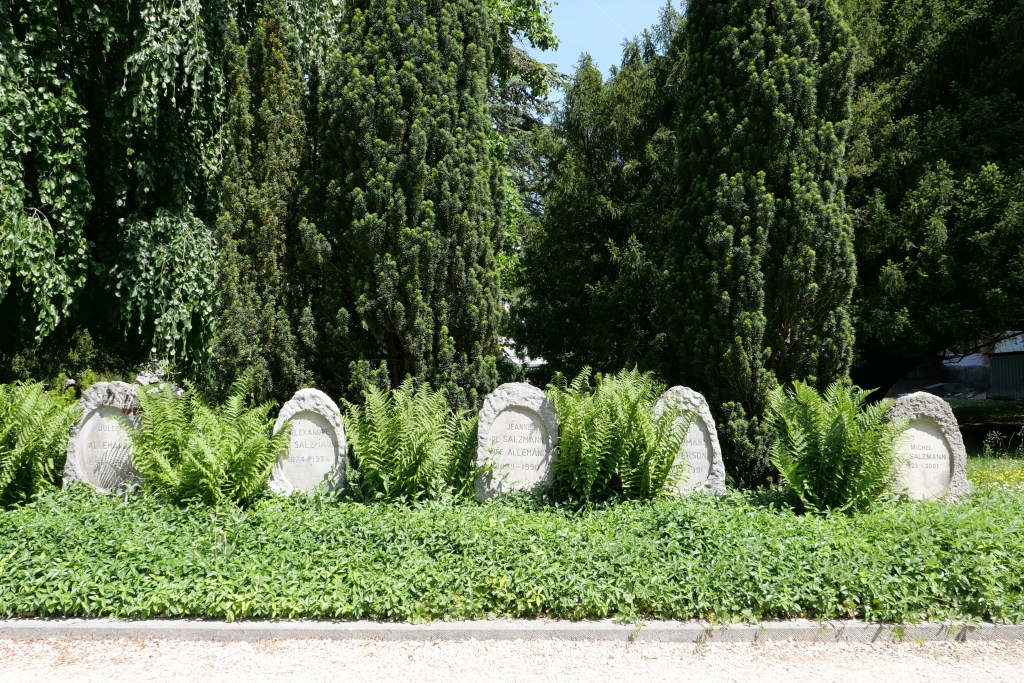
Hereunder her family grave.
https://www.realityofbeing.org/
Shunyam Adhibhu
 breath4balance