Kabir is one of those figures who stubbornly refuses to fit. Every tradition that later tried to claim him ended up being quietly dismantled by him instead. Hindus call him a bhakta, Muslims a Sufi, yogis a sant, philosophers a mystic. Kabir himself would likely have laughed at all of them. Labels were precisely what he spent his life dismantling. Labels are for bottles, as Fritz Perls said.
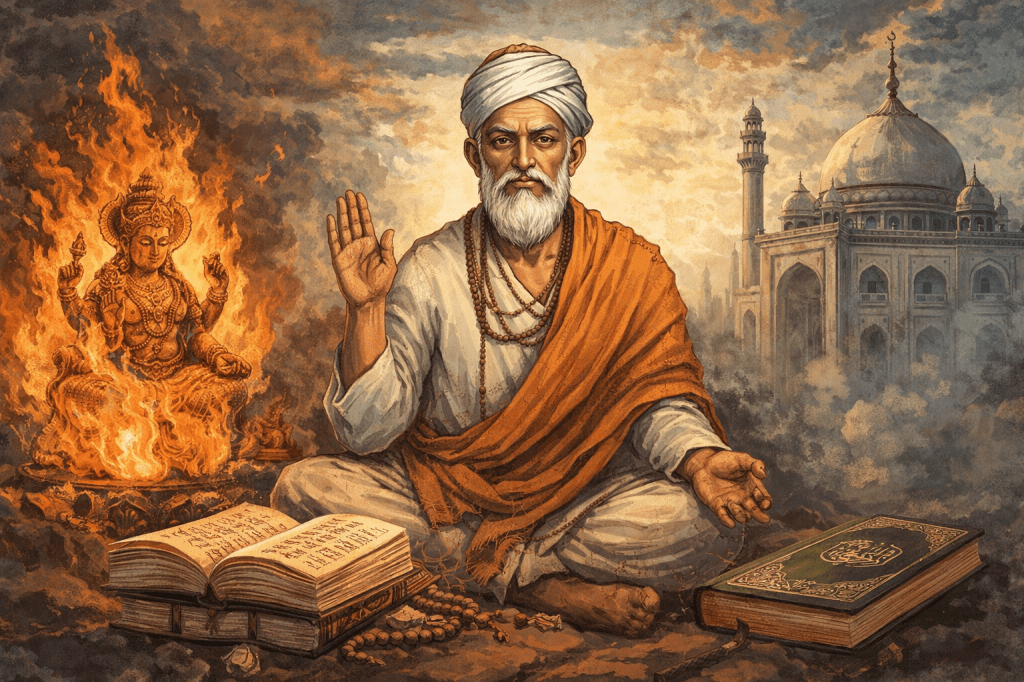
Kabir lived roughly in the fifteenth century, most likely in Benares (Varanasi), one of the most sacred cities of Hinduism. According to tradition, he was born to a Muslim weaver family, possibly adopted, possibly orphaned. Whether he was formally literate is debated, but it hardly matters. His genius did not come from books. It came from direct interior perception, expressed in a raw vernacular that cut straight through Sanskrit authority and Islamic scholasticism alike. This is the raw material VedicVibes embraces. Your own experience!
Kabir earned his living as a julāhā, a weaver. This is not a romantic detail. It mattered. Weaving is repetitive, embodied, rhythmic. His metaphors come from thread, cloth, knots, tension, and pattern. Kabir’s spirituality was not ascetic withdrawal or temple refinement. It was lived, bodily, immediate. And it was merciless toward pretense.
He lived at a time of intense religious polarization. Hindu ritualism and caste hierarchy on one side, Islamic orthodoxy and scriptural authority on the other. Both claimed exclusive access to truth. Kabir rejected both claims outright.
“The Hindu says Ram is beloved, the Muslim says Rahim.
Both die without knowing the truth.”¹
This is not interfaith harmony. It is demolition. Deconstruction in a modern term.
Kabir did not oppose religion because he was secular or skeptical. He opposed it because he thought it got in the way of realization! His critique was not moral but epistemological. Religion, in his eyes, substituted belief for knowing, ritual for transformation, and identity for truth.
No Temples, No Mosques, No Escape
Kabir’s most famous verses revolve around a single relentless point: truth is not outside you!
“If God were found by bathing, I would be an alligator.
If God were found by fasting, I would be the hungriest man.
If God were found in temples, I would worship a stone.”²
Kabir’s genius lies in how little patience he had for spiritual theater. He saw immediately what many still miss today: that external practices easily become defense mechanisms against inner confrontation.
From the perspective of the taxonomy developed in Beyond the Authenticity Debate, Kabir belongs to the deepest layer of yogic practice: inner-state and consciousness technologies. But with a crucial difference. He refused to systematize them. The moment inner practice becomes doctrine, it ossifies.
“Where do you search me?
I am with you.
Not in temples, not in mosques,
Not in Kaaba nor in Kailash.”³
Kabir means this literally. Truth is immediate presence, not an object of belief.
Kabir vs. Professional Spirituality
Kabir’s fiercest attacks were reserved for professional religious authorities.
“Reading books, the whole world died,
And none became wise.
The one who read the word of love,
He alone became learned.”⁴
Kabir would have recognized today’s spiritual marketplace instantly: certifications, influencers, curated “ancient wisdom.” Different era, same displacement. Talking replaces seeing. Identity replaces realization.
Kabir would not object to diversity of practices. What he would object to is confusing function with liberation.
Inner Sound, Inner Light, Inner Collapse
Beneath Kabir’s iconoclasm lies a precise phenomenology. He repeatedly refers to inner sound (śabda) and subtle perception.
“The flute of the inner sound plays without breath.
Who hears it, knows.”⁵
This places Kabir in continuity with Nāda Yoga and Surat Shabd traditions. But he refuses to fetishize experience. Altered states are not awakening.
“Where there is experience, there is still the experiencer.
Where there is the knower, bondage remains.”⁶
Kabir relentlessly points beyond experience to the collapse of the experiencer itself. Exactly what we teach with the Yoga of the Inner Light path!
Kabir as an Evolutionary Corrective
In evolutionary terms, Kabir represents a conserved corrective function. When spiritual systems become overgrown with ritual, hierarchy, and authority, figures like Kabir reappear. They do not reform systems. They puncture them.
Legend says that when Kabir died, Hindus and Muslims argued over his body. When the shroud was lifted, only flowers remained. Myth, of course. But accurate symbolism. Kabir leaves nothing to claim.
Why Kabir Still Matters
Kabir matters because he exposes a recurring human failure: replacing inner work with symbolic compliance.
He does not offer comfort. He offers confrontation. He does not reconcile systems. He exposes their shared emptiness when they lose contact with lived realization.
Kabir reminds us that the deepest yoga is not a style, lineage, or technique, but a refusal to lie to oneself.
And that is why no institution can ever fully contain him.
Notes and Sources (for quotations)
- Kabir, Bījak, various verses; English rendering after Linda Hess, The Bijak of Kabir (Oxford University Press, 2002).
- Kabir, Songs of Kabir, trans. Rabindranath Tagore (Macmillan, 1915).
- Kabir, Songs of Kabir, Tagore translation, poem often titled “Where do you search me?”
- Kabir, Bījak, Hess (2002), Sakhi verses on book learning.
- Kabir, Bījak, Ramaini section, inner sound imagery; Hess (2002).
- Kabir, variant verses across oral traditions; thematic rendering consistent with Hess (2002) and Vaudeville (1974).
 breath4balance