Om Agnim īḷe purohitam
yajñasya devam ṛtvijam
hotāraṃ ratnadhātamam
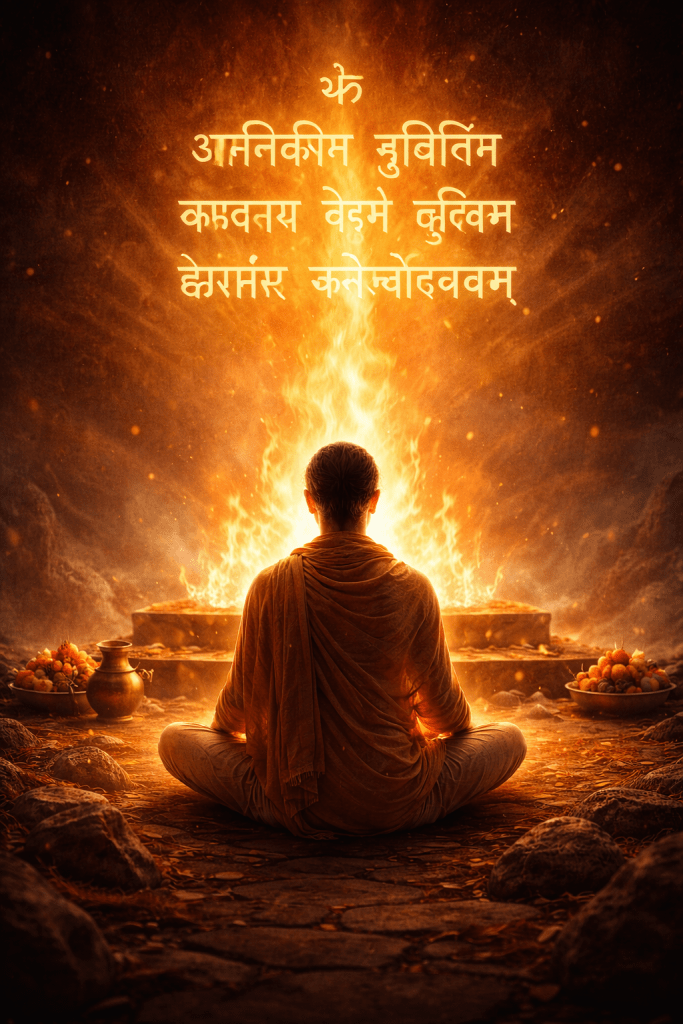
The first verse of the RigVeda is the ultimate recipe for self-recognition—for enlightenment. Basically by meditating and reciting it you follow the following steps:
- Invoke the Agni – the Will Power wanting to know its own source
- Invoking to become the interface where the divine can manifest itself in and through you
- Recognizing the essence of who you are: radiant emptiness in which all thoughts and emotions and sensations rise.
By centering yourself in this prayer/invocation, you will feel the grace descending on you and you will be bestowed with the ultimate insight, the Mahamudra, The Rigpa, or whatever you want to name it. It is all about being present and being willing to surrender to the divine manifestation.
In its historical context, this is an opening hymn to the fire priest who mediates between humans and the gods during sacrifice. However, when read through the lens of esoteric psychology, the verse can be understood as a structured description of an inner process of transformation.
Below is a sober esoteric – psychological interpretation of the key Sanskrit terms and their relevance for inner development.
Agnim īḷe — I Invoke the Inner Fire
Agnim refers to Agni, the fire principle. Exoterically, this is the ritual flame. Esoterically, Agni represents the inner luminous force of awareness, clarity, and willpower. It corresponds to what in yogic psychology could be described as tejas (radiant intelligence) and icchā śakti (directed will).
īḷe means “I invoke,” “I praise,” or “I call forth.” So I ask myself to focus on being and bringing the light, the fire of insight.
Thus, Agnim īḷe can be understood psychologically as:
I consciously activate the inner fire of clarity and will.
This is not passive admiration but deliberate engagement. The practitioner invokes the transformative principle within consciousness itself.
Purohitam — The Mediating Interface
Purohita literally means “placed in front” and traditionally refers to the priest who stands before the sacrificial fire. It refers to our ultrasubjective interface where we can meet and recognize the divine.
In an inner reading, this term points to a mediating function within our psyche. Agni as purohita becomes the interface between the individual personality and the transpersonal dimension of being.
Psychologically, this can be described as the organizing intelligence that aligns thought, speech, and action with a deeper source. It is the forward-facing faculty that prepares the field of consciousness for transformation.
In practical terms:
The inner fire becomes the mediating principle through which the divine can express itself.
Yajñasya devam ṛtvijam — The Luminous Intelligence Conducting the Inner Sacrifice
Yajña means sacrifice or sacred offering.
Deva means shining one or luminous principle.
Ṛtvij refers to a being/ness who acts in accordance with cosmic timing (ṛtu).
Esoterically, yajña is not an external ritual but the ongoing process of offering ego-identification into awareness. Thoughts, attachments, and fixed identities are not suppressed; they are offered into the fire of clarity. They are recognized as labels raised in our field of consciousness.
Agni as devam ṛtvijam represents luminous intelligence operating in alignment with order and rhythm rather than impulse or reactivity.
This can be summarized as:
The inner fire conducts the psychological sacrifice in alignment with a deeper intelligence. Recognzing our hang-ups for what they are. Just windmills of our mind. Including all emotions triggered.
It is the function within consciousness that ensures transformation unfolds appropriately and not chaotically.
Hotāram — The Invoking Principle of Expression
The Hotṛ is the priest who calls the gods into the ritual space.
In esoteric psychology, this refers to the expressive function of consciousness. When Agni operates as hotāram, speech and communication become transparent to a deeper source. You start speaking truth.
This aligns directly with the intention:
To create in oneself an interface so that the divine might express itself and communicate through oneself.
The individual does not disappear; rather, expression becomes aligned with a deeper ground of being.
Ratnadhātamam — The Bestower of the Supreme Treasure
Ratna means jewel or treasure.
Dhātama means the best giver or supreme bestower.
Traditionally, this refers to material blessings. Esoterically, the supreme treasure is recognition of one’s true nature. And rest in its clarity.
In this reading:
The highest jewel bestowed by Agni is the recognition of our identity with the ultimate source.
Through sustained inner offering, mediated by clarity and will, identification shifts. The practitioner moves from ego-centered self-understanding to recognition of consciousness as primary.
Integrated Esoteric Reading of the Verse
Taken together, the verse describes a structured inner process:
- Agnim īḷe
I invoke the inner fire of clarity and will. - Purohitam
This fire becomes the mediating interface between my limited identity and the transpersonal source. - Yajñasya devam ṛtvijam
It conducts the inner sacrifice of ego-identification in alignment with a deeper intelligence. - Hotāram
It transforms speech and action into vehicles through which the divine expresses itself. - Ratnadhātamam
It grants the supreme treasure: recognition that the ground of consciousness itself is the ultimate source.
The first verse of the Rig Veda can thus be understood not only as a ritual invocation but as a concise map of inner transformation: the activation of clarity, the mediation between finite and infinite, the offering of identity, and the eventual recognition that the one who invokes and the invoked are not separate.
Putting it all together:
When we say Agnim īḷe, “I invoke Agni,” we are not merely praising a deity. We are consciously activating the inner fire, the power of awareness that burns through confusion and inertia. Agni here is the force within us that seeks its own source.
As purohitam, “the one placed in front,” Agni functions as mediator. In outer ritual, the priest stands between human and divine. In inner practice, this mediating function becomes the interface through which the deeper ground of being can express itself through the individual mind and speech. HereAndNow.
The verse then calls Agni yajñasya devam ṛtvijam, the luminous intelligence that conducts the sacrifice in right order and timing. In esoteric terms, the sacrifice is psychological: it is the offering of ego-identity into awareness. Agni is the organizing clarity that ensures this process unfolds in alignment with a deeper intelligence rather than personal impulse.
As hotāram, the invoking priest, Agni becomes the principle through which expression happens. Speech, thought, and action become vehicles for something larger than personal will.
Finally, Agni is called ratnadhātamam, the supreme bestower of treasure. The highest treasure in this reading is recognition — the realization that the ground from which invocation arises and the source invoked are not separate.
Thus the first verse of the Rig Veda can be understood as a concise map of inner transformation:
invocation, mediation, sacrifice, expression, and recognition. Shunyam Adhibhu
 breath4balance