Agním īḷe purohitaṃ,
Yajñásya devám ṛtvijám,
Hotāraṃ ratnadhātamam.
How to pronounce?
ag-NEEM EE-lay poo-roh-hee-tam
yug-NJASJA- day-VUM rit-vee-JUM
hoh-TA-A-ram rat-nah-dhaa-TH-mam
The opening words of the Rig Veda, agnim īḷe purohitam, are usually understood in their ritual sense, as an invocation to Agni, the sacred fire, the divine priest of the sacrifice. On the outer level, the verse belongs to the world of offering, altar, flame, and invocation. It speaks the language of the ancient Vedic rite. Yet these same words can also be heard inwardly. Read in an esoteric way, they reveal not only a ritual act, but a profound map of inner awakening.
In this deeper sense, Agni is more than physical fire. Agni is the divine light itself, the living flame of consciousness, the subtle radiance that can awaken in the human being. He is the first illumination within darkness, the spark in the depth of the soul, the hidden fire that burns behind thought, prayer, longing, and transformation. To invoke Agni, then, is not merely to call upon a deity outside oneself. It is to turn toward the sacred flame within, to recognize that there is in us a principle of light that can be kindled, nourished, and made to shine.
The phrase īḷe, “I praise” or “I invoke,” takes on a special beauty in this context. It becomes more than speech. It becomes an inner gesture. One does not merely name Agni, one opens to him. One turns inward toward the possibility of illumination. The invocation is itself the beginning of awakening, the first movement of the soul toward the fire that has always been there, waiting beneath the surface of ordinary life.
The word purohita is especially rich. Literally, it suggests the priest who is placed in front, the one who stands before the sacrifice and mediates between human beings and the divine. But inwardly understood, this priest is not merely an external ritual figure. He is the indwelling mediator, the sacred presence within consciousness itself. Agni stands before us in the deepest sense, not as something foreign, but as that luminous principle within us which leads us toward the divine. He is both flame and priest, both fire and guide. He receives the offering, carries it upward, and opens the hidden path between the human heart and the unseen world.
The second line, yajñasya devam ṛtvijam, deepens this inner meaning even further. Usually it refers to Agni as the divine officiant of the sacrifice, the priest who performs the sacred rite in its proper order and season. Esoterically understood, this line shows that the whole movement of transformation is guided by a divine intelligence already present within the soul. The sacrifice is no longer only an outer act performed with ritual substances. The true offering becomes the self. One offers restlessness into stillness, confusion into clarity, ego into presence. One places into the fire all that is heavy, divided, or obscure, and Agni transforms it. He is the power of transmutation. What is dense becomes radiant, what is scattered becomes gathered, what is bound in darkness becomes touched by light. The altar is no longer only outside us. It is the inner field of consciousness, the secret chamber of the heart. As ṛtvij, the priest of the right moment, Agni also suggests that inner transformation unfolds according to a sacred rhythm. The divine fire works in us with hidden wisdom, ripening, purifying, and illuminating at the proper depth and time.
The third line, hotāraṃ ratnadhātamam, completes the movement. On the surface it praises Agni as the hotar, the invoking priest, the one who calls the gods and bestows treasure. But inwardly it reveals Agni as the luminous mediator who carries our deepest aspiration upward. He is the power within us that invokes the divine and at the same time links us to it. He is both the flame we offer into and the force that lifts the offering beyond us. In this way Agni becomes the bridge between the human and the transcendent, between longing and fulfillment, between prayer and revelation. And the treasure he bestows, ratna, need not be understood merely as outer wealth. In the esoteric sense it is the hidden jewel of the spirit, illumination, inner clarity, devotion, strength, warmth, presence, and the subtle radiance of awakened consciousness. Agni is thus not only the receiver of the offering, but also the giver of the inner riches born from transformation.
From this perspective, the ancient verse becomes an invocation of spiritual embodiment. Agni is the divine light, the purohita is the inner priest placed before consciousness, the sacrificer is the practitioner, and the offering is one’s own being. Agni as ṛtvij is the divine intelligence guiding the inner sacrifice according to a sacred rhythm. Agni as hotar is the mediating force that carries aspiration upward and returns illumination as grace. The human being is called not merely to worship the flame, but to bear it. The fire is invited to move through us so fully that we ourselves become transparent to its radiance. Then the one who invokes Agni is gradually transformed by Agni. The worshipper becomes the vessel. The seeker becomes the carrier of light. The priestly function of Agni awakens within the human soul itself.
This gives the opening of the Rig Veda a timeless and intimate power. It is no longer only the beginning of an ancient hymn. It becomes the beginning of an inner path. It tells us that the divine flame can be approached, awakened, and embodied. It suggests that spiritual life is not only devotion to something above us, but also a gradual becoming luminous from within. The prayer hidden in these lines is simple and profound, may the sacred fire be kindled in us, may it receive the offering of our life, may it guide our transformation with divine wisdom, and may it shine through us until we become bearers of the light.
In this spirit, the opening lines may be rendered esoterically as follows:
I invoke Agni, the divine fire set before the soul,
the inner priest of the sacred offering,
the luminous guide of the transforming rite,
the bearer and bestower of the hidden treasure,
may this radiant light move through us,
until we become the living bearers of the flame.
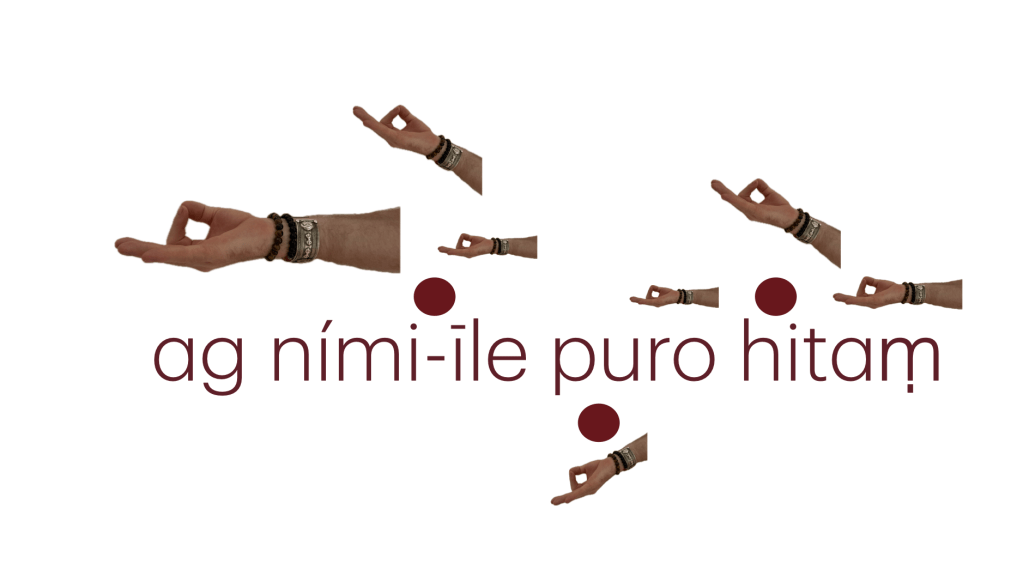
The Vedic hand gestures go with the first line of the Mantra
Shake Meditation with Chanting
After the mantra has been learned in stillness, it can also be brought into movement. One of the most direct and vital ways to do this is through shake meditation combined with chanting. In this practice, the body is allowed to loosen, vibrate, and gently shake, while the mantra is voiced in a simple rhythm over three exhalations. This creates a powerful union of breath, sound, and bodily release.
The shaking is not meant as a performance, nor as a forced exercise. It is a way of allowing the body to become more porous, more alive, and less controlled by habitual tension. Many people carry layers of holding in the shoulders, chest, belly, jaw, and pelvis. When the body begins to shake in a natural and relaxed way, these layers can begin to soften. The energy of the mantra then no longer stays only in the mouth or in the head, but starts to move through the whole organism.
In this practice, the mantra is divided over three exhalations. This gives a natural rhythm and prevents strain. The first exhalation introduces the mantra and sets the movement. The second exhalation deepens the vibration and allows the shaking to become more fluid. The third exhalation completes the cycle and ends in a prolonged humming resonance, a soft mmmmm, which lets the sound spread through the chest, throat, skull, and subtle body. In this way, the mantra is not only spoken, it is embodied.
The long humming at the end is especially valuable. It gathers the movement, settles the mind, and turns sound into resonance. Instead of merely repeating words, one begins to feel the mantra as vibration. This can help the practitioner enter a state in which chanting, shaking, breathing, and awareness become one continuous field. The body is no longer something separate from the prayer. It becomes the instrument of the prayer.
To begin, stand with the feet comfortably apart, the knees loose, and the spine relaxed but upright. Let the arms hang naturally or remain free to move as the body wishes. Start by allowing a gentle shaking from the legs upward. The movement should never be harsh. It can be subtle, springy, trembling, or wave-like. The important point is that it remains natural and unforced. The body should feel increasingly free, not increasingly controlled.
Once the shaking has found its rhythm, begin the mantra. Chant the first part on the first exhalation, then allow a small, easy inhalation. Chant the second part on the second exhalation, again followed by a natural inhalation. Then chant the final part on the third exhalation, extending the last sound into a long, humming mmmmm. After that, inhale softly and begin the next cycle. In this way the practice develops its own pulse, movement, sound, breath, movement, sound, breath.
This method is good for you for several reasons. First, it helps discharge accumulated tension and restlessness. Shaking can free the body from dullness and internal contraction. Second, it anchors the mantra in direct bodily experience. The mantra is no longer only mental repetition, but something felt in the flesh, the nerves, and the breath. Third, the combination of rhythmic movement and vocal resonance can help quiet discursive thought. It gives the mind a single channel, breath, mantra, vibration. This often creates a state of clarity, emotional release, warmth, and inward openness.
It may also support a deeper sense of integration. Some spiritual practices move upward too quickly and leave the body behind. Shake meditation with chanting does the opposite. It invites the body into the practice from the beginning. It allows prayer or mantra to descend into the muscles, bones, fascia, and breath. The practitioner may begin by shaking the body, but after some time it can feel as if the mantra itself is shaking, cleansing, and awakening the body from within.
For some, this practice brings joy and aliveness. For others, it brings grounding, purification, or emotional softening. At times it may feel invigorating, at other times deeply devotional. The exact experience is less important than the sincerity of the practice. One should not aim at dramatic effects, but at openness, rhythm, and receptivity. Let the body shake, let the breath carry the mantra, let the resonance spread naturally.
In this way, shake meditation with chanting becomes more than a technique. It becomes a living form of inner alignment. The body is loosened, the breath is deepened, the mantra becomes vibration, and the whole being is gently tuned to a more vital and luminous state. When practiced regularly, it can help dissolve inner heaviness, increase energetic flow, and make the practitioner feel less divided. One becomes more present, more embodied, and more available to the subtle power of the mantra.
The essence of the practice is simple, shake, breathe, chant, resonate, and allow. Over time, this simplicity can become a doorway to deep transformation.
 breath4balance