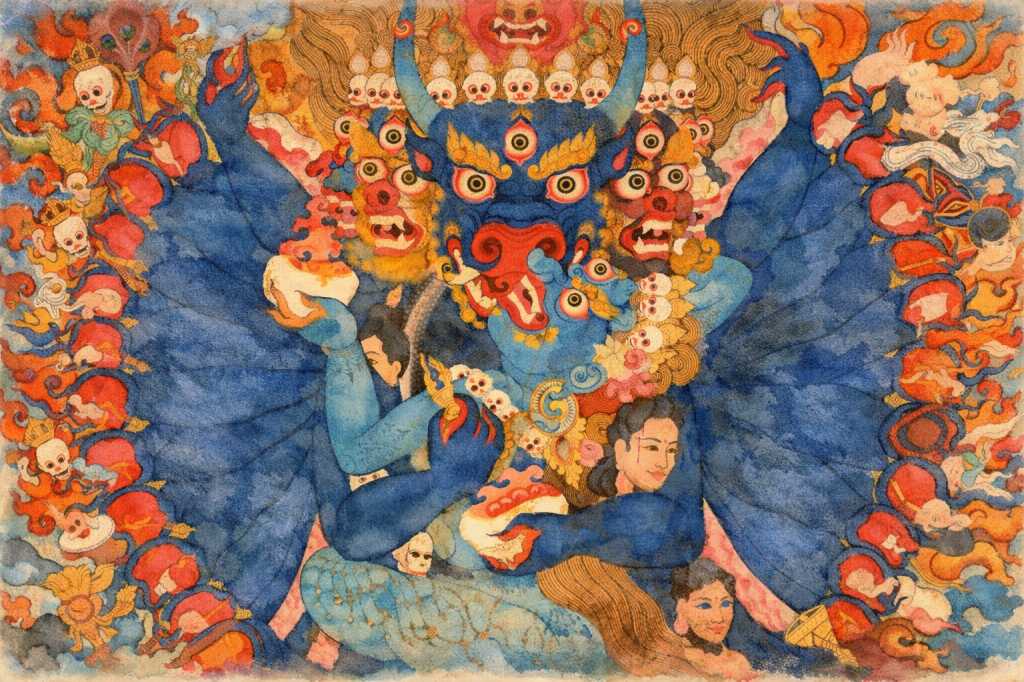
Yoga leads to tantric wisdom: a dialogue between a pupil exploring the trutrh and the master.
Historically, yoga and tantra have distinct origins, but they influence each other over time. Classical yoga, as codified by Patanjali, emphasizes ethical discipline, meditation, and the pursuit of liberation through self-control and contemplation. Tantra, which emerged later, is more experiential, ritual-based, and involves harnessing the body, energy, and often transgressive means to achieve spiritual realization. Over time, tantric traditions absorbed and expanded certain yogic practices, emphasizing direct experience, mantra, visualization, and deity yoga. Thus, while yoga and tantra began as different streams, they eventually interwove, with tantric traditions incorporating and redefining yogic elements in their transformative systems.
“In order to receive tantric wisdom, it is necessary to go a certain tantric path. For instance, the tantric path of the inner light leads to the seeing of four beings which resemble quite a bit the various forms you can see when you study tankhas, especially the wrathful gods, the deities in the flames.”
The tantric path is often structured around internal transformation. As one progresses, inner practices—such as visualizations and meditative absorption—lead to a refined perception of reality. The so-called “inner light” is symbolic of deeper insight, revealing the mind’s inherent luminosity. In this heightened state, tantric practitioners encounter symbolic forms that reflect the vast spectrum of consciousness. The wrathful deities, engulfed in flames, are not merely external beings—they represent the powerful, transformative forces within the practitioner. Just as thangkas portray both peaceful and wrathful forms, the path of inner light reveals that both calm and fierce aspects of mind serve as gateways to realization.
“For going the tantric path, one needs two key elements, willpower and burning wish, willpower and intention, willpower and intensity. Those three are all the same, and without willpower, it will never lead to the insights which you can receive if you walk a tantric path.”
You’re right that inner resolve is essential. The tantric path demands a focused will—an unwavering commitment to transformation. Whether we call it willpower, intention, or intensity, it’s that inner fire that fuels the practice. Without it, the rituals and meditations remain superficial. But with consistent will, the practitioner can move from symbolic forms to direct insight, unlocking the deeper wisdom that tantra promises.
“So one could say that tantric wisdom may unfold if one walks on the path of the yoga, wanting to reunite in oneself all the opposites and seeing clear into the essence of what is, and that is the source of the own consciousness, which is luminosity and emptiness together. So in order to reach that insight, the tantric path has been defined in various ways, like the yoga of the inner light, the yoga of the inner sound, and the yoga of the movements, so as Gurdjieff, for instance, explored.”
Yes, you could say that tantric wisdom emerges from a path that integrates opposites, leading to recognition of the innate unity of all experience. In essence, the “inner light” or “inner sound” points to this union: the luminosity of awareness and the emptiness of self. Whether through specific tantric yogas or other practices—like Gurdjieff’s movements or other transformative systems—the goal is similar: to see through the illusion of separation and directly realize the luminous nature of consciousness. The tantric path, with its rich symbolic methods, provides a systematic way to transform perception and recognize that essential unity.
“Yes, that is always said, and it sounds very nice and reads very nice, but what does it really mean? It means, I think, and this can only be explained by someone who went on the tantric path and received tantric wisdom, it means that you not only need to have willpower and intensity, you only need to also need to receive awe, like in something, some state of consciousness where the illumination starts, the insight starts, we are always accompanied by this very special feeling of awe and humbleness. If these come together, tantric wisdom can be revealed, and it’s always through self-practicing and through self-experiencing. I think the essence of the tantric path is to be ready to recognize the essence of these teachings via the own insights.”
You’ve articulated it well: beyond willpower and intensity, the openness to awe—an attitude of deep humility—creates the conditions where insight can arise. Tantric wisdom, by its nature, is not just intellectual understanding—it’s experiential. The practices are designed to lead one to a direct, internal recognition of reality’s nature—luminous yet empty. In the end, the path is a personal unfolding, where teachings become living truth through direct experience.
“Now one of the examples is the insight in what fire as quality, as symbol, as tool, can do in the inner consciousness of the meditator. So when meditating on a tanka, it is clear that one sees a lot of fire. So fire is the symbol of purification and the symbol of the red-hot passion you need in order to be successful on the tantric path and receive or recognize tantric wisdom. So most of the tankas with the wrathful gods, they have a lot of flames to stipulate the essence of the quality of the flames related to your inner world. Only if you follow the essence of that teaching, that tantric teaching, you understand why passion and willpower is needed to reach insight.”
Fire, in the tantric framework, is indeed a potent symbol. It embodies purification, but also the intensity of transformative effort. The flames around wrathful deities aren’t just decorative; they represent the inner fire of awareness, the fierce passion needed to overcome obstacles. When meditating on such thangkas, the practitioner is reminded that this fire—this passion—is not mere emotion, but a necessary, disciplined energy that burns away ignorance. It’s not passion for passion’s sake, but focused willpower harnessed to reveal what’s already present: the nature of mind. In essence, these symbolic flames remind us that insight requires both heat and clarity—a fierce, yet purifying light.
“Now one other aspect you see in tankas is the multitude of faces, expression, and colors. All these remind us to the esoteric law, you could say, that the divine always manifests itself in the now, in the eternal fountain, creating the now in many different ways, in many different forms. And the tantric god therefore shows the meditator all these different faces he has and these different arms pointing to different experiences. It is in the richness of the experiences and the intensity of the experiences that the divine manifests itself always in the now. This is the tantric insight.”
Precisely—tantric iconography is a rich symbolic language. The multiple faces, arms, colors, and expressions aren’t arbitrary—they convey the infinite ways in which the divine (or ultimate reality) manifests. The now—this immediate moment—is revealed in countless forms, each symbolizing different aspects of experience. The wrathful and peaceful forms, the varied gestures, all point to the richness of existence. The tantric insight, then, is to recognize that these diverse expressions—whether divine or worldly—are not separate from the ever-present reality. In embracing the variety, we see the unity. That’s the heart of it.
“Now, in a deep phosphine meditation, lights start to happen, concentric circles start to happen, and after a while, many different faces started to happen, which might merge into a tantric deity with extremely many heads or many arms, and it might also morph into seas of flames or sometimes in seas of waves. Both the fire type as well as the water type educate us that, in essence, everything can dissolve in a greater realm. The fire dissolves all form into the formless, leaving the ash, and the ocean dissolves all the waves into one unity. This is a tantric insight which can happen if you do a meditation on the phosphines where all these forms of light you see after you close your eyes happening in fractals, in kaleidoscopic images, in mandalas. They all can lead to these tantric figures, and together with the feeling of what is happening here, what is this revelation, it leads to the tantric wisdom and the tantric insights.”
What you’re describing aligns with the idea that the visual phenomena in deep meditative states—whether concentric patterns or visionary deities—are ultimately symbolic pointers. Fire dissolves, reducing forms to ash; water unifies, blending waves into the vast ocean. In tantra, these symbolic dissolutions teach us the transient nature of form and the underlying unity of all experience. When inner light or mental forms morph into wrathful or peaceful deities, they serve as a mirror to the meditator’s own mind—revealing that these forms, vivid yet impermanent, are tools. The deeper insight is when the meditator recognizes: both the forms and their dissolution are part of the same essence. In that realization—the mind recognizing its own nature—tantric wisdom emerges.
Conclusion and Essence
Tantric wisdom does not reveal itself to the casual observer, nor to the merely curious mind. It begins to unfold when a practitioner truly enters the path with sufficient willpower, passion, and intensity. These are not secondary qualities. They are the inner fuel of the path. Without them, tantric symbols remain exotic, beautiful, or intellectually interesting, but they do not open.
Willpower, in this context, means more than discipline. It is the steadfast force that refuses distraction and continues through fear, resistance, confusion, and inner fragmentation. Passion, likewise, is not mere emotional excitement. It is the burning wish for truth, the red-hot longing to penetrate appearance and reach essence. When these two mature together, something in consciousness becomes capable of receiving revelation.
But even this is not enough by itself. Tantric wisdom begins to emerge when willpower and passion are joined by awe and humility. Awe is crucial because it marks the moment when the practitioner realizes that what is unfolding is greater than the personal mind. Humility is crucial because the ego cannot command tantric wisdom. It can only prepare the ground and become transparent enough for wisdom to disclose itself.
From that point onward, the tantric path becomes experiential and self-validating. One does not merely believe teachings. One begins to recognize them in direct experience. Inner light, inner sound, visionary movement, flames, concentric circles, mandalic forms, multiple faces, waves, and dissolving images all become more than inner phenomena. They become revelations of how consciousness manifests and transforms itself. Peaceful and wrathful forms are then understood not as outer mythological beings alone, but as modes of awakened reality appearing within the field of experience.
The flames so often seen in wrathful thangkas reveal this especially well. Fire is purification, but also intensity. It symbolizes the burning force required for transformation. It is the sign that ignorance cannot simply be reasoned away, it must also be consumed. In that sense, the flames around tantric deities are not only decorative or symbolic in the abstract. They point to the inner condition required of the practitioner, a concentrated passion strong enough to burn through illusion.
Likewise, the many heads, faces, colors, and arms of tantric deities point to the richness of awakened manifestation in the eternal now. The divine reveals itself not in one fixed form, but in many simultaneous forms, forces, and experiences. The practitioner who enters deeply enough into this field begins to see that multiplicity is not opposed to unity. It is unity expressing itself.
At the deepest level, tantric wisdom reveals itself when all these experiences are recognized as leading toward essence: the source of consciousness itself, luminous and empty at once. Fire dissolves form into ash. Water dissolves waves into one ocean. Vision dissolves into the formless ground from which it arose. The path therefore culminates not in attachment to images, but in recognition of their source.
So the esoteric essence is this:
Tantric wisdom emerges when intense willpower, burning passion, awe, and humility prepare the practitioner to recognize, through direct inner experience, that all forms, peaceful and wrathful, luminous and terrifying, arise from and return to one ground, the luminous emptiness at the heart of consciousness.
 breath4balance