At our site we not only do meditation, but we are also linked to our farm in Algarve, Quinta Quixote, where we practice the results of meditation and the rise and impact of the meditative mind in real life and the world. We do that together with Wwoofers, people who lke to help and work on organic farms.
We wanted to create the most sustainable and “bee-centric” form of apiculture in the world. For that we recreated and resuscitated the ancient art of making a beehive from cork.
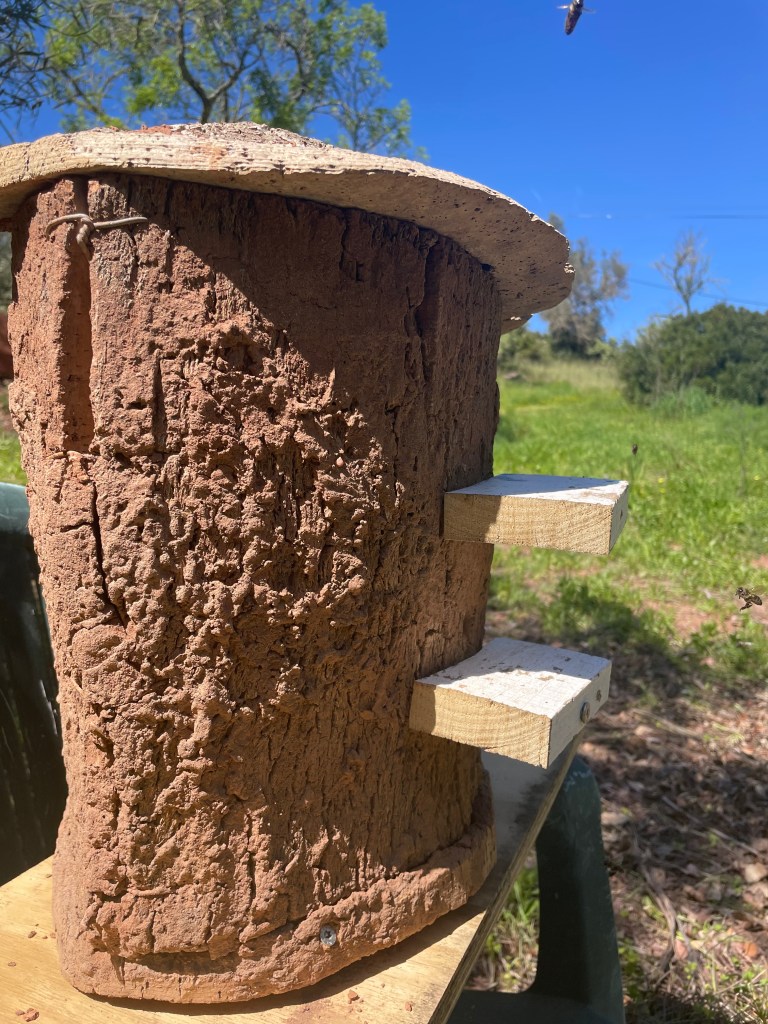
O Cortiço: A Living Relic of the Bee World
This is a hive in the Alentejo that has not changed in two thousand years. You can find it lon our land at Quinta Quixote, a rough cylinder of cork-bark with a cork hat, humming.
The Wood That Breathes
Before there were Langstroth boxes, before there were frames and smokers and wax foundation sheets, before modern beekeeping invented itself: Portuguese beekeepers looked at the cork oak and understood something quietly profound: nature had already built the perfect home for a bee colony.
The cortiço is not a manufactured object so much as a harvested one. A beekeeper would select a mature slab of cork bark from Quercus suber, curl it into a cylinder, seal it with clay or dung, cap it with a piece of slate, and crown the whole thing with a little thatched hat of heather or rye straw. The bees move in and do the rest : building their own comb directly onto the inner walls, following no plan but their own.
What makes cork so extraordinary as a hive material is the same property that makes it extraordinary as a wine stopper or a floor tile: it is simultaneously dense and porous, firm and forgiving. Cork cells are air-filled prisms that resist heat, resist moisture, and breathe just enough to let a colony regulate its own atmosphere.
In the blistering July of the Alentejo plain, where temperatures climb past 40°C, a colony living inside cork expends a fraction of the energy that a colony in a pine box would spend fanning and evaporating water to cool itself. That saved energy goes back into the work of the hive, into foraging, into brood rearing, and into the slow, accumulation of honey.
The Bee’s Own Architecture
Inside a cortiço, something remarkable happens that rarely occurs in modern hives: the bees are left to build entirely on their own terms.
In conventional beekeeping, colonies are given pre-stamped wax foundation sheets that dictate the size of every cell. It is efficient for the beekeeper, but it is a constraint the bees never asked for. In a cortiço, the comb hangs free, and the colony calibrates its cell sizes based on what it needs, larger cells for drones, smaller worker cells, and crucially, cells small enough to make life harder for Varroa destructor, the parasitic mite that has devastated honeybee populations around the world since the 1980s.
This is not a minor footnote. The global collapse of managed bee colonies, driven overwhelmingly by Varroa and the viral diseases it vectors, represents one of the gravest threats to agricultural food security on the planet. Roughly one third of everything we eat depends on pollination, and managed honeybees are our primary pollinator for dozens of staple and cash crops. When colonies fall, harvests shrink: almonds, apples, blueberries, melons, sunflowers. The list is long and it intersects with everything on our tables.
The cortiço, in its ancient stubbornness, holds a clue. Colonies in natural cavities, cork, hollow trees, rock crevices, have been self-selecting for Varroa-resistant traits for decades now, in ways that intensively managed hives cannot. Bees that build smaller cells, bees that express hygienic grooming behaviour, bees that synchronise brood breaks, these traits survive in populations left to their own rhythm. Traditional beekeeping, almost by accident, becomes a living conservation programme.
The Beekeeper’s Patience
The cortiço is not an easy hive to work with. There are no removable frames, no easy way to inspect comb for disease, no clean method of extraction short of destroying what the bees have built. Traditional Portuguese beekeepers harvested from the top at night, cutting combs and leaving the brood nest below, a slow, imprecise practice that no modern apiculture certification would sanction.
And yet this difficulty is itself a kind of wisdom. When inspection is difficult, beekeepers learn to read a colony from the outside, by the smell at the entrance, the pitch of the hum, the flight traffic on a warm morning. Based on accumulated observational knowledge, passed across generations the way a dialect or a bread recipe is passed: informally, bodily, between people who share a landscape.
That knowledge is now endangered. As the beekeeping profession ages and standardises around movable-frame hives, the population of people who can manage a cortiço and read a colony through cork is shrinking fast. When those practitioners go, something is lost that no manual can fully recover. We decided to re-introduce this beehive on our land. That is why we activated this beehive making. But we do nbot need to bother about many things related to honey-makingm, because we leave the bees their own honey.
Why It Matters Now, More Than Ever
We are living through what ecologists describe as an insect apocalypse, a quiet haemorrhage of invertebrate biomass driven by habitat loss, pesticide pressure, monoculture farming, and climate disruption.
In southern Portugal, the picture is mixed: the montado, that extraordinary mosaic of cork oak woodland and grazed pasture, remains one of the most biodiverse landscapes in Europe and one of the most important refuges for both wild and managed bees. The cork industry itself, that slow, 9-year cycle of bark harvest, keeps the montado economically viable, and the montado keeps the bees.
The cortiço sits at the centre of this web. It is made of the cork oak, it houses bees that pollinate the wildflowers that stabilise the pasture that supports the oaks. It is a closed loop, self-renewing, ecologically embedded in a way that modern commercial beekeeping, shipped in pallets of boxes to wherever the almond bloom demands, fundamentally is not.
Reviving or simply preserving the practice of cortiço beekeeping is therefore not nostalgia. It is a hedge against a fragile monoculture of apiculture. It is a repository of bee genetics that have adapted to this specific landscape over centuries. It is proof, standing quietly in the shade of a cork oak, that the most sustainable technology is sometimes the oldest one.
A Note on Our Project
We came to this hive form the long way around, through the questions that modern beekeeping kept failing to answer. Why are our colonies weakening? Why do bees in tree cavities outlast bees in managed boxes? What does a truly bee-centred approach to apiculture look like? And we do not want to take its honey, it is pure to support the bees.
The cortiço does not answer every question. But it asks better ones. And sometimes that is where the real work begins, not with new tools, but with very old ones, held carefully in both hands.
We are expanding our project with more cork beehives. Just for fun and to help the bees.
 breath4balance