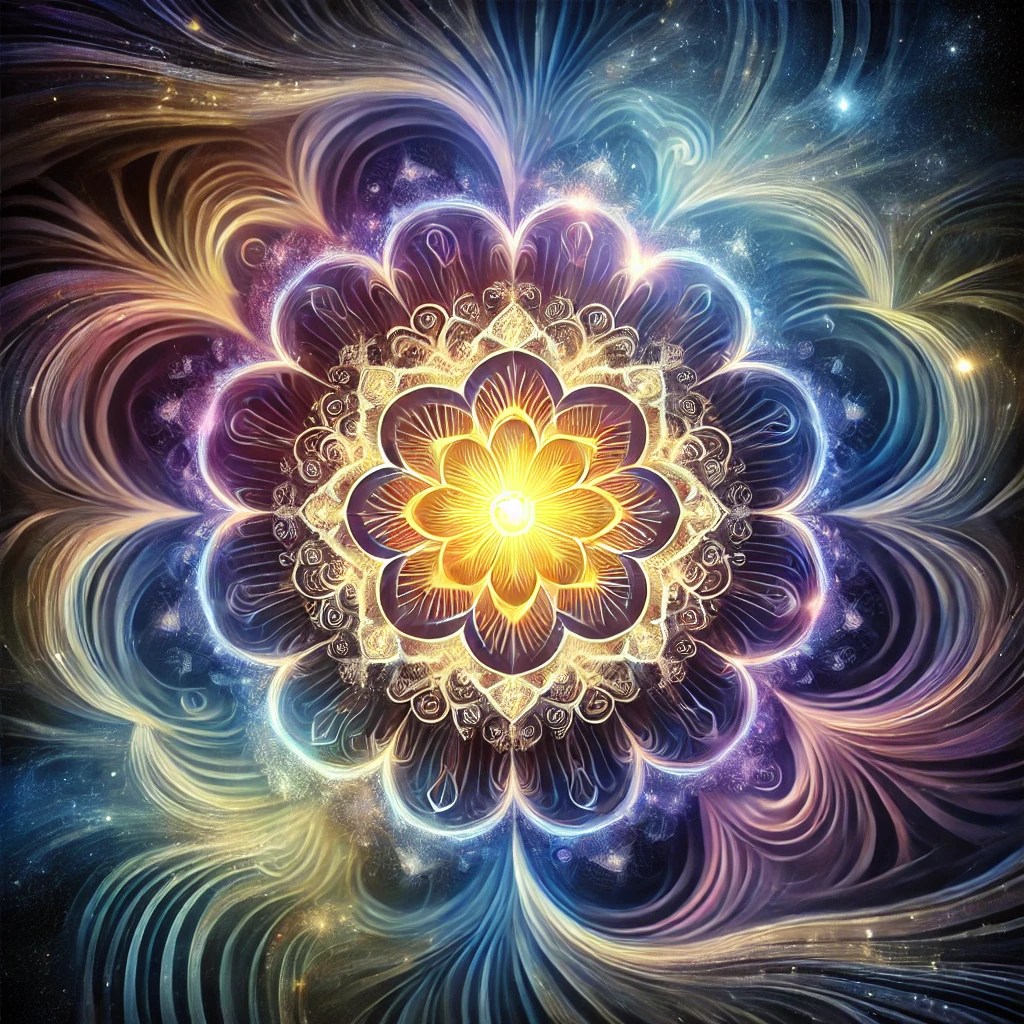
In the quiet of meditation behind the closed eyes, with the external world receding and the gaze turned inward, there arises a surprising phenomenon: the spontaneous formation of mandala-like patterns within the mind’s eye. These luminous structures, intricate and dynamic, seem to echo the sacred geometry found in spiritual art across cultures, from Tibetan thankas to Hindu yantras and beyond.
I first encountered this in my own meditation practice, during extended periods of focusing on the inner light. As I closed my eyes and settled into stillness, the usual play of phosphene-like flashes and streaks began to coalesce into something more organized. Points of light connected into lines, lines into spirals, and spirals into complex, radiating forms—mandalas of light unfolding and dissolving, as though painted by an unseen hand.
The Inner Light and Sacred Patterns
These mandala-like structures are not just visual artifacts; they are deeply symbolic and resonate with the essence of inner experience. In many traditions, mandalas represent the universe, the self, or the path to enlightenment. When such forms emerge during meditation, they act as guides, pointing to the unity and interconnectedness underlying all existence.
The process begins with the phosphenes—those dynamic patterns of light that appear when the eyes are closed and the mind relaxes its grip on external stimuli. What might initially seem chaotic or random takes on rhythm and symmetry as the meditative state deepens. The circles, spirals, and radiating forms reflect the fundamental harmony of the inner light, a light not bound by the limitations of the physical world.
In Tibetan Buddhism, mandalas are seen as maps of the cosmos and the mind. Their spontaneous emergence in meditation suggests that these sacred patterns are not just external symbols but intrinsic to the structure of consciousness itself. They emerge naturally when the practitioner tunes into the luminous field within, revealing the deep interconnection between the inner and outer worlds.
The Dynamics of Emergence
One striking feature of these mandalas is their fluidity. Unlike static designs on paper or canvas, the mandalas of inner light are alive. They form, expand, rotate, and dissolve, only to reconfigure into new patterns. This dynamic quality mirrors the flow of awareness itself, a continuous interplay of stillness and movement.
During one session, I recall focusing on the central point of light—a single radiant dot at the heart of my vision. As I held my attention, the dot began to expand outward, sending waves of color and geometry cascading toward the edges of my awareness. First came concentric circles, then spirals, then more elaborate designs with intersecting lines and petals, all pulsating with a sense of rhythm and energy.
This dynamism is often described in ancient texts. In tantric traditions, for example, the mandala is not just a static representation but a living experience, a “moving meditation” that reflects the shifting energies of the body, mind, and spirit. The bindu, or central point, serves as the origin of all creation, while the radiating patterns symbolize the expansion of consciousness into infinite forms.
Symbolism and Insight
The mandalas that emerge in meditation carry layers of meaning. At their core, they represent wholeness—the integration of all aspects of the self and the cosmos. The center of the mandala corresponds to the observer, the still point of awareness, while the outer patterns reflect the multiplicity of experiences arising within the field of consciousness.
In my practice, these forms often seemed to resonate with specific states of being. When I felt balanced and calm, the mandalas appeared symmetrical, with smooth transitions between patterns. During times of inner turbulence, they became jagged or chaotic, reflecting the disharmony within. Observing this connection taught me that these luminous forms are not separate from me; they are expressions of my inner state, projected onto the canvas of awareness.
The Pathway to Deeper States
The emergence of mandala-like structures in meditation is not just a fascinating visual experience; it is also a gateway to deeper states of consciousness. Focusing on these patterns can draw the practitioner into profound absorption, where the boundary between self and light dissolves.
In one particularly vivid meditation, I became completely immersed in a mandala of golden light. Its patterns seemed to breathe, expanding and contracting in harmony with my breath. As I focused on its center, the sense of “I” dissolved, and there was only the light—vast, timeless, and all-encompassing.
This experience echoes descriptions from traditions like Dzogchen and Advaita Vedanta, where the ultimate goal is to recognize the non-duality of observer and observed, light and self. The mandalas, in this context, are stepping stones, guiding the practitioner toward the realization of their own luminous nature.
A Universal Phenomenon
The spontaneous appearance of mandalas in meditation transcends cultural and spiritual boundaries. While Tibetan thankas and Hindu yantras provide a visual language for these experiences, similar patterns can be found in the visionary art of other traditions, from the labyrinths of medieval Christianity to the intricate designs of Islamic geometry.
This universality suggests that the mandalas of inner light are not merely cultural artifacts but reflections of something fundamental to human consciousness. They are the shapes of awareness itself, revealed when the mind turns inward and the layers of thought and perception are peeled away.
Embracing the Mandala Within
Meditating on the inner light is a journey into the unknown, a dance with the luminous patterns that arise from the depths of our being. The mandalas that emerge are not separate from us; they are expressions of our own essence, teaching us about the harmony, fluidity, and interconnectedness of existence.
By embracing these patterns—not as objects to control but as phenomena to observe—we allow them to guide us into deeper states of presence and insight. In the stillness of meditation, the mandalas unfold, pointing the way to the ultimate realization: that the light within is the same as the light of the cosmos, and that the patterns we see are the echoes of a universal truth, written in the language of sacred geometry.
This path of inner light is our focus on our Youtube channel, come and visit us!
 breath4balance