Meditating on inner light is an ancient practice that reveals the luminous beauty within the human mind. This journey often begins with the perception of phosphenes, subtle light patterns that emerge with closed eyes or in deep relaxation. Currently I am writing a book on these very special aspects of our and the divine beingnesses. Title: Mandala and Yantra Yoga
The inner path of light towards illumination and the divine

These initial flickers of light, dots, streaks, and clouds, appear as the visual system interacts with the mind’s neural activity. While they may seem random at first, with sustained focus and deepened meditative states, these patterns transform into breathtaking displays of fractals and, eventually, intricate mandalas and yantra-like forms, representing profound spiritual insights.
The experience begins with the spontaneous appearance of phosphenes, a play of random light that arises naturally in the absence of external stimuli. These might appear as glowing dots, gently shifting clouds, or faint sparks of energy that seem to shimmer in the mind’s eye. Early meditators often describe these phenomena as chaotic, unpredictable, and fleeting. Yet, this initial stage is the foundation for the more structured and meaningful patterns that emerge later.
As meditation deepens, the random appearance of phosphenes gives way to fractal-like patterns, self-similar designs that repeat across scales. The mind begins to impose an organic structure on the light, resulting in spirals that expand and contract, lattices that form shimmering grids, or branching shapes reminiscent of tree roots or veins. These fractals reflect the inherent order within the mind, echoing the mathematical principles found throughout nature. Their presence evokes awe and a sense of connection to the underlying harmony of existence.
With continued practice, these fractals evolve into mandalas, sacred geometric forms that embody unity and balance. These mandalas often appear as circular designs radiating outward from a luminous center, layered with concentric shapes, triangles, and patterns that pulse with life. Colors emerge—deep blues, radiant golds, vibrant greens—shimmering and shifting like a kaleidoscope. Unlike the earlier patterns, mandalas carry a sense of wholeness, representing the interconnectedness of all things. They are dynamic, ever-changing, and yet deeply harmonious, reflecting the unity within the apparent diversity of the universe.
At the pinnacle of the experience, mandalas refine further into yantras, precise geometrical forms imbued with spiritual significance. These yantras, often seen in the Tibetan and Bon traditions, include interlocking triangles, lotus-like petals, and intricate grids that symbolize cosmic principles. Unlike the flowing nature of mandalas, yantras have a crystalline clarity, glowing with an inner light that feels eternal and boundless. Witnessing these sacred patterns is said to align the mind with the deeper truths of existence, offering glimpses of divine order and balance. And from those Yantra’s light figures might happen to manifest.
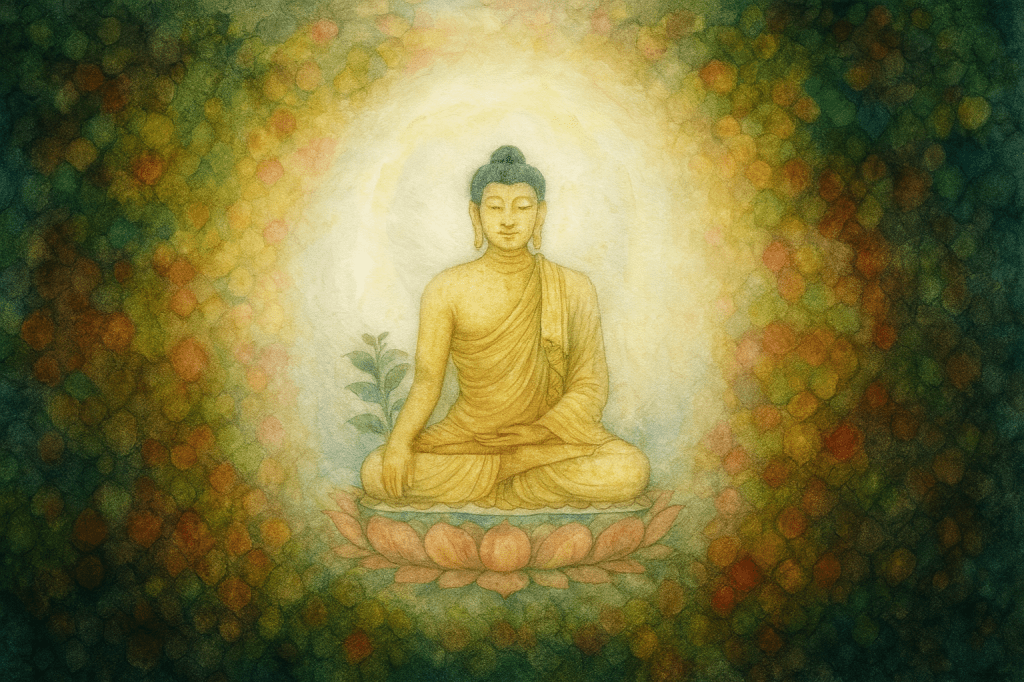
The transformation from random phosphenes to fractals, mandalas, and yantras mirrors the journey of meditation itself. It reflects a movement from chaos to order, from fragmentation to wholeness. Tibetan meditation masters often describe these luminous visions as manifestations of the clear light, the intrinsic radiance of consciousness that underpins all experiences. The colors and shapes that emerge are not just personal phenomena but universal symbols, arising from the collective reservoir of human consciousness.
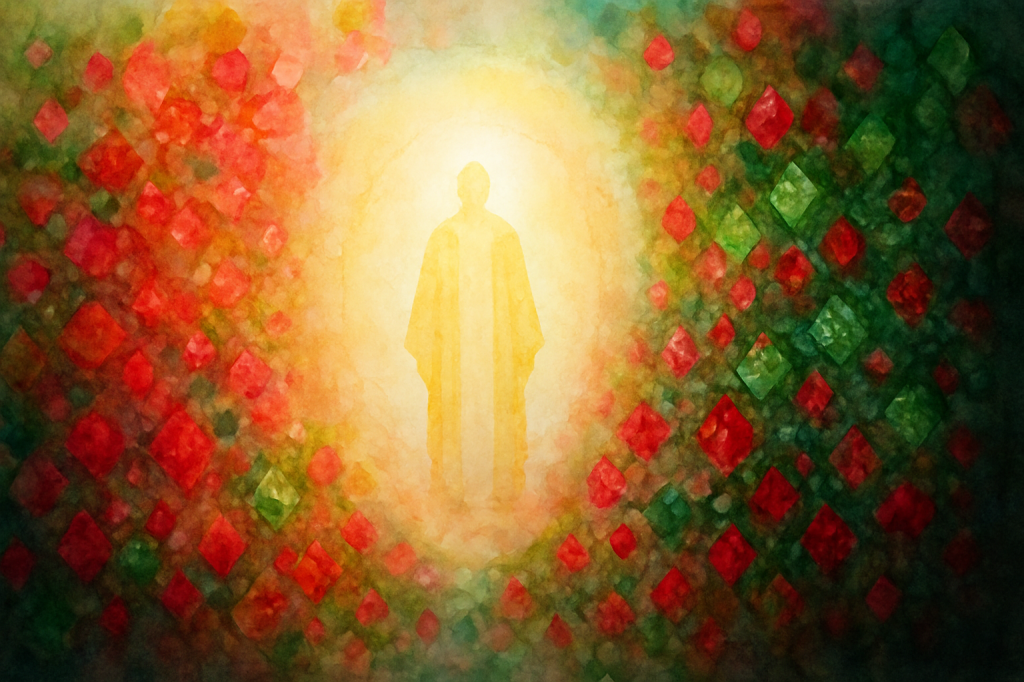
This journey requires patience, openness, and trust. By focusing inward and observing the patterns with a calm and steady mind, meditators can witness the emergence of these sacred forms. Practices such as mantras and mudras amplify the clarity and intensity of the inner light, while a relaxed body and mind provide the ideal canvas for these luminous phenomena to unfold.

The perception of mandala-like structures during meditation is a profound spiritual experience. It connects the practitioner to the boundless beauty of their inner world and the cosmic harmony of existence. These patterns, whether they take the form of fractals, mandalas, or yantras, remind us of the light that resides within, a light that reflects the infinite potential and unity of all creation. In this luminous journey, one discovers that the inner light is not separate from the external universe—it is the essence of both.
have you ever asked yourself why it is
0:03that while you meditate already many
0:05many years you do not reach the states
0:09of absolute tranquility and
0:13Enlightenment this is because you take
0:16yourself
0:17serious this is because there is not
0:22enough
0:24commitment not taking yourself serious
0:27and commitment
0:30seems to be contradictory but they are
0:32not if you start being committed to
0:37really wanting to see beyond the veils
0:40of
0:41Illusion then you can
0:44find the way to it only if you don’t
0:48take yourself
0:49serious the path of Mandela meditation
0:55or the path of inner light is a path we
0:59attic five designed to help you to reach
1:02the state of at Bliss it is not for
1:07nothing that mandelas and Yas are the
1:11utmost
1:12expressions of the harmony the symetry
1:16and the ultimate balance in nature in
1:19the universe and In
1:21Yourself by meditating on the lights
1:25behind the closed eyes you will find the
1:28PATH into the m
1:30you will understand why the Tibetan
1:33Masters went sitting in caves in dark
1:37caves for many years in order to find
1:41the path of inner light towards the
1:43ultimate expression of the mandelas and
1:46the
1:47Yas this path is not a very esoteric
1:51path but the path extremely nearby you
1:55only need to start walking it and our
1:58Channel makes that possible because we
2:00have collected many
2:03meditation techniques related to finding
2:07the Inner Light

 breath4balance