The Ancient Use of Black Mirrors
Black mirrors have long been used in mystical traditions for scrying, self-reflection, and deep meditation. Unlike regular mirrors, which reflect clear, tangible images, a black mirror absorbs light, creating a portal-like depth that allows the mind to enter altered states of consciousness. Throughout history, shamans, mystics, and seers have used black mirrors for divination, contacting the subconscious, and exploring visions beyond the physical realm.
The absence of direct reflection invites us to go beyond the surface, looking deeper into hidden aspects of the self and the fluid nature of perception. In this meditation, we will explore the transformative power of gazing into a black mirror, engaging in a unique practice of self-awareness, inner vision, and energetic attunement.
How to make a Black Mirror?
Historical Origins of Black Mirror Literature
The concept of the black mirror as a literary symbol can be traced back to early esoteric writings and Renaissance occultism. One of the earliest recorded mentions of mirrors as mystical tools comes from the ancient Greeks and Romans, where polished obsidian was used for scrying and prophecy. In ancient Mesoamerican cultures, particularly among the Maya and Aztecs, black obsidian mirrors were used in spiritual rituals and to communicate with deities. The legendary Oracle of Delphi is believed to have engaged in similar visionary practices, interpreting reflections to gain divine insight.
During the European Renaissance, occultists such as John Dee, the court astrologer of Queen Elizabeth I, popularized the use of scrying mirrors for communication with spirits and angels. Dee’s famous obsidian mirror, currently housed in the British Museum, was used for summoning celestial beings and receiving cryptic messages from beyond. The idea of reflective surfaces as gateways to other dimensions was a recurring theme in Renaissance magic and alchemy, often seen in grimoires and mystical manuscripts.
In literature, dark reflections and enchanted mirrors began appearing in medieval alchemical texts and early Gothic fiction. The idea of a mirror as a gateway to otherworldly knowledge was explored in stories of Faustian bargains, haunted reflections, and supernatural visions. The Brothers Grimm recorded folklore about magical mirrors in fairy tales, reinforcing the idea that mirrors could reveal deeper truths or hidden dangers. With the emergence of Romanticism and Symbolism in the 19th century, writers such as Edgar Allan Poe and Charles Baudelaire incorporated black mirror-like imagery to explore themes of self-destruction, duality, and hidden truths.
The 20th century saw the rise of modern surrealist literature, where mirrors, particularly black or distorted mirrors, were employed as metaphors for psychological introspection, altered reality, and existential dread. This concept was later expanded in speculative fiction, dystopian narratives, and cyberpunk literature, leading to the modern cultural resurgence of the black mirror as a literary and philosophical device.
Guided Black Mirror Meditation
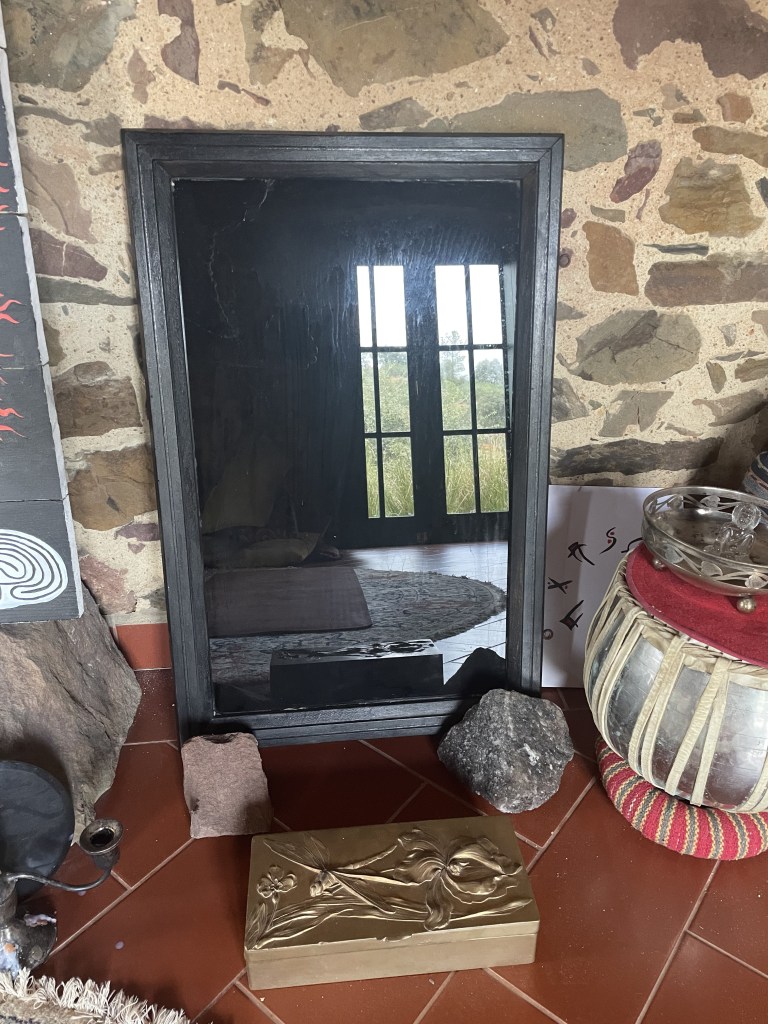
This is my new black mirror, and in this session, we will engage in a Black Mirror Meditation, a direct practice with the mystical properties of the black mirror.
A black mirror is simply a piece of glass with a black-painted backside, carefully framed to provide a window into altered perception. By gazing into this mirror, we bypass the ordinary visual field and enter a state of expanded awareness.
Find a quiet place, sit comfortably, and position yourself before the black mirror.
Step 1: Entering the Stillness
- Relax your body.
- Breathe deeply, letting each exhale release tension.
- Keep your posture steady yet relaxed.
Step 2: The Gaze of Awareness
- Look directly into the eyes of your own reflection in the black mirror.
- Keep your gaze soft, yet focused on the space between your eyes.
- Be aware of this space within yourself and within your reflection.
Step 3: The Shift in Perception
- As you remain focused, within 10-30 seconds, you will begin to notice subtle changes.
- Colors may start to appear around your silhouette, greenish, purplish, or radiant hues.
- Your reflection may seem to pulse, shift, or ripple as if moving in waves.
Step 4: Entering the Mystical Field
- You may start seeing flame-like auras forming around your image.
- Your face may shift, showing expressions you are not making.
- Unknown faces or images may appear, some from memory, others seemingly from beyond.
- The mirror becomes a fluid space, revealing what lies beyond habitual perception.
Step 5: Full Immersion in Presence
- Keep breathing naturally, soft, rhythmic, and aware.
- Stay relaxed, non-reactive, open to the experience.
- Allow what happens to unfold, every individual’s experience will be unique.
Closing the Meditation
After several minutes, or longer if you choose, slowly close your eyes and take a deep breath. Sit for a few moments in stillness, absorbing the experience. If needed, gently touch the ground or place your hands on your body to reconnect with physical reality.
For some, a soft hum or mantra can help integrate the energy shifts experienced during the session.
This practice is not about seeing specific things but about allowing vision to arise naturally, revealing the depth of consciousness beyond everyday perception. The more time you devote to this practice, the deeper and more profound the revelations become.
A black mirror is not just a tool, it is a gateway to inner dimensions of awareness. By engaging in this meditation fully and consciously, you may come to understand the immense power of this practice. Each session will reveal new layers of perception, guiding you deeper into the mysteries of self and being.
More on the History of Black Mirrors
The Ancient Use of Black Mirrors
Black mirrors have long been used in mystical traditions for scrying, self-reflection, and deep meditation. Unlike regular mirrors, which reflect clear, tangible images, a black mirror absorbs light, creating a portal-like depth that allows the mind to enter altered states of consciousness. Throughout history, shamans, mystics, and seers have used black mirrors for divination, contacting the subconscious, and exploring visions beyond the physical realm.
The absence of direct reflection invites us to go beyond the surface, looking deeper into hidden aspects of the self and the fluid nature of perception. In this meditation, we will explore the transformative power of gazing into a black mirror, engaging in a unique practice of self-awareness, inner vision, and energetic attunement.
Historical Origins of Black Mirror Literature
The origins of black mirrors trace back to the first known handmade mirrors, which were not silver but black. These early mirrors were made of polished obsidian and were found in the upper-class and royal households of ancient Anatolia, in what is now modern-day Turkey. Circular, hand-held black mirrors dating to around 6000 BC have been discovered in Neolithic burial sites at Catal Huyuk. Black mirrors were widely used in the early civilizations of Mesopotamia, including Babylonia, Assyria, Sumeria, and Akkadia, as well as in Persia, Arabia, and Egypt.
By 4000 BC, metal mirrors made of copper and bronze appeared in burial sites throughout the ancient Near East. These early mirrors evolved over time, with innovations that included decorative elements and new materials such as gold and silver. Beyond personal grooming, mirrors held spiritual and religious significance, often dedicated to deities. In ancient Egypt, copper and bronze mirrors were used in daily life, dating as far back as the Archaic Period (3200-2700 BC). These mirrors were carefully protected with covers made from leather, cloth, reed, and wicker. The presence of mirrors in Egyptian tombs, found alongside other essential afterlife possessions, suggests their role in spiritual practices beyond mere vanity.
In other ancient cultures, mirrors were crafted from various materials. The Chinese and Indians developed bronze mirrors, while civilizations in Central and South America used polished stone to create their reflective surfaces. These mirrors were more than just functional objects; they were tools for vision, transformation, and spiritual connection.
Greek and Roman Scrying Practices
The ancient Greeks crafted mirrors of copper and bronze and also practiced a form of water scrying known as lecanomancy, which involved gazing into bowls of water. They believed that the dead possessed deep knowledge of the future and were bound to tell the truth when summoned. Necromancy, the art of communicating with the dead, was considered a serious and sacred practice, often reserved for critical decisions regarding wars, politics, and personal dilemmas. The dead were also consulted to exorcise spirits that haunted the living, requiring negotiations between the summoner and the ghost.
Greek necromancy was performed with the help of intermediaries such as oracles, priests, priestesses, and sometimes sorcerers or witches. The most esteemed oracles resided in remote sanctuaries with subterranean connections to the underworld. The process of summoning the dead, known as katabasis, was complex and involved fasting, purification, and descending into a cave or sacred chamber. Contact with spirits was facilitated through reflective surfaces, altered states of consciousness, and dream incubation practices. Various terms described these sites, including nekuomanteion (prophecy place of the dead), psuchagogion (drawing place of ghosts), and psuchomanteion (prophecy place of ghosts). By the second century, the term psuchopompeion, meaning sending place of ghosts, was in use, later evolving into the Latinized nekromanteion, meaning divining place of the dead.
The Romans adopted Greek divinatory practices, adding their own interpretations. By the first century AD, they developed glass-blown mirrors, but these were rare and not widely used. Instead, mirrors primarily served as tools for official Roman scryers known as specularii, named after the Latin word specere, meaning to look at. The term speculum was used to describe their scrying mirrors, a word still associated with reflective divination today.
The Evolution of Glass and Silvered Mirrors
As glass-blowing techniques spread across Europe, mirrors became more widespread. During the fourteenth century, convex glass mirrors gained popularity, though their reflective quality remained limited. It was not until the Renaissance that artisans developed a method of coating glass with tin and mercury, greatly improving reflectivity. The most significant breakthrough occurred in 1835 when German chemist Justin von Liebig invented a process for applying a thin silver coating to glass, leading to the modern mirror.
Silvered mirrors quickly became objects of folklore and mystery. They were believed to reflect both the body and soul of the gazer, serving as portals to the spirit world and the afterlife. Despite their widespread use, silvered mirrors never replaced black mirrors in the realm of scrying. Black mirrors and other reflective surfaces continued to be favored for divination because they allowed seers to perceive visions rather than their own reflection. In fact, whether using a black or silvered mirror, the most effective method of scrying involved angling the mirror away to prevent seeing one’s own face, creating an open gateway for otherworldly insights.
Shunyam Adhibhu
Further Reading on Black Mirrors:
Baudelaire, C. (1857). Les fleurs du mal [The Flowers of Evil]. Poulet-Malassis et de Broise.
Dee, J. (1591). A True & Faithful Relation of What Passed for Many Years Between Dr. John Dee and Some Spirits.
Guiley, R. E. (2016). The Art of Black Mirror Scrying. Visionary Living, Inc.
Liebig, J. von. (1835). Method of Applying Silver to Glass to Produce Mirrors.
Poe, E. A. (1845). The Raven and Other Poems. Wiley and Putnam.
Shah, I. (1957). The Secret Lore of Magic: Books of the Sorcerers. The Citadel Press.
Wikipedia Contributors. (n.d.). Scrying. Wikipedia, The Free Encyclopedia. Retrieved [date], from https://en.wikipedia.org/wiki/Scrying
Wikipedia Contributors. (n.d.). Catoptromancy. Wikipedia, The Free Encyclopedia. Retrieved [date], from https://en.wikipedia.org/wiki/Catoptromancy
 breath4balance
Pingback: The Neurophysiology and more of Black Mirror Gazing: A Guide to Visionary Perception | breath4balance