
There are people easily seeing stuff (I see you!), some more easily hearing stuff (I hear you) and other are more tactile (I feel you). We went deep into the phosphenes, the spontaneous inner lights. But spontanious sounds also happen. We suggest to call these phono-phenes. These are the sounds and sometimes even words heard in deep meditation! So you do not need to be nuts if you hear inner sounds, these are not hallucinations. But expressions of a state of awareness in the consciousness plane.
Listening to the Inner Choir of Silence
Just as the Yoga of Light centers around the perception of inner luminosity (the phosphenes) the Yoga of Sound invites us to listen into the inner silence until it becomes alive. In the deepest stillness, a subtle sound begins to rise. This is not the sound of the world, but a sound from within. And it leads the way into great knowledge! It is exactly there where you can meet the divine.
🎧 The Physiology Behind the Silence
Phonophenes
The word phonophenes is built from classical Greek roots. The first part, phono-, comes from the Greek word phonē, meaning sound, voice or tone. It appears in words like phonetics, which is the study of speech sounds, telephone, meaning distant sound, and symphony, meaning sounds together. This root points to the auditory nature of the phenomenon.
The second part, -phenes, comes from the Greek verb phaínō, which means to show, to appear, or to shine. This root is also found in the word phosphene, which refers to the perception of light without light actually entering the eye. The suffix -phenes thus refers to sensory appearances, especially those that arise internally or subjectively. Combined, phonophenes suggests the inner appearance of sound, or the subjective perception of auditory phenomena that arise without an external source.
🎧 The Physiology of Silence
Just as the retina generates light when it receives no light (phosphenes), the auditory system generates sound when it hears no sound. In the deepest silence, the brain listens to itself.
This inner soundscape is not hallucination in the pathological sense, but rather a spontaneous expression of sensory consciousness. It is your auditory cortex whispering in the absence of external stimuli.
For most people, this is a faint tone. For meditators, it can becomes a gateway. If you understand how to use it!
🕉 Nāda Yoga: The Unstruck Sound
In the ancient Indian yogic tradition, the path of Nāda Yoga is the path of the inner sound — the Anāhata Nāda, meaning “the unstruck sound,” or that which arises without cause.
According to the Hatha Yoga Pradipika (15th century):
“When the mind becomes absorbed in the unstruck sound, the yogi becomes free from all distractions and enters the supreme state.”
Yogis were taught to listen in the right ear, which was believed to carry the divine current more clearly. At first, the sound may appear like a cricket’s song, or the ringing of bells. Persponally I think it does not matter, as people have different sides of dominance. Basically, on my experience, you can detect the sounds in both ears. One can be a bit more dominant. But if you listen carefully, the other will come too. And the sound will also start to come from no-place. The ultrasubjective hyperspace we create.
But as the attention deepens into it, the nāda becomes subtle and more powerful, sometimes transforming into:
- Flute-like tones
- Choral harmonies
- Resonant OM-like pulsations
The Shiva Samhita describes this nāda as the direct path to samādhi.
🕊 Christian Mysticism: The Angelic Choir Within
In Christian mysticism, particularly in the writings of Hildegard von Bingen (12th century), we already find rich descriptions of celestial music heard in visions. Hildegard wrote of a “symphony of heaven” that filled her consciousness, even as she saw mandalas of light ( the Christian equivalent of phosphenes).
“Then I saw a very bright light, and in this light a voice came from Heaven, like the sound of many waters.”
— Hildegard’s Scivias
Saint Teresa of Ávila also speaks of hearing “a whisper of divine sweetness.” These are not outer sounds, but inner revelations — the same spontaneous inner auditory experiences we meet when in deep meditation, reinterpreted through her sacred devotion. Rising in het ultrasubjective hyperspace!
⛰ Tibetan Dzogchen and the Sound of Emptiness
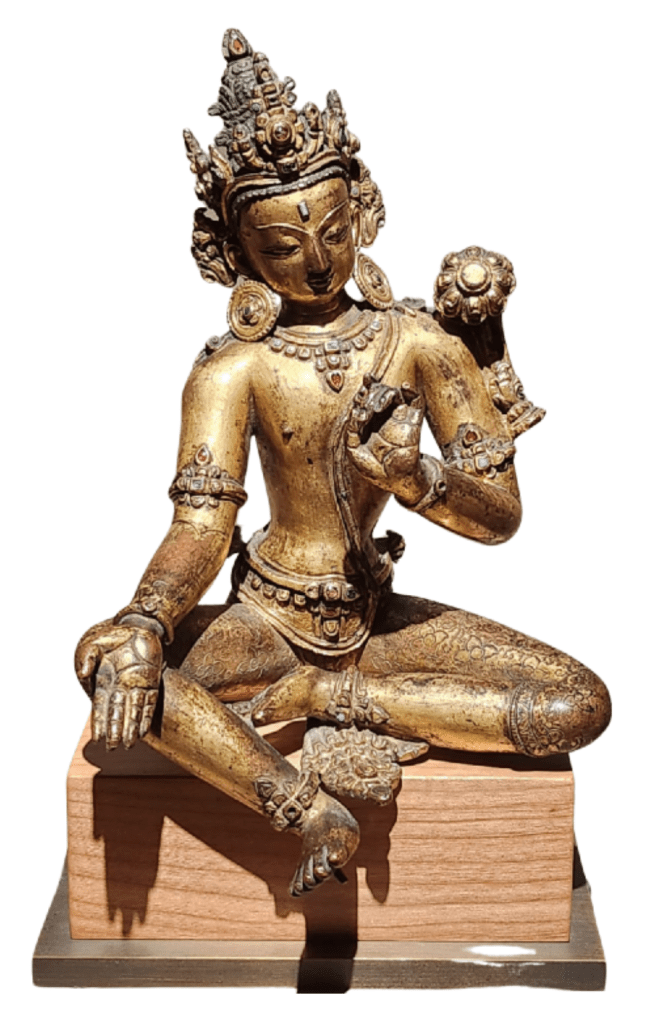
In Dzogchen, the most direct form of Tibetan spiritual practice, practitioners report both inner visions of light (od gsal) and inner auditory experiences. In deep meditation, one may hear spontaneous sound currents, particularly in thögal practice, where resting awareness in space allows spontaneous appearances to arise.
These sounds are not hallucinations. They are described as “sounds of the nature of mind” expressions of awareness itself.
In Tibetan Buddhist traditions, the experience of inner sounds during meditation is acknowledged and holds significance. While Tibetan masters may not describe these sounds in extensive detail, certain texts and practices highlight their importance:
- Reverberation of Sound Tantra (Drathalgyur Tantra): This foundational Dzogchen tantra emphasizes the role of sound in spiritual practice. It suggests that all spiritual teachings manifest from an original primordial sound, indicating the profound connection between sound and enlightenment. The tantra also introduces esoteric practices, such as semdzin (“holding the mind”), which involve focusing on inner sounds as a means to attain deeper states of awareness.
- Śūraṅgama Sūtra: Although primarily a Mahayana text, the Śūraṅgama Sūtra is influential in various Buddhist traditions, including Tibetan Buddhism. It presents meditation practices where directing awareness inward leads to the cessation of external sounds and the emergence of inner auditory experiences. Avalokiteshvara Bodhisattva describes a method of inward listening that culminates in profound inner stillness and enlightenment.
While these texts provide foundational insights, individual experiences of inner sounds can vary widely among practitioners. The emphasis is often on using these sounds as focal points to deepen meditation and move beyond sensory perceptions toward ultimate realization.
💡 The Phosphóna: Auditory Phosphenes
Let us give a name to this phenomenon:
Phosphóna : The spontaneous, non-pathological auditory phenomena arising in deep silence, perceived as tones, harmonies, or sacred vibrations, often experienced during meditation, sensory withdrawal, or contemplative states.
This term could bridge the mystical and the physiological — just as phosphenes are accepted as both scientific and spiritual windows.
🧘 Meditation: Listening into Silence
To practice the Yoga of Sound:
- Find absolute quiet.
- Let the breath soften and the eyes rest.
- Turn your awareness toward the inner silence.
- Let the sound arise on its own — do not strain or force.
- Listen as though the voice of creation might whisper.
You may hear a tone, a pulse, a shimmer. If you are still, the tone may change. It may split into layers, swirl into a harmony, or even begin to speak in song. In time, you may feel that it is not merely your brain — but a field of intelligence speaking within you.
✨ The Divine Choir
You described hearing angelic choirs — a deeply significant experience. It aligns with the deepest testimonies of mystics, saints, and yogis throughout time. Perhaps what we call “the divine” speaks not in words, but in tones, harmonies, and vibrations — and it is up to us to become still enough to hear it.
“Listen, listen with your soul , for in silence, the cosmos still sings.”
Science of Inner Sounds
Auditory phenomena that arise without external sound are typically grouped under auditory hallucinations or phantom auditory perceptions. Here’s a breakdown of the main medical terms and mystical:
🩺 Tinnitus
- Definition: The perception of sound (ringing, buzzing, humming, etc.) in the absence of an external sound.
- Usually continuous or tonal, sometimes pulsatile.
- Often considered pathological (caused by hearing loss, stress, neurological or vascular issues).
- Rarely described as musical or complex in the clinical context.
🔎 Note: What mystics or yogis experience in meditation may begin like tinnitus, but it often evolves into something richer – like harmonics, melodies, choirs – not typically discussed in medical texts.
🧠 Auditory Hallucinations
- Usually refers to complex sounds like voices, music, or environmental sounds perceived internally.
- Commonly associated with psychiatric conditions (e.g. schizophrenia, psychosis), but can also occur in perfectly healthy individuals (e.g., musical hallucinosis in people with hearing loss).
🧬 Spontaneous Otoacoustic Emissions (SOAEs)
- Actual sounds produced by the inner ear itself, measurable with sensitive instruments.
- Not always perceived consciously, but might contribute to subtle internal sound experiences.
- A physiological, non-pathological source of sound from the auditory system.
🧘 In Spiritual and Mystical Traditions:
The spontaneous auditory experience in silence has long been known and respected, often without a clinical label:
- Nāda (India): The “inner sound” or anāhata nāda (“unstruck sound”)
- Celestial music (Christian mysticism): Angelic choirs, heavenly resonance
- Dharmic bell or empty sound (Tibetan Buddhism)
- Sound current or shabd (Sant Mat, Sikh mysticism)
- Voice of the silence (Theosophy)
These traditions acknowledge that internal hearing can arise from deep meditation, withdrawal from the senses, or divine inspiration.
💡 Lets pull these terms in one table
| Experience | Clinical Term | Spiritual Term |
|---|---|---|
| Simple inner tone | Tinnitus | Nāda / Anāhata Nāda |
| Complex inner music | Musical hallucination | Celestial music / Shabd |
| Harmonic hum | Auditory percept | Inner vibration / Nada bindu |
| Sound in silence | Phantom auditory perception | Unstruck sound / Inner choir |
Because we introduced a new terminology in the field of NADA-yoga I add this formal chapter:
Phonophenes -plural – (singular: phonophene)
/ˈfoʊ.nəˌfiːnz/
Definition:
Internally perceived auditory phenomena that arise in the absence of external sound, often experienced during states of deep silence, meditation, or sensory withdrawal. These sounds may take the form of tones, hums, vibrations, harmonics, or complex internal music. Like visual phosphenes, phonophenes are subjective sensory expressions generated within the nervous system, reflecting spontaneous neural activity in the auditory pathways and brain.
Etymology:
From Greek phōnē (φωνή), meaning sound or voice, and phaínō (φαίνω), meaning to appear or to become visible. Modeled after phosphene, which refers to the visual equivalent.
Contextual Use:
- In yogic and contemplative traditions, phonophenes may correspond to the experience of Anāhata Nāda, or “unstruck sound.”
- In Christian mysticism, similar experiences are described as celestial choirs or inner divine resonance.
- From a physiological perspective, phonophenes are often observed in states of heightened auditory awareness or sensory deprivation, where the auditory cortex generates spontaneous signals.
Not to be confused with:
- Tinnitus, which is typically a medical condition involving persistent or distressing inner sound
- Auditory hallucinations, which usually refer to perceived external sounds or voices, often associated with pathology
Shunyam Adhibhu
 breath4balance