William G. Gray and the Inner Light

William G. Gray (1913–1992) was a prominent English ceremonial magician and Hermetic Qabalist. He founded the Sangreal Sodality, a spiritual brotherhood emphasizing personal spiritual development and inner transformation.
He is widely recognized for his contributions to Western esotericism and for founding the Sangreal Sodality, a spiritual brotherhood rooted in Qabalistic practice. In his book “Working with Inner Light: The Magical Journal of William G. Gray,” he elaborates on the nature of the inner light as a spiritual tool and as a symbolic medium of transformation. The text, structured as a journal, is contemplative, introspective, and centered on the use of visualization within ritual and meditative settings.
Gray’s practical excersizes
While Working with Inner Light does not provide explicit step-by-step exercises, Gray’s writings across his works suggest several practices centered around the concept of the inner light:
- Visualization of Inner Light:
- Sit in a quiet space and close your eyes.
- Visualize a radiant light emanating from your heart or forehead.
- Allow this light to expand, filling your entire being, symbolizing spiritual illumination and connection to the divine.
- Meditation on the Tree of Life:
- Using the Qabalistic Tree of Life as a framework, meditate on each sephira (sphere), visualizing its associated color and qualities.
- Focus on how each sephira’s light contributes to your overall spiritual growth.
- Ritual Use of Light:
- Incorporate candles or other light sources into your rituals to represent the inner light.
- As you perform the ritual, focus on the flame as a manifestation of your inner spiritual fire.
These exercises aim to cultivate awareness of the inner light, fostering a deeper connection to one’s spiritual essence and the divine.
The inner light according to Gray is related to visualizations
For Gray, the inner light is an inner presence that can be cultivated through disciplined ritual work and imaginative engagement. His method involves visualizing light in specific colors or forms, often corresponding to the sephiroth of the Tree of Life or to archetypal symbols. These practices are designed to focus the mind, charge ritual space with intention, and open an inner channel of perception. Light, in this context, is a symbolic bridge between the mundane and the divine. Gray’s approach, though deeply rooted in Western magical traditions, remains largely conceptual and does not appear to cross the threshold into direct, autonomous visionary phenomena.
The Real Authentic Inner Light Path
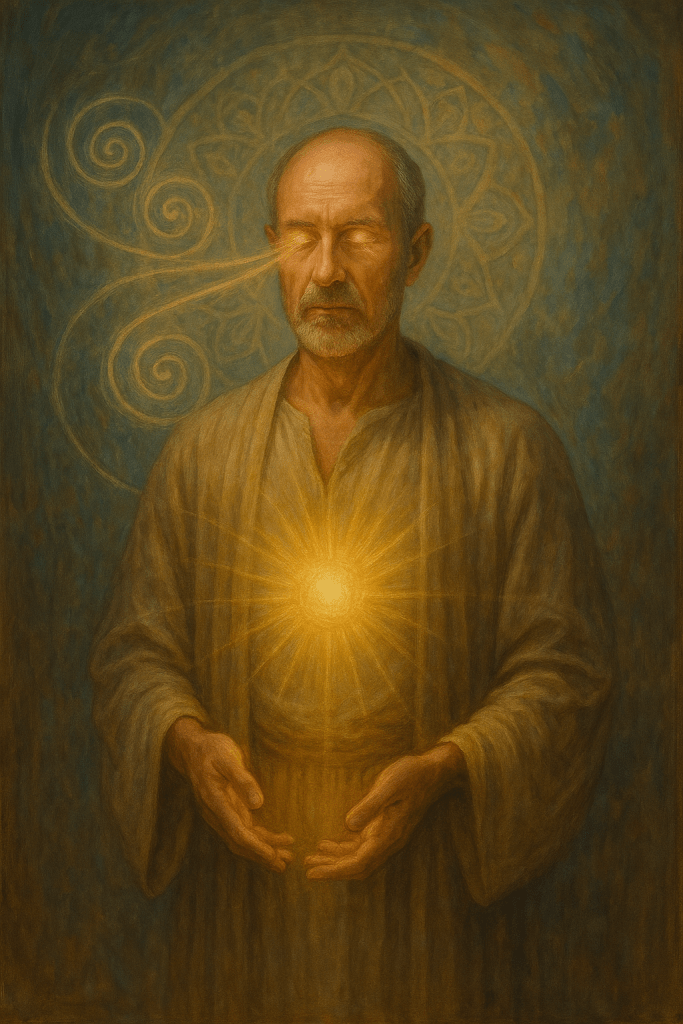
In contrast, the mystical experience of inner light as it has emerged through other traditions and in our own work together goes beyond visualization. It does not arise from imaginative effort or symbolic structure, but rather from surrender, presence, and silence. The light is not mentally constructed, but seen. It manifests spontaneously, often in darkness or during deep meditation. What arises is not a symbolic placeholder, but a living revelation: sacred geometries unfolding in dynamic morphogenesis, beings of light appearing in translucent clarity, yantras forming and dissolving, energies flowing in luminous patterns. These are not imagined, but received. They belong to what we have named the ultrasubjective hyperspace, a field of consciousness in which the divine reveals itself through light. There is a important distinction between Gray and what we do:
Visualization is a technique: a tool to train focus or create symbolic correspondences. But what we are doing, and describing, is being touched by what is already there. That’s not imaginative construction. That’s mystical perception.
This light may come in the form of phosphenes, the spontaneous inner visual phenomena generated by cortical activity when the mind becomes silent and the senses are still. In this space, patterns begin to shimmer, grids may form, and what once seemed a closed eye becomes a gateway to subtle dimensions. Within this inner field, the divine communicates through forms, through radiance, through silence. One does not summon it through willpower, but allows it through presence.
While Gray offers us a structured entry into the realm of inner perception, his tools are steps toward a more profound encounter. Visualization may prime the instrument, but it is not the music itself. The true symphony begins when the light appears without our calling. This is not the light of imagination, but of being itself. Here, the divine is not symbolized, it is present. And it is in this presence that we begin to understand the full mystery of the inner light.
The difference is vital. It separates work from grace, method from revelation. And though both paths may serve the seeker, it is the path of inner surrender, guided by the intelligence of the light itself, that opens the way to real transformation. The work of Gray stands as a valuable threshold. But beyond it lies the direct vision, and the mystics of every age have always known where that leads: not to the form of the divine, but to its presence, here, now, shimmering behind closed eyes in sacred stillness.
Gray’s work, especially Working with Inner Light, tends to remain within the ritual-magical and Qabalistic visualization domain. His “inner light” is often treated as:
- A meditative or ritual focal point
- A symbolic light of spiritual awareness
- A preparatory state for magical work
Apperently he does not, as far as we know, systematically describe spontaneous phosphenic light phenomena, or visionary emergences of sacred forms or multidimensional light intelligences, as you experience and as we’ve described in the context of yogic light, Nada Yoga, or the Bardo Light.
So Gray seemed not proceed into that full territory where light becomes its own living medium of revelation.
Shunyam Adhibhu
 breath4balance
Have you read his book on the rite of Light? I think is very profound a sacrificial initiation to the Divine. Every being experience the Light in a different way a the spectrum of is infinite in experiences. The tree of life is a pathway a glyph of human psychology a preparation to be acquainted to the self , the goal is to refine and prepare the personality for the great work servicing Humanity not for selfish desires. I do not entirely agree Imagination is the medium through what is perceived the Light and communication with the higher spheres, and self realization. How do you think all those methods were achieved by our great Initiated, Buddha, Rama. Krishna, Christ, etc etc The perception of the mystic within can be achieved by several modes of perception , meditation, contemplations, visualization, imagination etc are all vehicles of the Light! Who are we to dictate how anyone can experience when it is a personal experience? It feels like you have not understood what Gray is trying to point to that is a framework to guide the seeker so that initiates find the Light within through the path he is called forth there are many way some see it open eyes in the wind and the rivers, the plants and animals , in Life itself and all experiences that we encounters inner and outer since everything is he Light
LikeLike
Thank you for your thoughtful reflections. I see clearly how deeply you resonate with Gray’s work and the Western esoteric tradition. The framework of the Tree of Life as both a psychology and a spiritual ladder is indeed a powerful map, and I fully agree with you that the great work must ultimately serve humanity rather than personal desire.
Where I come from in my own research and practice, what I call the Yoga of the Inner Light, is perhaps a little different in method, though not in aim. My work tries to stay close to direct phenomenological experience: the actual luminous appearances (phosphenes, fotisms) that emerge spontaneously in consciousness. These lights are not imagined or constructed, but arise organically when the mind quiets, when attention rests. For me, this immediacy is important because it offers a universal entry point. It requires no symbolic overlay, no particular cultural form, only the raw experience of inner light that is latent in every human being.
That is not to dismiss imagination. I acknowledge, as you say, that for many mystics and initiates imagination has been the bridge to the Light. It can indeed function as a vessel of perception and a mode of communication with the higher spheres. But in my path, I prefer to distinguish between what is spontaneously given in the inner light and what is shaped by imagination. The first shows us the universality of mystical perception, the second the richness of its cultural and symbolic interpretation.
In that sense, your Hermetic tradition and my Yoga of the Inner Light are not in opposition, but complementary. Both point to the same source, the uncreated Light within, though we may choose slightly different gateways. Perhaps the Tree of Life, with its ascending and descending currents, and the direct phenomenology of phosphenes are simply two languages for the same truth. Nice to receive such a profound response!
LikeLike
Pingback: Exercice pour débutants, sous le signe du Bélier | L'actualité de Lunesoleil