Window to the Spirit
It is a truth whispered across mystical traditions: when the body is still and the senses quiet, the mind begins to shine. Not metaphorically, but literally. Behind closed eyes, in the depths of focused meditation, patterns of light begin to appear described as glowing halos, radiant orbs, cascading veils of brightness. These are not hallucinations in the psychiatric sense. Nor are they mere optical illusions. They are windows into a different mode of perception, a threshold between the physical and the ultrasubjective.
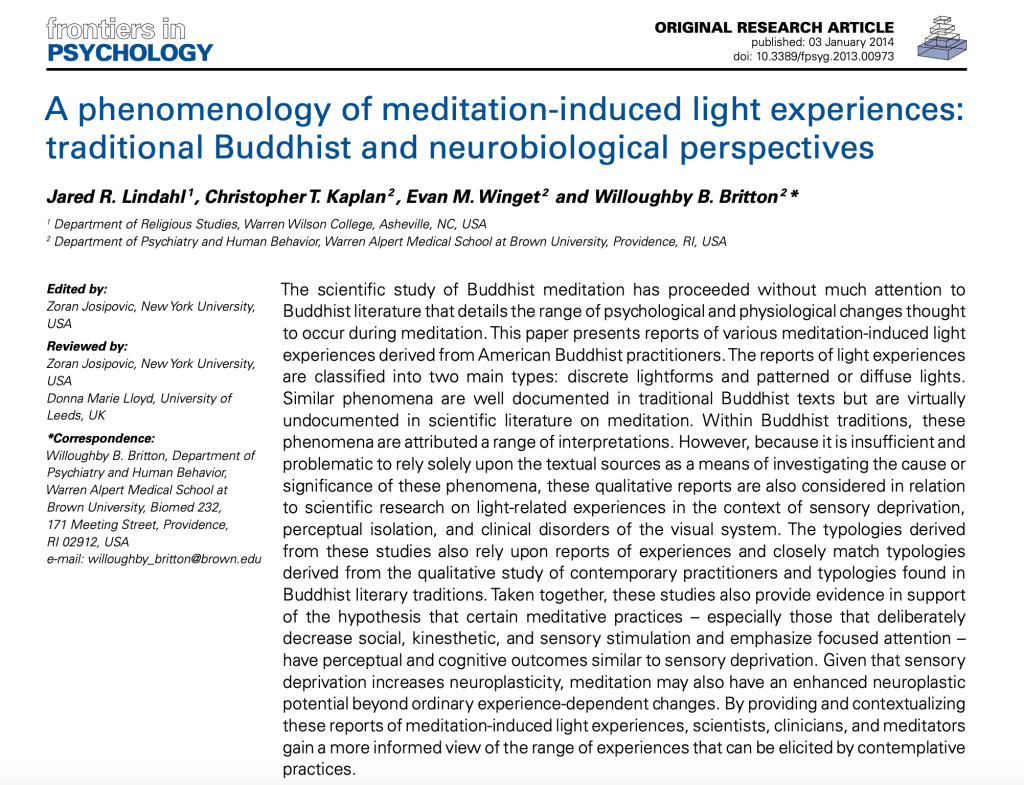
A compelling and methodologically rich study by Lindahl, Kaplan and Davidson (2014) explores this mysterious terrain. Titled “A Phenomenology of Meditation-Induced Light Experiences: Traditional Buddhist and Neurobiological Perspectives”, the research brings together interviews with experienced Buddhist meditators and contemporary neuroscience to ask a deceptively simple question: what is the nature of the light that arises in meditation?
The researchers collected detailed phenomenological reports from sixteen meditators, many with decades of practice. They described light that began as subtle dots or flashes and developed into stable forms—glowing screens, geometric patterns, radiant beings, and eventually an all-encompassing white luminosity. This trajectory closely mirrors descriptions in the Pali Canon and Tibetan Dzogchen texts, where the “nimitta” or sign-light is considered a gateway to jhāna or non-dual awareness.
But the researchers went further than cataloguing experiences. They explored possible neural correlates for these light events. Visual hallucinations in non-pathological states are well documented in settings of reduced sensory input. In fact, brain imaging studies confirm that the visual cortex, especially the primary and associative areas, becomes more active during sensory deprivation and deep meditation. The eye may be closed, but the brain continues to “see”, from within. The study suggests that these meditation-induced lights might reflect the spontaneous, self-organizing activity of the visual system in a state of internally directed attention.
And this is where our own work on phosphene meditations enters the picture. The practice of gazing at a white wall or resting attention on the dark field behind closed eyes often gives rise to these same lights—initially flickering, later stable, and finally transformative. But what matters most is not the visual display, but the recognition that the light is consciousness itself. What appears in the ultrasubjective hyperspace is not an object to be examined, but the source that allows all things to appear.
This study validates what has long been known by direct contemplative experience: the light is not just an event in the brain. It is an emanation of presence. When attention is pure, when the mind is quiet, the default appearance of the inner field is radiance. In this space, we do not imagine the divine. We perceive it. We dwell in it. And also: we are it! So we can see that the Yoga of the Light directly lead to the highest insight of the Advaita. I am That.
And so, when the study participants describe a light that feels alive, benevolent, or intelligent, we nod in recognition. The light begins as phosphene. It becomes a field of knowing. It may become sacred geometry or fractal intelligence or a being of light. But its essence remains constant: it is the echo of source, the shimmer of the uncreated in our created form. YOU ARE IT!
In a world obsessed with outward stimuli and scrolling on the phone, it is this inward turning that reveals the sacred. Not because it provides us with visions, but because it restores our deepest identity that we are vessels of light, receptacles of consciousness, each moment an invitation to return.
This is what it means to meditate with the light. And this is why the study matters. It confirms in scientific language what the mystics have known for centuries: that in stillness, the light is.
Grasp or no Grasp?
And if you do not grasp, if you do not seek, it will become you.. that is the normal last sentence for such a chapter like this….however…..actually it is you even if you grasp or if you seek. You only do not recognize that. Because you are not present. Only in presence relevant thoughts, emotions, feelings and actions can rise…In the state of sleep and projection, in the state of identification all this is not knowable, neither recognizable. LOL it is what it is…. Shunyam Adhibhu

 breath4balance