Use only words you really can say, speak the simple truth!
In the field of modern spirituality, language has become both a tool and a trap. Words once intended to point toward the ineffable now weigh down the experience with layers of expectation and performance. Terms like “I have a deep connection,” “this process is very deep,” or “I’m going through something intense,” echo through retreats and spiritual forums. They sound meaningful, they feel sacred, but are they?
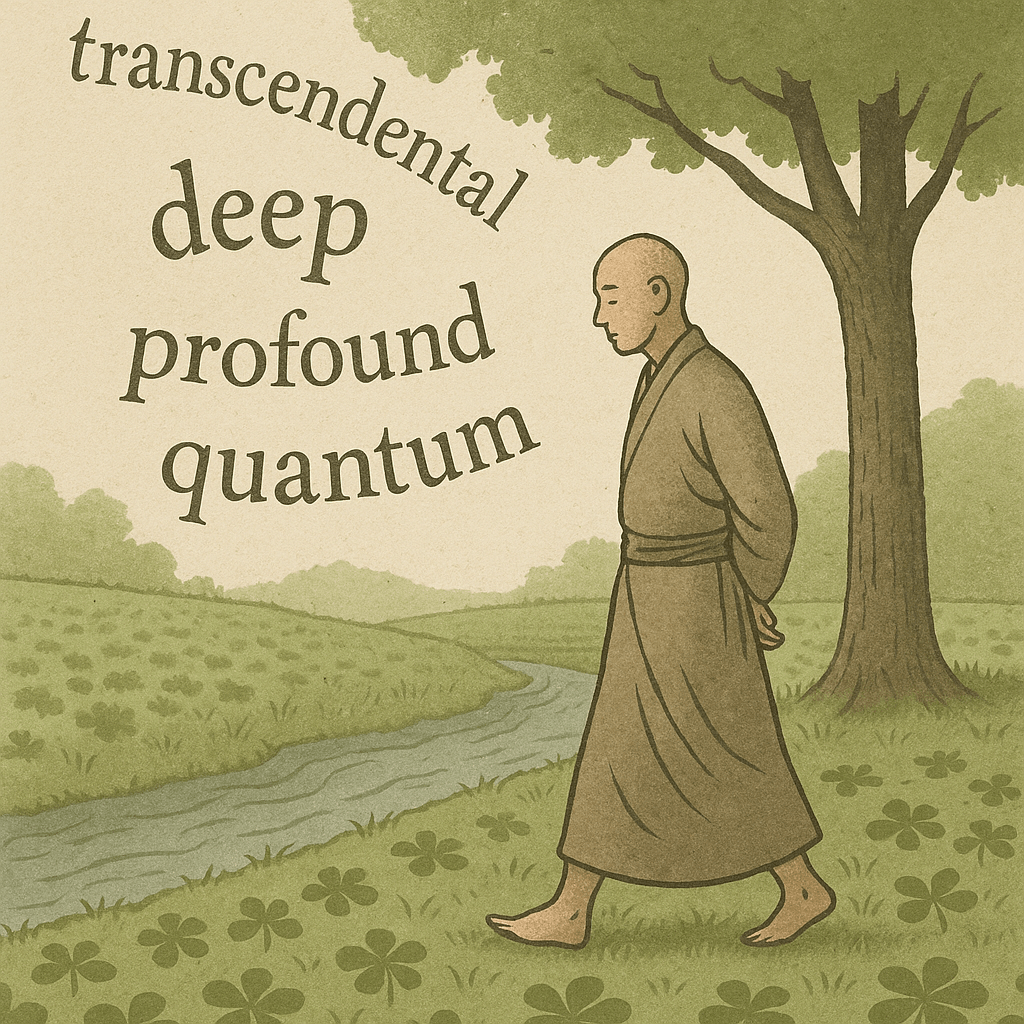
I go through an intense process…
The issue with such language is not simply that it is overused, but that it creates a pseudo-depth. “Deep,” “intense,” “transcendental,” “profound,” “sacred,” “high frequency,” “soul-aligned,” “quantum,” “encoded,” “activated”, all of these become spiritual currency in a marketplace that increasingly trades in abstraction. They are the baroque ornaments of spiritual discourse: beautiful to some, excessive to others, but always shaping the way experience is understood and conveyed.
From a linguistic point of view, these superlatives construct a specific kind of inner theatre and a peergroup feeling. By naming an experience as “deep” or “powerful,” one conditions the mind to associate inner truth with intensity. A quiet moment of ordinary awareness, like simply watching one’s breath, may no longer seem sufficient. The language creates an expectation of fireworks, of shifts, of transformation. And when that doesn’t happen, the practitioner may assume something is wrong.
On the dialect of ascension
In Dutch, we have a fitting term for this inflation of sacred vocabulary: spiri-wiri. It refers to the airy, often ungrounded language that dominates new-age circles. It is not just imprecise, it is performative. It is a way of presenting oneself as someone who has felt more, seen more, surrendered more, and who speaks the dialect of ascension. In the recent past we called people who used exagerated language ‘hysterical’….
You colonize your own consciousness
But spiri-wiri does more than clutter language, and that isn my main point here. It colonizes consciousness. It introduces a certain tone of voice into our thinking, one that privileges abstraction over immediacy, specialness over ordinariness, and metaphor over silence. In this context, spirituality becomes a stylized performance, not a return to simplicity. The true risk is that this language filters our experience so thoroughly that we forget to be present. We are busy processing when we could be simply being.
J. Krishnamurti, who relentlessly challenged the assumptions behind words, famously dismantled the use of the word “meditation” as it had come to be used in the West. He pointed out that once a word is filled with cultural baggage, it no longer points to the real. It becomes a symbol of conformity, not liberation. In that light, the contemporary spiritual lexicon often obscures what it aims to reveal.
Keep it fuckin simple! It is already grandiose
Zen masters have long favored minimalism in language. A koan does not explain; it shatters. A haiku does not decorate; it distills. In these traditions, the sacred is found in what is unsaid, in the pause, in the gaze, in the empty bowl. The fewer the words, the clearer the transmission.
It is time we reclaim the courage to speak plainly, even about the ineffable. To stop saying “deep” and start speaking with our own true words. To stop announcing “downloads” and start attending to the simple miracle of awareness. Silence, presence, attentiveness, these are enough. More than enough.
If spirituality is to remain authentic, it must strip itself of its own poetry and walk naked again. Otherwise it becomes a brainwash, inauthentic, and pointing into the world of spiritual materialism. Shunyam Adhibhu
 breath4balance
I agree with your perspective, as a Buddhist priest. Yet, given my neurodivergence, particularly the confluence of giftedness and AuDHD, my perception of what others term “spiri-wiri” diverges significantly. I don’t experience it as mere ornamentation or performative excess. Instead, I perceive reality and thought as a complex, multi-layered encoding of information that, while seemingly baroque, often distills to a fundamental simplicity. This isn’t a dismissal of the potential for linguistic inflation within spiritual discourse; rather, it’s an acknowledgment of how my mind processes and interprets such language.
My heightened pattern recognition, a characteristic feature of my neurodivergence, allows me to dissect the seemingly convoluted terminology and identify underlying structures. Some term that may sound baroque or sophisticated is not simply an abstract signifier. It often represents (what others find) complex constellations of interconnected phenomena – physiological, emotional, energetic – that I can perceive and process with greater acuity. So the language, to me, will be always imprecise, but it becomes anyway a form of compressed data, a shorthand for experiences that are difficult to articulate within the constraints of conventional language. My linguistic background further allows me to deconstruct the etymology and semantic evolution of these terms, tracing their roots and uncovering the historical and cultural contexts that have shaped their usage.
The “dialect of ascension,” which others might dismiss as mere posturing, often reveals to me a nascent attempt to articulate non-linear, trans-rational experiences. The perceived excessiveness is not necessarily indicative of insincerity or delusion. Instead, it reflects the inherent challenge of translating subjective, often ineffable states into a linear, symbolic system. My brain neurodiversity, together with my linguistic training allow me to analyze this dialect as a developing language, with its own internal logic, grammar, and syntax. I see the potential for it to evolve into a more precise and nuanced mode of communication, capable of conveying subtle shades of meaning that are currently inaccessible through conventional language.
The concern about “colonizing consciousness” through such language is valid. However, my inherent critical thinking skills provide me with a robust filter. I am less likely to uncritically adopt these “baroque” terms and more inclined to subject them to rigorous analysis, comparing them against my own direct experience and seeking to identify their empirical correlates. My background in developing algorithms to detect bias in speech further equips me to discern the potential for linguistic manipulation and to guard against the uncritical acceptance of dogma.
Ultimately, I recognize that my path to personal enlightenment, like everyone else’s, is unique. My neurodivergent wiring shapes my perception of reality and my approach to spiritual inquiry. I find simplicity not in the absence of complexity, but in the ability to discern the underlying order within seemingly chaotic or convoluted systems. The “spiri-wiri” that others might find obfuscating often serves as a complex map that I can navigate with relative ease, uncovering profound insights into the nature of consciousness and existence. I acknowledge that this is my individual experience, and I deeply respect the validity of other perspectives and approaches. No one path is inherently superior; each individual must find their own way.
LikeLike
Thanks for this valuable feedback, very interesting to hear your perspective. Having said that it is my experience at a farm, where we do farming as meditation, to make it simple and down to earth, some friends who want to be stewards of the earth and have high language, they do not see what is needed in the garden…..They leave stuff hanging around and have no clue what real fengshue in a natural environment means. They use eloquent language to prove how spiritual their way is, but do not see a thirsty chicken. That is what I mean. Walk your talk. Talk simple. The truth is simple. Too simple for words.
LikeLike