Within the contemplative and mystical traditions of Christianity, the phenomenon of seeing inner light, luminous impressions perceived in silence or darkness has long been a source of revelation and sacred imagery. These light forms, known today as phosphenes, arise naturally in the closed-eye field of vision or through meditative focus on a light source. They are neurophysiological defined. They tell us something about our finest perception when our senses see and listen to the inside, not the outside.
For the devoted seer, they are not random neural flickers but structured portals, revealing archetypal forms, cosmic order, and divine presence.
Point-centered phosphenes, in particular, manifest as concentric rings, radiant wheels, and star-like geometries. These patterns correspond remarkably with Christian iconography: the radiant nimbus around Christ’s head, the mandala-like rose windows of cathedrals, or the wheel imagery of Ezekiel and mystics such as Hildegard of Bingen and Niklaus von Flüe. When stabilized through practice, gazing, prayer, or ascetic withdrawal, these forms can become fixed visionary templates, opening into symbolic structures of profound theological resonance.
Niklaus von Flüe (1417–1487) (also known as Brother Klaus), the 15th-century Swiss mystic and hermit, reported profound inner experiences during his long periods of solitude and fasting. Though the term phosphenes didn’t exist at the time, many of his visionary accounts suggest vivid inner light phenomena that are consistent with what we today would call phosphene experiences.

Professor Jung wrote: “It is nice to think that the only outstanding Swiss mystic received, by God’s grace, unorthodox visions and was permitted to look with unerring eye into the depths of the divine soul, where all the creeds of humanity which dogma has divided are united in one symbolic archetype.
In the visions of Brother Klaus, the terrifying countenance of God and the wheel of the Trinity emerge not as fantasies, but as interior diagrams of spiritual force. The “swords without handles” piercing the divine face may mirror radial phosphene bursts, often seen as darting rays from a central point. Similarly, his famous wheel vision, nine concentric circles with Christ at the center, evokes the structured unfolding of light from the spiritual source outward into creation.
Rather than hallucination, these inner visions can be understood as a deep engagement with the architecture of consciousness. They translate the raw energy of divine encounter into sacred form, and through the lens of phosphenes, we glimpse a luminous cartography where spirit and light are one.
Inner Light Context
- Prolonged fasting and sensory isolation : Brother Klaus lived in a small cell with very little sensory input. Such conditions are known to naturally provoke strong inner sensory phenomena, including light visions (phosphenes), sounds (inner auditory events), and other multisensory inner imagery.
- Reports of inner light : In his visions, he often described blinding circles of light, rotating structures, and divine figures emerging from radiant forms. These are consistent with advanced phosphene experiences as described in neurological or meditative contexts.
- Religious interpretation : As with Hildegard von Bingen or other mystics, these experiences were interpreted through a theological lens, manifestations of divine truth or communications from God, angels, or Christ, but neurophysiologically, they resonate with the kind of hypnagogic and phosphene-rich experiences seen in modern contemplatives.
Niklaus withdrew from worldly life to live in almost complete solitude in the Ranft valley of Switzerland. There, he fasted for decades, receiving only the Eucharist and living in what could be called a state of profound sensory and worldly withdrawal. In his isolation, he began to report deeply symbolic, visionary experiences. He spoke of rotating wheels of light, radiant portals, concentric circles, and divine figures emerging from luminous configurations, visions that left a lasting impression on Christian mysticism.
At the time, no terminology existed to describe these phenomena outside of religious or symbolic language. But today, with a richer understanding of sensory deprivation, neural activity, and meditative states, we can recognize many of these visions as consistent with phosphene experiences — spontaneous visual sensations caused by the brain itself, often in total darkness or states of trance.
Navigating the sacred cartography of phosphenes
In his solitude, Brother Klaus likely entered a form of neuro-sensory openness where the boundaries between self and vision dissolved. This was not merely imagination, but a deep entry into what we might now call the ultrasubjective hyperspace, the internal, neurophenomenological domain in which the divine, the symbolic, and the neurological overlap.
In this state:
- The lack of external stimuli may have allowed the visual cortex to generate self-activating patterns such as geometric lights, mandala-like forms, pulsing and rotating structures, all well-known in the literature of phosphene meditation and totally easy to see once starting with the path of thye Yoga of the inner light.
- His inner world was with symbolic content from his Christian faith, giving meaning and language to the ineffable images he encountered. This is not unlike the visionary art of Hildegard von Bingen, who described similarly radiant inner landscapes.
- He was not hallucinating in a pathological sense, but rather navigating a sacred cartography that arises in many contemplative traditions when the sensory and cognitive systems are finely tuned to inner silence.
The mysticism of Brother Klaus is a testimony to a universal path: that of inner light as a doorway to the divine. His visions, which for centuries were interpreted only through theological categories, can now also be appreciated as insights into the natural architecture of the contemplative brain.
In contemporary terms, we might say:
- He entered and activated the ultrasubjective hyperspace, the same inner realm accessed by deep meditators, Nada Yogis, and visionaries across cultures.
- His images were phosphenic, but not meaningless. Rather, they served as a language, one that arises at the threshold where the divine impresses itself onto the receptive soul.
Ultimately, Brother Klaus offers a powerful model for integration. His life bridges neuroscience and theology, inner experience and divine symbol, perception and revelation. He did not need terms like “phosphene” or “hyperspace.” He simply described what he saw, and what he knew to be real — radiant, meaningful, and utterly transforming.
His visions have been well documented, especially through the accounts of his spiritual experiences and iconographic representations. While he didn’t write extensively himself, his mystical visions were recorded by others, most notably in:
1. The “Sachseln Book” (“Die Luzerner Handschrift” or “Das Sachselnbuch”)
This is the main collection of testimonies and records about Brother Klaus’s life and visions, compiled shortly after his death. It includes the famous account of his “wheel vision”, often interpreted as a mandala-like image — highly relevant to phosphene research due to its radiating geometric pattern.
2. The Visionary Drawings attributed to Brother Klaus
The “Radbild” (Wheel Image) is one of the most powerful visual documents. While not directly called phosphenes, the radiating, abstract, and symmetrical patterns in these drawings resemble entoptic imagery — similar to what people report during deep meditation or under the influence of phosphenes.
3. Modern analysis by Carl Gustav Jung
C. G. Jung interpreted Brother Klaus’s mandala-like visions (especially the “wheel vision”) as deeply archetypal. He related them to inner psychic images that emerge from deep unconscious layers, what we might today frame as experiences within the ultrasubjective hyperspace, rich in symbolic phosphene-like manifestations.
Phosphenes Rulez
While Niklaus von Flüe never uses the term phosphene (as it is modern), his “Radbild” and the mystical experiences recorded in the Sachseln manuscript contain the clearest examples of imagery that parallel phosphene phenomena , especially in the context of religious ecstasy and mystical insight.
His Visions were phosphenes
Placing the vision of Niklaus von Flüe (also known as Brother Klaus) into the context of phosphene meditations opens a profound symbolic reading, particularly through the lens of inner light practices and the visionary states that accompany prolonged contemplation in darkness, stillness, or gaze-based meditation.
Niklaus claimed to have had visions from the womb, which aligns with the phenomenon of spontaneous phosphenes, inner light experiences not induced by external stimuli, that can arise in fetal or early childhood consciousness, as some mystics and researchers into prenatal memory and light phenomena have suggested. In phosphene meditation traditions, especially within the Yoga of the Inner Light, such early visionary impressions are understood as the soul’s intimate contact with the formless, luminous source—an origin memory that continues to echo throughout life.
The vision of the terrible countenance of God, reported ten years before his death, takes on an even deeper resonance when seen through the lens of inner light yogas. The terrifying expression, full of anger and threat, recalls the intense, sometimes overwhelming imagery that can arise in the deep phases of phosphene-based meditation or in advanced trataka (fixed gazing), when the ego confronts archetypal or cosmic images from the unconscious. These visions are often described as simultaneously awe-inspiring and terrifying, what Rudolf Otto called the mysterium tremendum, and can evoke intense forms, such as wrathful deities in Tibetan Buddhism or apocalyptic Christs, as in Revelation 1:13.
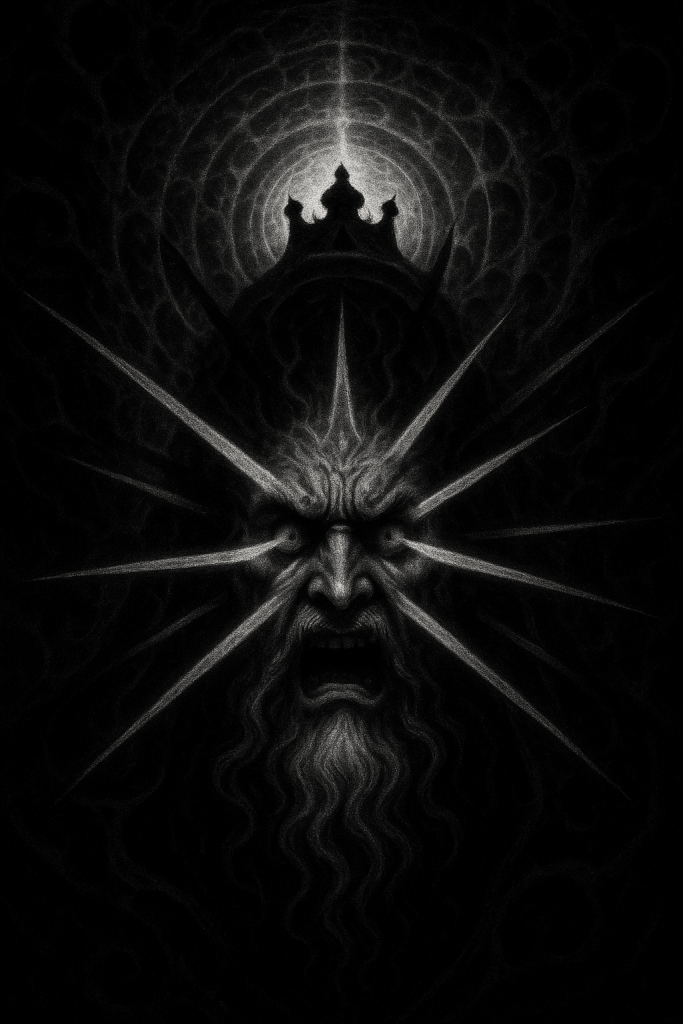
The threefold crown and tripartite beard above and below the face may correspond symbolically to the upper and lower triads of energy centers in subtle body systems: crown–brow–throat and solar plexus–sacral–root. These could be seen as visual metaphors for a fully opened vertical axis of light, sometimes experienced in advanced phosphene meditation as a column of light running through the center of the body.
The six sword blades without handles, a striking image, might represent piercing insights or luminous intrusions that overwhelm the ordinary personality structure. In inner light yoga, intense light entering through the third eye or eyes can feel like a “sword” cutting through veils of illusion. The upward-pointing sword from the forehead corresponds to the ajna center, the seat of vision. Blades in the eyes, ears, nose, and mouth suggest a full sensory overload, a total inner activation or penetration by the divine light, experienced as terrible when the self is unprepared or when shadow material arises.
Thus, Niklaus’s vision can be interpreted as a powerful inner light event, one in which the visionary, perhaps after decades of inner practice and asceticism, faced the unfiltered force of the transcendent. From a phosphene meditation perspective, this was not merely symbolic but the experiential threshold of divine encounter: a raw and purgative confrontation with the formless forming itself into the most intense, paradoxical image the human psyche can bear.
Further on the visions
here we describe his visions phenomenologically and related to phosphene structures—visual phenomena characterized by luminous patterns perceived without external light stimuli.
1. Vision of the Terrible Countenance of God
Phenomenological Description: Niklaus described a terrifying divine face with six sword-like rays piercing it, symbolizing a profound spiritual encounter.
Phosphene Correlation: The six sword-like rays can be likened to radial phosphene bursts, often seen as darting rays from a central point.
2. The Wheel Vision (Sachsler Meditationstuch)
Phenomenological Description: This vision features a central crowned face surrounded by six medallions, each illustrating pivotal events in the life of Christ. The six rays connecting the central face to the surrounding scenes are interpreted as representing the dynamic interaction between the divine and the world.
Phosphene Correlation: The concentric circles and radial spokes mirror common phosphene patterns, such as concentric rings and star-like geometries.
3. Vision of the Stream
Phenomenological Description: Niklaus envisioned a stream flowing from the Tabernacle, covering the earth, symbolizing sanctifying grace emanating from the Paschal Victim on the Cross.
Phosphene Correlation: The flowing stream can be associated with dynamic phosphene patterns that resemble moving light or fluid forms.
4. Vision of the Cloud
Phenomenological Description: In this vision, Niklaus expressed a desire to surrender to God, who responded with a scolding, highlighting the tension between human will and divine command.
Phosphene Correlation: The cloud motif may correspond to diffuse phosphene patterns, representing obscured or veiled light perceptions.
5. Vision of the Tower
Phenomenological Description: Niklaus envisioned a tower, which has been interpreted as a symbol of spiritual ascent or the structure of the soul.
Phosphene Correlation: The verticality of the tower aligns with linear phosphene patterns, such as vertical lines or bars of light.
6. Prenatal Faces and the Baptismal Vision
Phenomenological Description: Niklaus claimed to have had visions already in the womb, including faces and a profound baptismal experience.
Phosphene Correlation: These early visions may relate to spontaneous phosphenes—inner light experiences not induced by external stimuli, that can arise in fetal or early childhood consciousness.
7. Vision of the Trinity
Phenomenological Description: Niklaus experienced a vision emphasizing the unity and interaction of the Father, Son, and Holy Spirit, reflecting the core Christian doctrine of the Trinity.
Phosphene Correlation: The triadic structure of this vision can be associated with phosphene patterns that exhibit symmetrical, three-part formations.
These visions and their symbolic representations have been the subject of various interpretations, including psychological analyses by scholars like Carl Jung and Marie-Louise von Franz. They suggest that such visions serve as manifestations of universal archetypes and play a role in the individual’s spiritual development. However, they missed the unifying phosphene character of all.
Prayer of Niklaus von Flüe
Mein Herr und mein Gott,
nimm alles von mir,
was mich hindert zu dir.
Mein Herr und mein Gott,
gib alles mir,
was mich führet zu dir.
Mein Herr und mein Gott,
nimm mich mir
und gib mich ganz zu eigen dir
Carl Gustav Jung once wrote:
«‹Gott› ist eine Urerfahrung des Menschen, und die Menschheit hat sich seit unvordenkbaren Zeiten eine unausdenkbare Mühe gegeben, diese unfaßbare Erfahrung darzustellen, zu assimilieren, durch Deutung, durch Spekulation und durch Dogma, oder sie zu leugnen»
Translation:
“‘God’ is a primordial experience of the human being, and humanity has, since time immemorial, gone to unimaginable lengths to represent, assimilate, interpret, speculate about, and dogmatize this unfathomable experience — or to deny it.”
Contextualization:
Jung here is not speaking about “God” as a religious figure or theological concept per se, but rather as a deep, inner human experience, something that emerges from the collective unconscious. In his psychological framework, “God” represents an archetype, a symbolic expression of the totality of the Self, and the profound sense of mystery, awe, and inner knowing that transcends reason.
He notes that humans have always struggled to make sense of this experience, by means of mythology, religion, philosophy, and science. We’ve turned this “ungraspable” reality into symbols, dogmas, rituals, and belief systems , or, in the modern world, we’ve tried to deny its relevance altogether.
Jung’s point resonates deeply with our work on the ultrasubjective hyperspace, that inner field where the sacred becomes directly experienced, not through external dogma but through inner vision, sound, and knowing.
Shunyam Adhibhu
References
Marie-Luise von Franz: Die Visionen des Nikolas von Flüe. 2., erweiterte Auflage der
Originalfassung, die 1959 im Rascher-Verlag erschien; Daimon-Verlag, Zürich 1980; ISBN 3-
85630-001-5.
Roland Gröbli: Die Sehnsucht nach dem «einig Wesen». Leben und Lehre des Bruder Klaus
von Flüe. NZN-Buchverlag, Zürich 1992. Neuauflage: Rex-Verlag, Luzern 2006, ISBN 978-3-
7252-0829-6.
Rupert Amschwand: Bruder Klaus. Ergänzungsband zum Quellenwerk von R. Durrer. Sarnen
1987.
Iso Baumer: Niklaus von Flüe, Der Wüstenvater am Bergbach. Verlag Kanisius,
Freiburg/Schweiz, 1998, ISBN 978-3-85764-485-6.
Robert Durrer: Bruder Klaus. Die ältesten Quellen über den sel. Nikolaus von Flüe, sein Leben
und seinen Einfluss. 2 Bde., Sarnen 1917–1921 (Nachdruck 1981).
Roland Gröbli, Heidi Kronenberg, Markus Ries, Thomas Wallimann-Sasaki (Hrsg.): Mystiker –
Mittler – Mensch. 600 Jahre Niklaus von Flüe. Theologischer Verlag, Zürich 2016, ISBN 978-3-
290-20138-8.
Johannes Hemleben: Nikolaus von der Flüe. Der Heilige der Schweiz. Huber, Frauenfeld
1977, ISBN 3-7193-0550-3.
Werner T. Huber: Bruder Klaus. Niklaus von Flüe in den Zeugnissen seiner Zeitgenossen.
Benziger, Zürich und Düsseldorf 1996; ISBN 3-545-20122-8 (neusprachliche Quellen bis 1501
mit Kommentaren).
C. G. Jung: Bruder Klaus. In: Neue Schweizer Rundschau. Neue Serie I/4, Zürich 1933,
S. 223–229 (zuletzt in C. G. Jung: Zur Psychologie westlicher und östlicher Religion.
Walther/Patmos-Verlag, ISBN 3-530-40087-4).
Pirmin Meier: Ich Bruder Klaus von Flüe. Eine Geschichte aus der inneren Schweiz. Ammann
Verlag, Zürich 1997, ISBN 3-250-10309-8.
Heinrich Wölflin: Die älteste Biographie über Bruder Klaus (1501). L. E. Kaiser, Malters 2005,
ISBN 3-033-00390-7.
 breath4balance