One of the most important mystics of our own environment were those of the Swiss Bruder Klaus, Niklaus von Flüe. We describe some of his visions, this time the tabernacle, a clear example of a phosphene vision – you can find it in the publication referred here.
The publication titled Bruder Klaus, Weg der Visionen: Wegbegleiter is a contemplative guidebook designed to accompany pilgrims and spiritual seekers along the “Weg der Visionen” (Path of Visions), a meditative trail in Switzerland that traces the life and mystical experiences of Niklaus von Flüe, known as Brother Klaus. This path begins at his birthplace in Flüeli-Ranft and culminates at his burial site in Sachseln.
The guidebook details six key visionary experiences, five attributed to Brother Klaus and one to his wife, Dorothee Wyss. Each vision is represented by a metal sculpture created by Obwalden artist André Bucher, installed along the trail. These sculptures serve as focal points for reflection, inviting pilgrims to engage with the spiritual insights of Brother Klaus.
The Weg der Visionen is not merely a physical journey but also a spiritual one, encouraging introspection and connection with the divine. The guidebook provides introductions to each vision, prompts for personal contemplation, and excerpts from original texts to deepen the pilgrim’s experience.
The visions presented in the booklet Bruder Klaus, Weg der Visionen: Wegbegleiter are inspired by the spiritual experiences attributed to Niklaus von Flüe (Brother Klaus), but not all of them come directly from his own writings or firsthand testimonies. Here the sources:
✅ Authentic Core Visions
Some of the visions such as hereunder are clearly from Bruder Klaus:
- The Terrible Countenance of God
- The Wheel Vision (often depicted in the Sachsler Meditationstuch)
- His Vision of Light or Radiance
- The Tabernacle (see under)
These are attested in historical sources close to Brother Klaus, including:
- the Humanist Johannes von Gerson (Bovillus), who interviewed him,
- accounts written down shortly after his death,
- and visual documents such as the meditation cloth (Meditationstuch), which reflect his inner experience.
These can be considered authentic or near-contemporaneous representations of his visions.
Scholars like Marie-Louise von Franz, Carl Gustav Jung, and theologians of Swiss mysticism regard his core visions as genuinely mystical, deeply archetypal, and reflecting a visionary consciousness shaped by asceticism, isolation, and Christian contemplation.
The Tabernacle
One night, Brother Klaus sees himself in a square
where many people are working, yet remain miserably poor.
Next to them stands a beautifully built tabernacle.
The door is open. He enters and finds himself in the kitchen of an entire community.
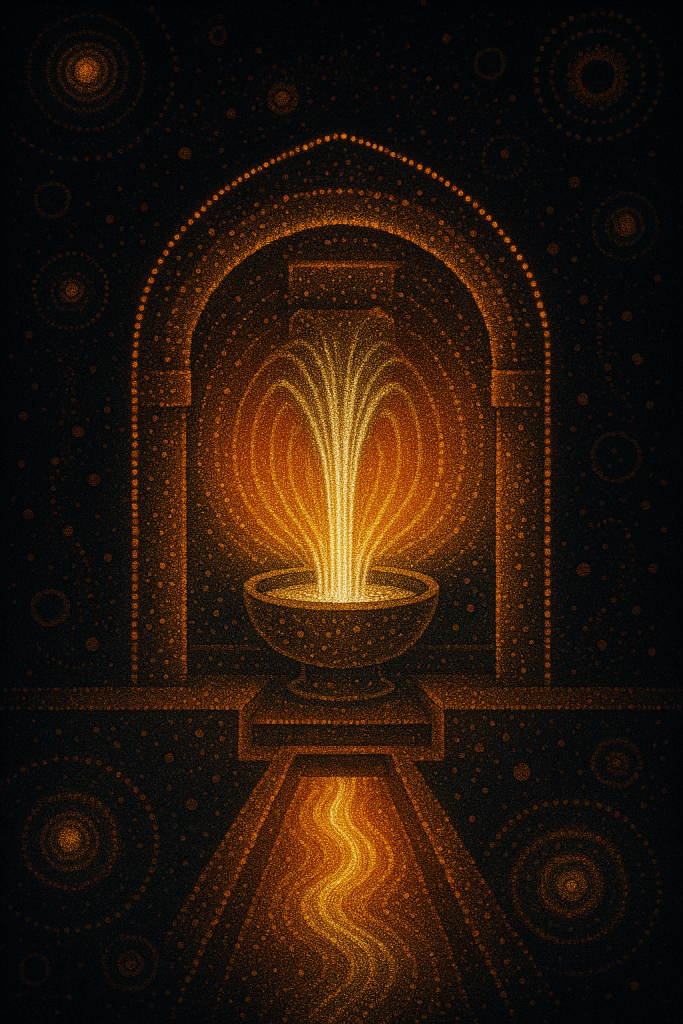
There, a fountain flows made of three things: wine, oil, and honey.
He ascends a staircase and sees the fountain springing forth from an iron-clad chest.
Crystal-clear and powerful, it bursts out from every crack.
It is one fountain, yet three rivers flow out in a single channel.
Brother Klaus goes outside and watches what the people are doing:
Some have built a fence and demand a penny from anyone who wants to pass.
Others perform music or work as tailors and shoemakers.
All chase after money and yet remain poor.
No one goes to the source to draw water.
Then Brother Klaus realizes:
This tabernacle is himself.
Commentary and Phenomenological Interpretation
This vision is rich in symbolic, mystical, and spiritual imagery. Here’s a layered analysis, especially in relation to phosphene meditation and inner light mysticism:
🌟 The Tabernacle as the Inner Self
- The open tabernacle, central in Christian liturgy as the dwelling of the divine presence (often housing the Eucharist), is revealed to be Brother Klaus himself.
- This aligns with mystical traditions—from Meister Eckhart to Eastern Orthodox hesychasm to Christian yogic experiences—where the divine source is found within.
- In phosphene meditation, inner luminosity is experienced as a sacred presence, sometimes in the form of a central fountain or well of light, reinforcing the idea of the body as a temple.
💧 The Fountain of Wine, Oil, and Honey
- These three fluids symbolize sacrament (wine), anointing (oil), and divine sweetness or wisdom (honey). They reflect the Trinitarian mystery expressed materially.
- The fountain is one, yet three rivers flow—an unmistakable Trinitarian image.
- This also mirrors the way phosphenes may emerge from a single point of light yet manifest as multiple forms or rays in vision.
🛠️ The Iron-Clad Chest
- The iron chest represents the containment of divine power, much like the Ark of the Covenant or the human heart when it carries the divine spark.
- Its crystal-clear flow bursting from the cracks reflects the idea that spiritual radiance is hidden in the dense body and breaks through under pressure, similar to how luminous inner visions arise in deep meditative states.
🧍♂️ The People Outside
- The people symbolize a world distracted by commerce, superficial productivity, and materialism.
- They remain poor despite constant activity—because they have forgotten the source.
- The fact that no one draws from the fountain reflects the tragedy of spiritual amnesia: abundance within, scarcity without.
- This is a classic mystic critique, found in Christian saints, Sufi poets, and Indian rishis alike.
🧘♂️ Mystical Realization
- The final realization that “this tabernacle is himself” is a moment of deep mystical union.
- It echoes Paul’s words: “Do you not know that you are God’s temple?” (1 Corinthians 3:16).
- In phosphene terms, this is the moment when the seer realizes the inner light source is not external, but is the very root of one’s being.
This vision is found in early written records that collected and preserved Brother Klaus’s mystical experiences, particularly those recorded by:
- Johannes von Gerson (also known as Nicolas of Cusa or Bovillus) — a Humanist who visited Brother Klaus and documented his experiences.
- Heinrich von Gundelfingen, and
- Ulrich Wagner, the parish priest of Kerns who played a role in transmitting some of Klaus’s visions.
While Brother Klaus did not write extensively himself, these visions were preserved through eyewitness reports and oral transmission, often within a few years of his death. The vision of the tabernacle and the source is consistently mentioned in this tradition and is not a modern invention or symbolic reconstruction like some others.
📜 Primary Sources of this vision of Bruder KLaus
1. Ulrich Wagner – “Ein kurtze geschicht” (c. 1488)
- Who: Parish priest of Kerns and a contemporary of Brother Klaus.
- What: This is one of the earliest biographies of Brother Klaus, written shortly after his death in 1487.
- Value: Contains detailed accounts of his life, including his mystical experiences and visions, some of which were shared directly with Wagner.
- Language: Middle High German.
- Status: Considered highly credible and close to the source.
2. Heinrich von Gundelfingen – “De Vita et Revelationibus Nicolai de Flue” (c. 1488–1492)
- Who: A Benedictine monk and historian.
- What: Latin biography detailing the life and revelations of Brother Klaus.
- Value: Includes theological reflections on the visions and emphasizes Klaus’s inner transformation.
- Language: Latin.
- Status: A respected early source, though sometimes more interpretive.
3. Johannes von Gerson (Jean Charlier de Gerson) / Nicolas of Cusa / Johannes von Rütlin (possibly a mix-up)
- Clarification: There’s sometimes confusion in naming—Johannes von Gerson (France) and Nikolaus von Kues (Cusa) were both 15th-century mystics but different individuals. Johannes von Rütlin (Bovillus) is the correct Humanist who visited Klaus.
- What: Describes the vision of the terrible countenance of God and his interpretation of Klaus’s teachings.
- Value: Important external testimony that records Klaus’s most dramatic vision.
- Language: Latin.
- Status: Important third-party report of firsthand conversation with Klaus.
4. “Die Offenbarungen des seligen Niklaus von Flüe” (The Revelations of Blessed Niklaus von Flüe)
- Collected texts: Various early accounts of his visions, compiled by monastic chroniclers and mystics.
- Editions: Appears in devotional and hagiographic collections from the 16th century onward.
- Modern editions: Often cited in Swiss-German Catholic spiritual literature.

