Mindfulness is everywhere these days. Apps tell us to “just breathe,” courses teach us to sit still and focus on our breath, and we’re told that this is the path to inner peace. But here’s a simple question:
Is that all there is?
For many of us, the answer is quietly becoming clear: no. While watching the breath can help us feel calmer or more grounded, something deeper, something more alive, is waiting to be discovered. And it’s right there, behind your closed eyes. You can become illuminated and enlightened in this life and much quicker than you ever thought if you switch to the path of the Yoga of the Inner Light!
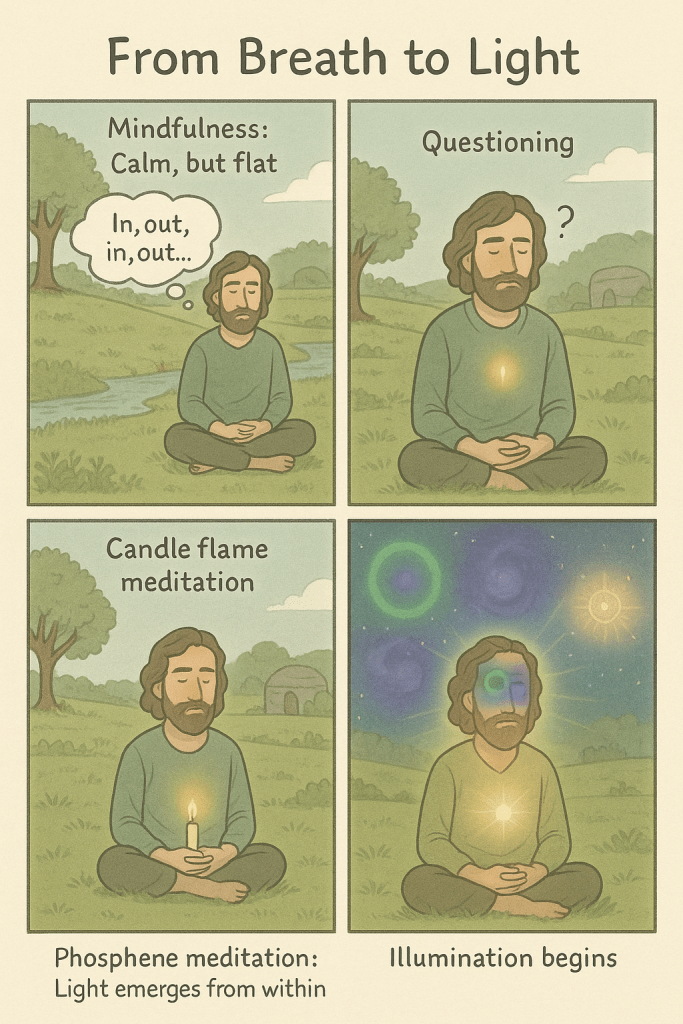
So, welcome to phosphene meditation, an ancient and natural gateway to inner light, vision, and transformation. I am amazed myself what it brought me. From understanding the function of the eye of Horus in the old Egyptian rituals to the essence of Advaita and its non-duality aspect.
Phosphenes are the spontaneous lights you may have seen in the dark, especially in deep relaxation or after rubbing your eyes. But here’s what most people don’t know: these lights are not just a visual glitch. They are part of a built-in doorway to deeper consciousness. Through focused attention and simple techniques, these subtle lights begin to unfold in beautiful, evolving forms, rings, mandalas, moving energy patterns, and then into full visionary states described by mystics across cultures.
Unlike the flat, neutral focus of modern mindfulness, phosphene meditation offers a living path of discovery. You’re not just observing your breath, you’re entering the inner temple of your own awareness.
This isn’t theory. It’s something you can experience, easily, naturally, and without years of training. It’s already built into your physiology. And once you see the light, you’ll realize why traditions from the Egyptian temple schools to Tibetan yogis, from shamans to Christian mystics, all spoke of light in the darkness as the beginning of true spiritual awakening.
Mindfulness calms you. Phosphene meditation transforms you.
Now some Q&As
Phosphene Meditation: Questions & Answers
Q1: What are phosphenes?
A: Phosphenes are the subtle lights and shapes that appear behind your closed eyes, especially in darkness or after looking at a light source. They may show up as glowing dots, spirals, clouds of color, or mandala-like forms. These are natural and deeply connected to the visual and neurological system, and when approached with focused awareness, they can become a gateway to inner stillness, vision, and insight.
Q2: Isn’t watching the breath enough for meditation?
A: Watching the breath is a calming practice and a great place to begin. But often, it remains surface-level. It teaches focus, but not necessarily depth or transformation. Phosphene meditation invites you into the visual core of consciousness itself. Rather than focusing on a neutral anchor, you begin to explore the spontaneous emergence of inner light, a process that often leads to profound clarity, vision, and silence.
Q3: Are these lights just tricks of the brain?
A: They arise from the body and brain, but they are not meaningless. Phosphenes are part of the natural bridge between perception and consciousness. Just as dreams come from within but can carry deep significance, so too can the lights seen in meditation become tools for transformation. Many mystical traditions describe similar lights as signs of inner awakening.
Q4: What about colors and chakras? Do they match?
A: The idea that specific colors map to fixed chakras is a modern invention, not an ancient teaching. While inner colors may appear during meditation, they do not neatly correspond to personality traits or spiritual levels. Phosphene meditation is not about interpreting symbols but about staying present with the experience. The lights evolve according to your inner state, not a color chart.
Q5: Can anyone see phosphenes?
A: Yes. Almost everyone can access phosphenes, especially in the dark or through gentle techniques. With time and attention, the lights become more distinct and organized. You do not need to force anything. The key is awareness without expectation.
Q6: Is this a safe practice?
A: Yes, for most people it is entirely safe and deeply calming. It is a gentle, body-based practice that does not rely on drugs or intense states. Simply being present with what arises naturally from the nervous system makes it safe and deeply grounding. If you have a neurological condition like epilepsy, it is wise to consult a professional first.
Q7: How is this different from psychedelic vision?
A: Phosphene meditation can resemble some of the early visual phases reported in psychedelic experiences, but it is completely natural and self-regulated. There is no altered chemistry involved. The beauty of this practice is that it builds clarity, not chaos, and offers a clear doorway into the same realms that many have described through visionary states.
Q8: What is the goal of phosphene meditation?
A: There is no fixed goal, but many practitioners experience a shift from scattered perception to spacious awareness. Some describe reaching a radiant center of light, or the sense of being drawn into a vast space of consciousness. Others simply feel more awake, connected, and grounded in presence. The real aim is not to achieve, but to see, to witness the natural unfolding of inner light.
Q9: How do I start?
A: A simple and powerful way to begin is with the candle flame meditation, practiced in a quiet, dimly lit room.
Practice: Candle Flame Meditation and the Emergence of Phosphenes
- Sit comfortably, spine upright, in front of a steady candle flame.
- Gaze into the flame with soft, unwavering eyes for about 2 minutes.
- Allow your vision to rest in the heart of the flame. Observe the shapes and colors — the blue at the base, the yellow glow, the gentle flicker and the halo around it. Keep your eyes still, relaxed, and focused.
- After 2 minutes, gently close your eyes and sit back in silence. Stay in a dimly lit space.
- Observe the afterimage — you may see the shape of the flame etched in light, then watch as it begins to shift, morph, and fade.
- Remain still and present. Let whatever lights or shapes arise move freely. These are your first phosphenes. Simply observe, without trying to control or interpret them.
Repeat this practice regularly. Over time, you may notice more complex and luminous phenomena, and a deepening sense of inner presence.
Q10: Why haven’t I heard of this before?
A: In many cultures, inner light practices were reserved for advanced students or mystical schools. In the modern era, the rise of simplified mindfulness has largely ignored this ancient and universal experience. But now that the inner sciences are being rediscovered, more and more people are remembering what the mystics always knew, the light is within.
Q11: What can phosphenes really bring over time?
A: Phosphenes are not just lights — they are the visible edge of a deeper process unfolding within consciousness. When approached with stillness and sustained attention, these lights evolve into structured patterns, into moving geometry, and eventually into a field of luminous presence. For many dedicated practitioners, this becomes the threshold of illumination, the moment where the inner light reveals itself as the nature of consciousness itself.
This is not imagination or belief. It is a direct perception of pure seeing without an object, often described in mystical traditions as the first stage of true enlightenment. The light becomes more than light. It becomes awareness, clear, silent, radiant. In this way, phosphene meditation is not a side-practice or curiosity, but a genuine path of awakening, accessible to anyone willing to look inward with devotion and clarity. Yes really, no bullshit here. Shunyam Adhibhu
 breath4balance