Discovering the concept of the “Da’ Lam,” this mystic “arrow way,” has been an incredible revelation for me. It feels like uncovering an ancient map that perfectly aligns with my own journey.
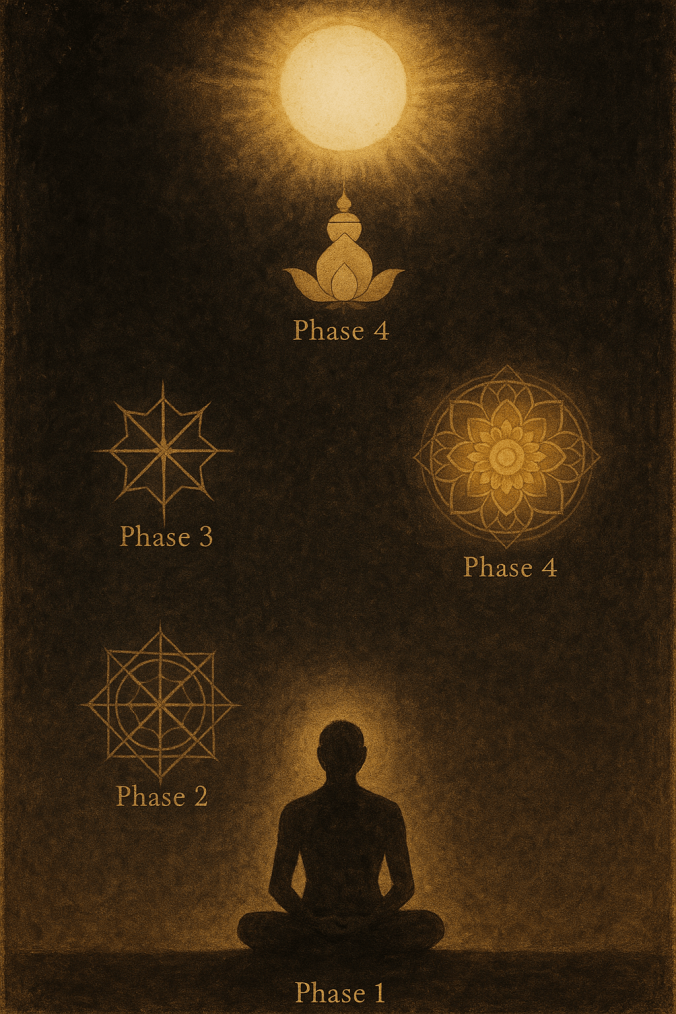
What immediately struck me was how this direct, unmediated path resonates so deeply with my experience of phosphenes—particularly their effortless appearance. I’ve seen these inner lights unfold, not because I was actively visualizing them or straining to make them appear, but because they simply arose, spontaneously, from the spaciousness of awareness. This “arrow way” mirrors that very process: a direct pointing, a sudden recognition, without the need for contrivance or effortful construction.
This profound effortlessness is key to understanding the very heart of Dzogchen, especially the crucial distinction it makes between meditation and contemplation. I’ve been incredibly fortunate to study for over seven years with Namkhai Norbu, a truly great Dzogchen master and a terma revealer who brought these profound teachings forth in a contemporary manner. His wisdom, often conveyed with great humor, has shaped my understanding. As he emphasizes, in Dzogchen, our nature or our real condition isn’t just emptiness; movement is also inherently present. There’s no difference between being in movement and being in a state of calm or stillness.
This insight fundamentally differs from certain Sutra path understandings, which often focus solely on cultivating a state of emptiness or stillness through meditation. In those approaches, thoughts are often deemed “bad” distractions, and a thought-free state is seen as the ultimate goal. However, in Dzogchen, the calm state of emptiness is not contemplation. Contemplation is the state of pure presence. It’s about being in that pure presence, and emptiness is simply one experience within it. What’s meant by “meditation” in Dzogchen, on the other hand, refers to the various practices like gaze fixation or visualization done to prepare one to enter this state of contemplation. So, in meditation there’s something to do, but in contemplation, there is not; my mind makes no effort whatsoever. There’s nothing to do, or to abstain from doing, because “what is” is already self-perfect.
My Own Phosphene Way
This distinction truly illuminates my own phosphene journey. As I continued my practice, I began to witness the unfolding of phosphenes through distinct stages. What started as mere flickering points of light (Phase 1) against the darkness or the open sky gradually transformed into more organized geometric patterns (Phase 2). These patterns then became increasingly elaborate and dynamic, forming complex, moving structures (Phase 3) that sometimes resembled intricate designs or even rudimentary scenes. The visions then evolved into highly structured and vibrant displays (Phase 4)—like the mandalas, lotus flowers, or even stupas described by the yogi. At this point, the light itself became undeniably central, leading to a stage where forms became less defined, giving way to the direct experience of pure light (Phase 5).
This understanding clarifies how these profound phosphene experiences lead to the ultimate realization. It’s in Phase 6, where all forms dissipate, that it’s not about fabricating anything, but about simply letting go into what’s already there. The directness of the “arrow way” beautifully explains how this effortless seeing ultimately leads to recognizing the essential luminosity of our own consciousness—that pure, primordial light that is our true nature.
Pure Issness
This fundamental dimension of pure presence, which is luminous awareness manifesting through our experience both within and without, is the very field of immanence from which life arises. To be in awareness of our own awareness naturally brings forth various meditative experiences. The first is a non-conceptual, direct perception of suchness, or reality as it is—the great expanse. Within this vast openness, there’s no grasping, no narrow focus; it’s an unbound, expansive focus, a pre-reflective knowing that forms the very heart of Dzogchen. This doesn’t mean I cannot think or feel, but that my thoughts arise from within this non-conceptual state of gnosis, or direct knowingness.
Sometimes, within this great expanse, there’s the spontaneous manifestation of a drop of liquid luminescence, a tigle. As spaciousness opens within and beyond the body, this vital essence arises from the heart essence, sometimes as a vast, round drop that represents the oneness of basic reality. These nectarian drops are like fluid, liquid light, containing the essence of awareness, the heart drops of dharmakaya – pure bliss. They can appear blue, like a blue pearl, or luminous white, or even darkness.
The second meditative state is an all-encompassing illumination, or the body of light. In essence, awareness itself is luminous spaciousness, intrinsically compassion. This vajra body, unborn and undying primordial presence, is compassion made manifest as radiance, naturally glowing and extending, bringing light into one’s self and others’ emanations. This heart essence radiance fills our worldly realm, accomplishing the realization of our nature for both ourselves and others. This benefit is not a solitary moment; the field and the drop bring forth the same realization in oneself, in others, and even in nature itself. Compassion’s natural glow invokes an echo-like sound that awakens me and others, spreading this all-encompassing illumination.
In truth, what arises within—that gift in me—is not simply for me, but for everything and everyone around me. I become a vehicle, an opening. It happens quite naturally if I don’t work too hard at it; too much effort can lead to an obsessive, compulsive “hell,” as Freud understood to be the course of most religion. The heart drop shines immeasurable light, manifesting as a tigle, a drop of liquid light that is meant to be shared.
This experience of the body of light encompassing illumination can metabolize old, pre-verbal, and pre-conceptual patterns. This light is the very source of realization; it brings a profound oneness within me, and easily allows oneness with another, with place, and even with time. The brief manifestation of my life, as the vajra youth body, is this radiance of primordial awareness coursing through me. The degree to which I sustain this body of light determines how fully my physical body transforms into light, becoming a wisdom deity. Dualistic clinging, desperate grasping, and fear dissolve, and I experience my body as the youthful, indestructible, ongoing continuity of being – truly, the deathless state becomes mine. I can even be a “luminous nut” or a “luminous ass” – the essence remains.
We place ourselves in wisdom gnosis, in non-conceptual awareness, and think and feel from within this vajra vase body, this youth body of light. I fill my awareness with this fearless body, filling my physical form with luminosity, resonant to light in the room, in other human bodies, to sound, to appearances, to smells. Even affects reveal themselves as light. The pure lands are actually here and now; Nirmanakaya, Sambhogakaya, and Dharmakaya are all present, right here, right now. This timeless presence is completely ordinary. We mistakenly think God is elsewhere, Buddha is elsewhere, Shiva elsewhere. They are here and now.
Finally, the state of awareness as sacred syllables arises, acting as a cause. The Dharmakaya manifests itself as light and energy, which are soundless syllables. We can truly understand divinity as luminous sound, and the human voice as luminous sound that opens appearance such that nature itself is revealed. Sambhogakaya and Nirmanakaya are miraculous forms of enlightenment, constantly manifesting through this profound experience. Shunyam Adhibhu
 breath4balance