In order to go the dzochgen quick recognition path, some meditations have been delivered by the ancient ones. One is the lion’s pose. Some details about this amazing phosphene meditation.
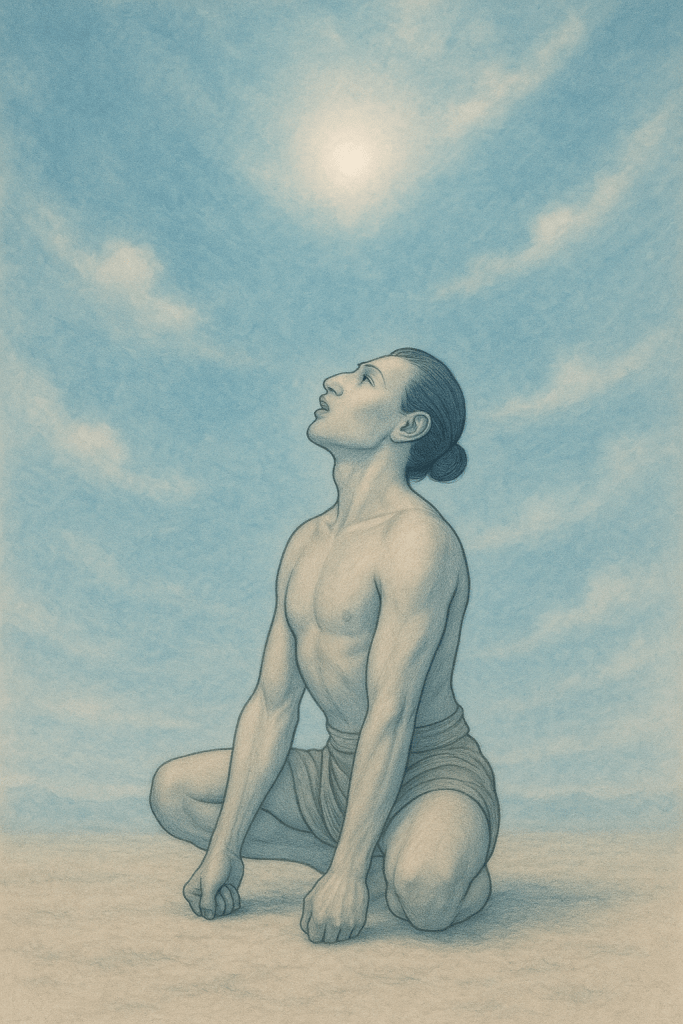
Building on my understanding of the effortless path in Dzogchen, I’ve come to appreciate the profound significance of its sky-gazing practices, which aren’t about forcing visions but about opening doorways to our true nature. There are three key postures recommended for this meditation, each designed to align our being for direct experience.
One striking example is the Dharmakāya posture, often likened to a seated lion. Here, I would settle on the ground with my feet’s soles together, my hands resting in front in a vajra fist. It’s about extending the upper body upwards, chin slightly tucked, with my spine and neck straight. This alignment isn’t rigid; it’s designed to facilitate the free flow of vital energies through the cranial pathways and the delicate ‘light channels’ that intimately connect my heart and eyes. With a gentle outward flow of breath through slightly parted lips, my gaze is then directed upwards, past an imagined point at the crown of my head, into the vast, limitless expanse of the sky. This deep blue sky then becomes a canvas for inner experience. While the seated lion is powerful, other postures like the elephant and the rishi are also used, allowing me to shift freely between them during a session while maintaining a profound stillness of body, eyes, and consciousness.
These physical postures, the gentle suspension of breath, and the precise gazes – whether raised, lowered, or sidelong – act as veritable ‘doors’ to a direct experience of multi-dimensionality, leading me beyond the single, dualistic reality to which we typically feel confined. The aim is to make the indwelling, pristine awareness, which is the innermost essence of the heart (snying thig), a living reality. This innate radiance, or lhun gyis grub pa, residing in the heart-center, doesn’t need to be conjured. It manifests spontaneously, first as delicate, flickering, gossamer strands, then as vibrantly present spheres of light. This occurs through a subtle, almost imperceptible channel – like a white silken thread or a ‘far-ranging noose’ – that directly links my heart and eyes.
These luminous essences, known as thig le, emerge as reflections of innate reality in the empty mirror of the sky, evolving through sequential stages. The halos of light eventually expand and transform into five concentric circles, with the central one embodying pure, unmanifest potentiality. As this central circle widens through my steady gaze, it gradually pervades immeasurable space. At this point, all distinction between subject and object, between mind and body, effortlessly dissolves in the boundless light of enlightenment. This practice is a direct path to experiencing consciousness as luminous, boundless, and always already perfect. Shunyam Adhibhu
 breath4balance