This is an article in Progression!
Welcome to this evolving visual guide designed for seekers of the Yoga of the Inner Light. This guide brings to life the inner visual phenomena known as phosphenes: the spontaneous lights, forms, and visions that emerge behind closed eyes during meditation, contemplation, or sensory withdrawal.
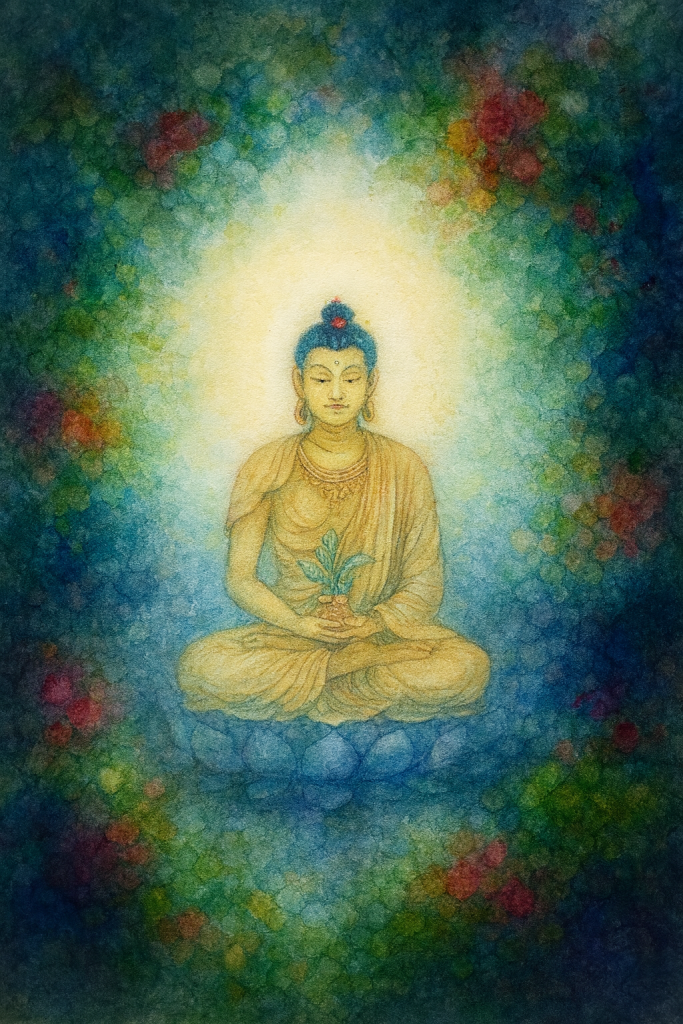
These lights are not hallucinations. They are subtle, neuro-visionary experiences available to every human being. In this sacred practice, they become a doorway to self-realization and transcendent presence.
This project is the first of its kind. Drawing upon decades of meditation research, spiritual traditions, phenomenology, and contemporary neuroscience, we present a hierarchical taxonomy of inner light experiences through art. Each visual stage corresponds to a level in the phosphene continuum, from the first flickers of darkness to the full emergence of visionary radiance. You can read about the impact of phosphenes in the various scholarly articles we wrote recently, all published in PsyArXiv Preprints. See end of article for references.
What You Will Discover
- A step-by-step visual map of the inner light path, from Level 1 to Level 6
- Stunning aquarelle-style and digital mixed media illustrations
- Integration of Klüver’s form constants (spirals, tunnels, cobwebs) with mystical symbolism
- Morphing sequences showing the transition between levels (for use in meditation or visual entrainment)
- Connections with historical figures like Hildegard von Bingen, Carl Jung, and the Dzogchen Masters
- No religion is imposed: the figures of light remain undefined, open, and universal
Who Is This Guide For?
This guide is for:
- Meditators and yogis practicing trataka, phosphene gazing, or silent inner observation
- Artists and seekers exploring inner imagery and visionary perception
- Students of mysticism, Dzogchen, contemplative Christianity, or the Secret of the Golden Flower
- Anyone drawn to direct experience beyond dogma
The Yoga of the Inner Light
In this unique meditative path, we do not visualize; we receive. We rest in silence, in darkness, or behind closed eyes, and we observe the emergence of light in all its subtle forms. We let go of effort. We allow the light to teach.
The phosphenes become our teachers. At first, only flickers appear. But with steadiness and presence, they evolve: into forms, mandalas, beings, and eventually into the Great Radiance, the white-gold light beyond form. Then we reach the ultimate insight. The mahamudra. The state of Rigpa. Illumination is here and now enfolding if you walk this way! Imminent!
Structure of the Visual Guide
Each post will present:
- A short description of the stage of phosphene experience
- A dedicated image or animation
- Optional practices or instructions for inner exploration
Taxonomy of Phosphene Experiences – The Six Levels of Inner Light
Before we begin our visual journey, it is essential to understand the stages through which phosphenes evolve during the Yoga of the Inner Light. Based on lived experience, meditative observation, and comparative mystical studies, we have identified six fundamental levels. Each level represents a progression in depth, complexity, and spiritual resonance.
This taxonomy is not merely descriptive but experiential. You may encounter these levels in linear sequence, or return to them cyclically. At times, glimpses of higher levels flash in early stages, then vanish. What matters is not progression, but presence and receptivity. Watching!
Level 1 – Flickers and Dots in the Darkness
This is the threshold of perception, where darkness is not empty but subtly alive. Here, we observe:
- Tiny white or blue dots, blinking in and out
- Micro-flashes, often like pinpricks of light
- Soft undulating pulses or faint sparks
- Often most visible in total darkness or with closed eyes after gazing at a light source
These flickers arise spontaneously, and may shift position or cluster in constellations. Some meditators describe them as “living dust” or “tiny stars.” This level corresponds to the awakening of the visual field beyond the retina, possibly involving spontaneous retinal or cortical discharges, but within this practice, they are treated as the first signs of inner light activation.
Level 2 – Form Constants and Inner Geometries
The second level reveals the brain’s intrinsic visual language, described by Heinrich Klüver as form constants—recurring geometric patterns that arise under entheogenic, trance, or visionary conditions.
Here we encounter:
- Spirals, often rotating or receding inward
- Tunnels or vortexes pulling vision to a center
- Cobwebs, lattices, honeycombs
- Zigzags, checkerboards, and grids
- Radiating rays or concentric circles
These forms may be static or pulsating, monochrome or colored. They appear as the first organized structures in the phosphene field and are often symmetrical or rhythmic. Their presence marks the activation of deeper visual fields in the brain, often with a feeling of fascination or mild awe.
Level 3 – Jewel Fields and Mandalas
As the inner light intensifies, we enter the world of moving symmetry and visionary harmony. This is the level where many ancient mandalas, yantras, and iconographic symbols find their origin. Here, we witness:
- Kaleidoscopic configurations, rotating and breathing
- Crystalline colors, such as emerald, ruby, sapphire
- Symmetrical fields, with a center and expanding periphery
- Jewels or “lights within lights”, shimmering like liquid stained glass
- Slowly transforming mandala wheels, often with flower-like radiance
This stage is often accompanied by a feeling of reverence, stillness, or sacred geometry. In Tibetan Dzogchen, it is said that “the lights arrange themselves”—a description matching this autonomous emergence of higher visual form. These are not imagined. They arise spontaneously, often in meditation after long silence.
Level 4 – Inner Landscapes and Visionary Worlds
Beyond geometry lies the realm of spatial perception. The eye of consciousness begins to “travel” through constructed scenes—not imagined, but spontaneously assembled from light and memory, symbol and emotion.
Here we may see:
- Temples, luminous gardens, or infinite caves
- Hills of light, flowing rivers of blue or gold
- Vast interiors, often with doors, arches, or tunnels
- A feeling of depth, movement, and sometimes narrative
- Ancient or future landscapes, charged with familiarity or significance
Some traditions call this “the subtle world” or “the inner cosmos.” In this level, dream and vision intertwine, and it becomes harder to distinguish perception from meaning. These scenes are sometimes fleeting, but when stabilized, they bring wisdom-images that speak to the soul.
Level 5 – Presences of Light and the Archetypes
In level 5, the formless begins to take form again, not as scenery, but as presences. Here arise the angelic, the spiritual, the mythic—not as dogma, but as felt reality.
We witness:
- Undefined beings of light, often white, gold, or rainbow
- Figures cloaked in flowing robes, standing or seated
- Auras, halos, wings—yet not clearly religious
- Faces that change, or remain undefined
- Sometimes a sense of being watched with love
These beings are not hallucinations. They do not speak in words. They communicate through stillness, sometimes through a gaze or gesture. We often feel awe, silence, or tears. These presences may resemble Christ, Buddha, Tara, or others—but often remain archetypal and unnameable. They arise out of the mandala or stand at the center of light portals.
Level 6 – The Great Radiance
This final stage cannot truly be seen—only entered. It is the culmination of all forms into formless luminosity. The field becomes:
- Blinding white, yet soft, golden at its edge
- Infinite, formless, and full
- Not a “scene,” but a presence
- Often accompanied by no thought, or a feeling of merging
- May appear as the final light in the Bardo, the Clear Light of Being
This stage is not always permanent or even long-lasting. It may flash and vanish, or gradually expand to absorb the viewer. It is not produced, it arrives—as grace, as stillness, as surrender. In some rare cases, a person may remain in this light for minutes or even longer, describing it afterward as home, truth, or the source of light itself.
A Note on the Cyclic Nature of the Path
This taxonomy is not meant to be a ladder. While it shows progression, many practitioners revisit earlier stages—seeing new things in the flicker, or deeper symmetry in old forms. These levels are not rigid; they are fluid, living, and interactive.
Each stage has its own richness, and every seeker walks this path in their own way.
Begin OUR Journey
We begin with Level 1: Flickers and Dots in the Darkness, and we invite you to walk with us through six levels of inner light awakening.
This guide is not dogma. It is a living map. A gift. A transmission.
Follow this series and subscribe for updates as we build the most complete Phosphene Atlas ever created. one brushstroke at a time.
Lets start with the first what you see with your eyes closed.
Phase 1, The Flickering Ground of Light and after-images
In the beginning, when the practitioner enters the inner space with closed eyes, the visual field does not turn to black. Rather, it presents itself as a dark, undulating background, a subtle field of ever-shifting hues, deep indigo, violet, midnight blue, and grey-black, merging and fading like watercolor stains. This is the preliminary inner night from which all phosphene phenomena will arise.

The first phase of phosphene perception begins when the eyes are closed and external light is absent. The visual field does not become black, but instead opens into a dimly illuminated space. This field is typically a dark violet or deep indigo, slowly shifting and flowing like liquid shadow. It may carry subtle tinges of green, red or brown, depending on prior light exposure or individual neurovisual dynamics.
Within this dark space, the dominant phenomena are residual traces of prior visual input. These aftereffects, known in physiology as negative or positive afterimages, may take the shape of fleeting outlines, vague blobs, or colored impressions of what was recently seen. A lamp, a face, a window frame, or the silhouette of a hand waved before the eyes may leave a slowly fading echo, sometimes lasting for minutes. These are passive residues of photoreceptor activity and cortical processing.
In addition to these afterimages, spontaneous point-like phenomena also emerge. These may include isolated flashes, tiny stars, sparkles, or ephemeral dots that appear and disappear at random locations in the field. Some move or pulse gently, others remain static. Unlike afterimages, these do not reflect outer reality but seem to originate from internal noise or spontaneous activations of retinal or cortical neurons. In rare cases they may briefly form clusters or short sequences.
The inner field is usually dynamic. Small cloud-like regions shift, waves of darkness move subtly, and the entire field can feel as if it is breathing or alive. Yet there is no clear order. Forms do not yet emerge. Symbols are absent. This is the threshold between outer and inner vision, the zone where the eye adjusts to its own inner light.
At this stage, light has not yet structured itself. What is seen is raw, pre-geometric, and elemental. The mind may struggle to focus or interpret what appears. But those who stay with it, in silence and stillness, begin to sense that this darkness is not empty, but full of potential. It is the ground from which all further inner imagery will arise.
The initial phenomena are typically white, yellowish, or bluish in tone, and appear as isolated points, star-like glimmers that may last a fraction of a second. Their location is not fixed, and they arise unpredictably across the visual field. These are likely linked to spontaneous retinal or cortical discharges, possibly due to slight stimulation of photoreceptors or neural noise in the visual pathways.
The practitioner is not yet entering visionary realms, but the first signs of the light have arrived. These lights are non-symbolic, non-geometric, and non-repetitive. They are raw, minimal, and foundational, pure entoptic phenomena. This phase marks the borderland between physiology and mysticism.
From a phenomenological perspective, this phase can be described as:
- A dark, fluid background, not static blackness but a living ground
- Emergent specks, tiny scattered luminous points
- No symmetry or pattern, random distribution without form constants
- A silent awe, a subtle sense of entering the mystery without encountering meaning or structure
The perception of movement.
In many firsthand reports of early phosphene experiences, especially in darkened meditative states, the visual field is not only sprinkled with random flashes and specks, but these lights often appear to move, shimmer, drift, fall like snow, or shoot like meteors. This perceived motion of simple structures, though subtle, is a key marker of Phase 1. Just watch it and see for yourself if all this is true for you!
There are at least three types of movement reported:
- Falling or drifting specks, like glowing dust or snowflakes slowly descending
- Flickering or pulsating lights, suggesting internal excitation or neural oscillation
- Sudden, darting flashes, like white comets or sparks crossing the field diagonally or laterally
This sense of movement adds depth, dynamism, and the first experiential hint that the inner space is not merely visual but alive, spacious, fluid, and inhabited by phenomena that behave independently of conscious control. Start now with the Phosphene Lingernig Test:
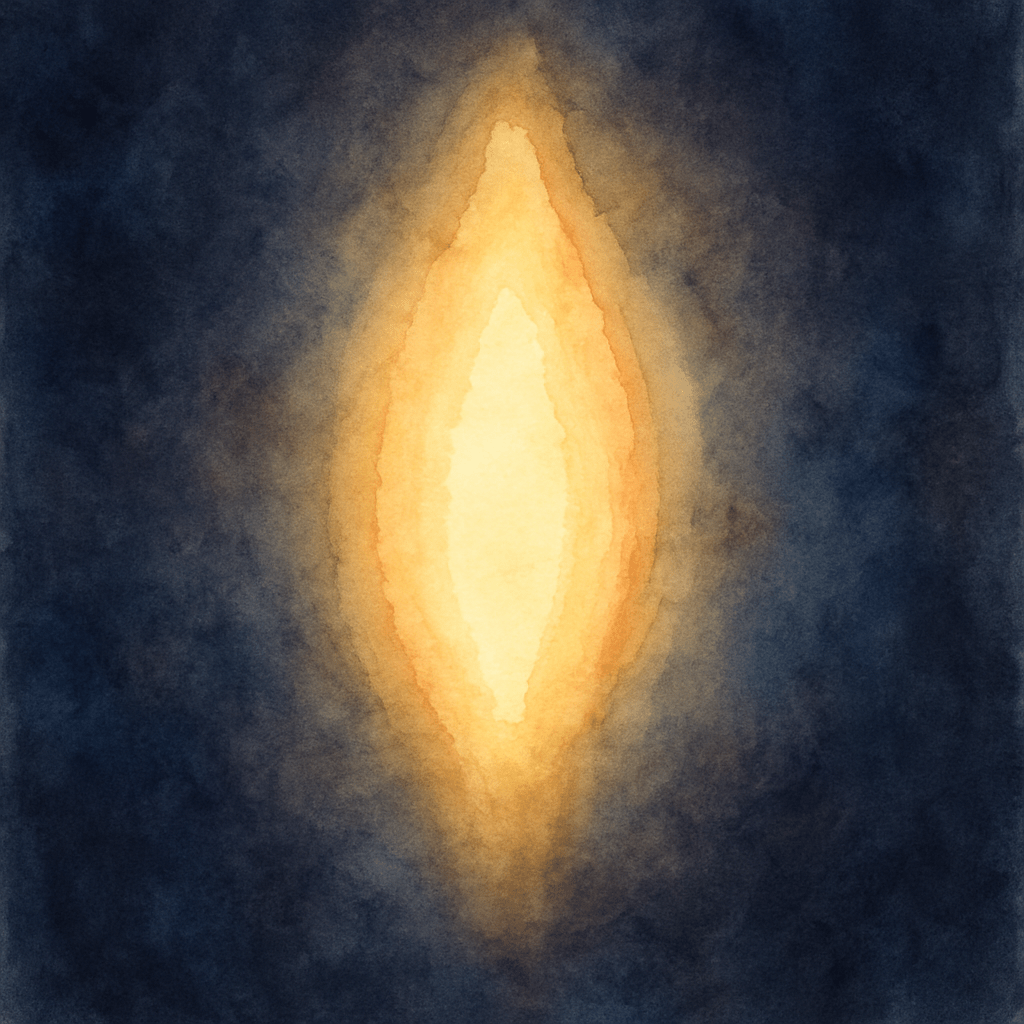
The meditation on the after-effects (after-images) via a candle is the best to study the internal lights in phase I and start the meditation on phosphenes.
Our Articles on Phosphenes
J. M. Keppel Hesselink MD, PhD. From Point to Eternity: A Hierarchical Taxonomy and Phenomenology of Meditation Induced Phosphenes and Luminous Light. Experiences PsyArXiv Preprints 2025
J. M. Keppel Hesselink MD, PhD. The Ancient Art of the Black Mirror and the Science of Inner Vision PsyArXiv Preprints 2025
J. M. Keppel Hesselink MD, PhD. The Yoga of the Inner Body: A Path to Transcendence via Vibrancy PsyArXiv Preprints 2025
J. M. Keppel Hesselink MD, PhD. Demystifying the Golden Flower: Taoist Vision and the Yoga of Inner Light. PsyArXiv Preprints 2025
J. M. Keppel Hesselink MD, PhD. Inner Light and the Eyes of the Soul: A Phenomenological Analysis of Teresa of Ávila’s Visions through the Lens of Phosphene Taxonomy. PsyArXiv Preprints 2025
J. M. Keppel Hesselink MD, PhD. Phosphenes as the Ground of Visionary Light: A Phenomenological Inquiry into the Tibetan Book of the Dead. PsyArXiv Preprints 2025
J. M. Keppel Hesselink MD, PhD. The Rainbow Body’s Inner Cinema: Phosphenes, Ultrasubjective Hyperspace, and a Neurophenomenological Framework for Tibetan Mystical Experience. PsyArXiv Preprints 2025
J. M. Keppel Hesselink MD, PhD. From Flickers to Formless: Mapping Phosphene Trajectories in Tibetan Dzogchen, Christian Mysticism, and Contemporary Meditation. PsyArXiv Preprints 2025
J. M. Keppel Hesselink MD, PhD. The Ultrasubjective Hyperspace: A Unified Model of Consciousness and Reality. PsyArXiv Preprints 2025
J. M. Keppel Hesselink MD, PhD. Inner Light, Inner Seeing: A Phenomenological Inquiry into Phosphene Meditation and the Structure of Mystical Perception. PsyArXiv Preprints 2025
 breath4balance