In the book The Reality of Being Jeanne de Salzmann brings an important clarification around how we can and should perceive ‘impressions’ in order to grow.
The decisive point of inner work
The moment of impression
In the Gurdjieff Work, the word impression refers to a precise and critical moment: the instant at which reality meets the human organism. An impression is not the external event itself, nor is it a thought or feeling about what happens. It is the point of contact, prior to interpretation, reaction, or habit. The teaching insists that this moment is decisive, yet almost universally misunderstood.
“We do not understand the moment of receiving an impression and why it is so important.”
Most inner efforts fail because this moment is overlooked. People try to change their thoughts, emotions, or behavior, but by then the decisive contact has already passed unnoticed. The Work begins earlier, at the threshold where something enters.
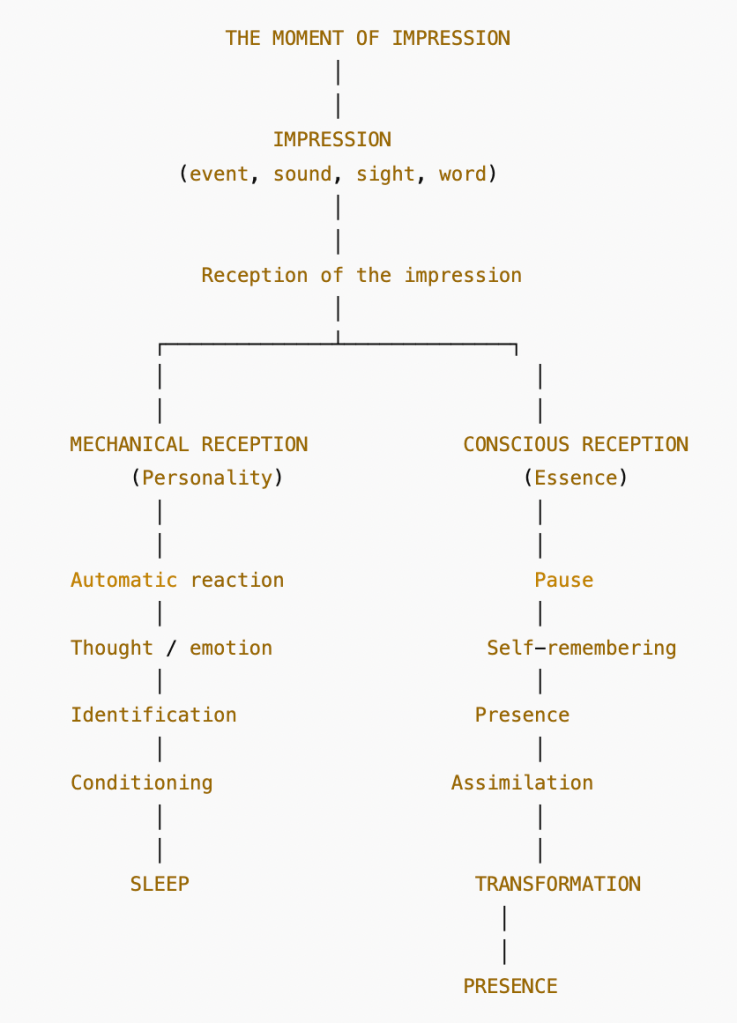
Mechanical reception and sleep
In ordinary life, impressions are received mechanically. Something happens and immediately thoughts appear, emotions react, associations take over, and the body responds according to habit. There is no pause and no presence at the point of entry. The impression is instantly transformed into reaction.
“If there is nobody here at the moment an impression is received, I react automatically, blindly, passively, and I am lost in the reaction.”
This condition is described as sleep. It is not inactivity, but the absence of inner presence. A person can be active, intelligent, and emotionally engaged while remaining asleep in this sense.
“I am a being who is asleep, a being with no consciousness in himself.”
In sleep, impressions do not reveal reality. They merely reinforce conditioning.
The false “I” and the refusal of impression
A recurring theme in the text is that the ordinary sense of “I” actively interferes with the reception of impressions. Instead of allowing what is to be seen, the person inserts an image of self, a narrative, or a judgment. In doing so, the impression is refused.
“I refuse the impression of myself as I am. In thinking, in reacting, in interposing my ordinary ‘I’ in the reception of this impression, I close myself.”
The ordinary “I” is not a stable entity but a collection of habits, memories, and identifications. It lives in imagination rather than direct perception.
“I am imagining what ‘I’ am. I do not know the reality. I am the prisoner of this imagination, the lie of my false ‘I.’”
As long as this false “I” dominates, impressions cannot be received as they are.
Essence and the assimilation of impressions
The distinction between personality and essence becomes crucial at this point. One of the most exact statements in the text defines the origin of essence:
“Essence is formed from impressions that are assimilated in early childhood.”
This sentence clarifies that impressions alone are not sufficient. What matters is assimilation. Assimilation requires presence. In early childhood, impressions may be assimilated naturally. Later, as personality takes over, impressions are usually received mechanically.
“Ordinarily impressions are received in a mechanical way. They are received by our personality, which reacts with automatic thoughts and feelings that depend on its conditioning.”
Personality reacts, but it does not digest. It cannot transform impressions because it lacks inner life.
“We do not assimilate impressions because personality itself cannot be alive—it is dead.”
For essence to continue developing, impressions must again be received consciously.
“In order to be assimilated and transformed, impressions have to be received by essence.”
Remembering oneself and presence
The practical condition for this shift is clearly stated in the Work.
“We need to ‘remember ourselves’ for our essence to receive impressions.”
Self-remembering is not an abstract exercise. It is the act of being present at the very moment an impression enters, without immediately reacting or identifying. When this happens, a pause appears.
“There is a stop, an interval that allows my energy, my attention, to change direction. It turns back toward me.”
This interval is decisive. It is the only place where freedom can appear.
Impression as shock
In this context, impressions are often described as shocks. This does not mean something dramatic or external. The shock refers to the interruption of mechanical flow when an impression is received consciously.
“This will be a shock that awakens me, a shock brought by an impression that I receive.”
The shock lies in the gap between impression and reaction. Without this gap, life continues mechanically. With it, awakening becomes possible.
The impression of oneself
Work on impressions inevitably leads to the impression of oneself. Awakening does not begin by striving toward an ideal, but by opening to what one actually is in the present moment.
“I must learn to awaken by opening consciously to the impression of myself and seeing what I am at the very moment.”
This often reveals emptiness or absence. The text emphasizes that this cannot be bypassed by effort or will.
“My effort to awaken cannot be forced… All forcing comes from the ego.”
What is required is acceptance.
“I need to accept emptiness, accept to be nothing, accept ‘what is.’”
Only through this acceptance can a new quality of perception arise.
Presence and the decisive role of attention
Everything ultimately depends on how impressions are received.
“All my possibilities are here. What follows—whether I will open to the experience of Presence—depends on the way I receive this impression.”
Presence is not achieved later. It appears, or fails to appear, at the moment of contact with reality. This is summarized in a sentence that condenses the entire Work into a single principle:
“Where our attention is, God is.”
In the context of the Gurdjieff Work, this is not a theological statement. It means that attention at the point of impression determines the quality of being.
Summary
- Impressions are the primary point of contact between reality and the human being
- Mechanical reception of impressions maintains sleep
- Conscious reception allows impressions to be assimilated by essence
- Personality reacts to impressions but cannot assimilate them
- Essence develops only through impressions received with presence
- The moment of impression is the only real point of freedom
- Awakening depends not on what happens, but on how impressions are received
 breath4balance