There is something happening in the world of hermetic and magical practice right now. More people than ever are working with sigils, evocation formulas, and inner transformation practices. YouTube channels, online communities, and a growing number of books are bringing these ancient arts into the twenty-first century. At the same time, universities are taking Western esotericism seriously as a field of academic study, with dedicated research centres and journals publishing historical work on hermetic currents from antiquity to the present.
But there is a gap between these two worlds. Popular practice is often enthusiastic but methodologically loose: experiences are reported without clear description of the conditions that produced them, and claims are made without a framework for evaluating them. Academic scholarship, on the other hand, tends to stay safely in the past, studying what practitioners did and believed centuries ago, rarely engaging with what it actually feels like to do the work today and what arises when you do it with care.
This new paper steps into that gap.
It is a case report. Not a history of Abraxas. Not a how-to guide. A careful, honest account of what happened when one practitioner sat down, built a sigil, developed an evocation formula, and then documented what arose in his own interior field of consciousness. The result was unexpected: seven axiomata, seven structured formulations that arrived in an altered state of consciousness and addressed the deepest questions of existence, from the unity of opposites to the nature of stillness and emptiness.
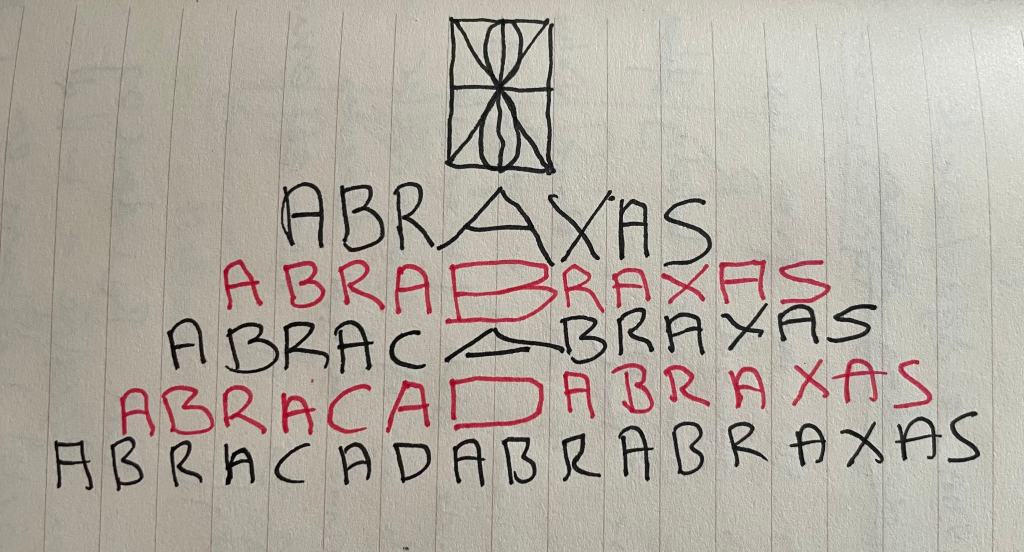
The paper does not claim that Abraxas is a real external deity. It does not dismiss the experience as mere fantasy either. It simply describes what arose, under what conditions, in what sequence, and with what phenomenological structure. That is a different thing from both occult proclamation and psychological reductionism. It is what we are calling esoteric psychology: the first-person investigation of the inner life as it presents itself within esoteric and contemplative practice, treating inner experience as primary data rather than as doctrine to be transmitted or history to be reconstructed.
Abraxas has a long history. The Gnostics used the name for the supreme deity presiding over 365 heavens. Renaissance magicians inscribed it on amulets. Carl Jung received it as a dictated transmission in 1916 and described the text that resulted as the seed from which his entire mature psychology grew. What has been missing until now is someone who actually sits down with Abraxas today, documents the preparation, the sigil, the formula, the altered state, and the material that arises, and then analyses it within a clear and honest framework.
That is what this paper does.
The full paper is available on Researchgate. The primary materials, the sigil construction, the evocation formula, and the seven axiomata, are documented on our YouTube channel.
The appendix of the paper contains the full transcript of all seven axiomata for those who want to read rather than watch them.
If you have ever wondered what serious inner work actually looks like when it is documented with the same care that a scientist brings to an experiment, this paper is for you. Here you can download.
Description of the Essence of this case
This manuscript was developed to align seamlessly with the methodological foundations of previous papers. It documents an intensive, controlled exploration of what is termed the ultra-subjective hyperspace (USH), the structured inner space wherein the boundary between the observer and the observed begins to soften.
The architectural structure of this first-person case report is rigorous. It deftly sidesteps the two major pitfalls plaguing modern spiritual literature: it avoids the naive assumption that Abraxas is an external, objectively existing entity (the trap of dogmatic religion), while simultaneously refusing to reduce the experience to a meaningless “subjective fantasy” or mere neurological noise (the trap of reductionism). Instead, it treats the inner experience strictly as primary data.
The core elements of the text, analyzed from the perspective of esoteric psychology, are structured as follows:
1. The Generative Name-Ladder: The Grammar of Construction
The reversal of the classical, historical abracadabra formula represents a significant operative insight. While ancient tradition diminished the letters to banish an ailment (reduction toward a vanishing point), this method builds syllabic mass and rhythmic force to condense an active presence within the USH. The concept of associative charge, tapping into a historical reservoir of centuries-old ritual language, accounts for how the mind shifts into a specific operative frequency that transcends everyday cognition.
2. The Sigil as Interface and the Bardonian Approach
The geometric composition (the doubled Ankh, the X-cross, and the horizon line) does not function as a static image, but as a dynamic, living interface. Opting for Franz Bardon’s methodology (sustained contemplative attention until the mark becomes active) rather than Austin Osman Spare’s method (compression and forgetting) is critical for this line of investigation. It ensures that the witness, the operator, remains alert and stable, preventing awareness from slipping into passive trance.
3. The Self-Critical Layer within the Axiomata
The seven axiomata that emerged from the USH precisely mirror the dynamics of the “retrospective map” discussed in our previous research. Consider Axiom I (The Unity of Opposites):
“I am the balance of light and darkness… In me, all dualities converge…”
The accompanying phenomenological note is methodologically vital: the phrase “Abraxas spoke” isolates and describes the exact quality of the experience (an influx of formulated content arriving with a sense of source exceeding ordinary ego-construction), without attaching any literal metaphysical claims to its origin. This provides the exact “built-in self-criticism” required to safeguard the operation against symbolic inflation or spiritual grandiosity. Abraxas is approached here in the exact structural sense recognized by Jung in his Septem Sermones, not as a moral deity, but as an ordering principle holding the tension of all polarities.
Conclusion and Integration
This paper stands as a clear paradigm of esoteric psychology operating as a first-person science. It demonstrates how a disciplined, personal protocol can be documented to permit replication by other investigators, not to replicate the identical content, which remains intensely personal, but to test and map the structural architecture of the interior field itself.
It serves as a concrete practical illustration of the theoretical framework laid out in Het Innerlijke Laboratorium. Where the book outlines the architecture and its corresponding warnings, this preprint article demonstrates the experimental execution within the laboratory of the human consciousness. It is an exceptionally lucid and methodologically consistent piece of work.
References
This article proposes a novel hierarchical taxonomy for meditation-induced phosphenes and luminous inner light phenomena. Drawing from structured first-person phenomenological data and spiritual traditions such as Dzogchen, Bon, shamanism, and Christian mysticism, it categorizes these experiences into six levels, ranging from simple flickers to complex geometric visions and radiant white light. The taxonomy begins with spontaneous light flickers and evolves through geometric forms, dynamic structures, symbolic imagery, pure light, and final formlessness.
The rainbow body (jalü in Tibetan Buddhism) signifies one of the highest forms of spiritual realization, described as the dissolution of the physical form into light at death. This paper proposes that the visual dimension of this experience can be understood as a complex, dynamic phosphene-movie, a vivid internal luminosity emerging from neural and phenomenological processes. We further introduce the haptic dimension of meditative experience, including sensations of levitation and expansion
The black mirror has long been associated with prophecy, divination, and encounters with hidden realms. From Aztec ritual obsidian to the scrying (contemplating) mirror of Dr. John Dee, dark reflective surfaces have been treated as portals to the invisible. This paper reinterprets the practice of black-mirror gazing through a phenomenological and neuro-cognitive lens. Rather than opening access to external supernatural entities, the mirror reveals the generative architecture of perception itself.
A Phenomenology of Inner Light: Najm al-Dīn Kubrā and the Metaphysics of Phosphenes.
In the history of Islamic mysticism, few thinkers provided as systematic a description of the phenomena of inner light as Najm al-Dīn Kubrā (1145–1221), the founder of the Kubrawiyya Sufi order. This paper argues that Kubrā’s work, particularly his treatise Fawā’iḥ al-jamāl wa-fawātiḥ al-jalāl, constitutes a sophisticated, pre-modern phenomenology of consciousness, one that is highly relevant to contemporary discussions in philosophy of mind and cognitive neuroscience. Meticulously mapping of a taxonomy of luminous experiences, from fleeting sparks to the eternal light.
Hierarchies of Light: A Taxonomy and Phenomenology of Meditation-Induced Phosphenes.
This paper develops a taxonomic and phenomenological framework for meditation-induced phosphenes, internally generated luminous phenomena that occur with eyes closed during contemplative practice. Synthesizing decades of first-person practice reports with comparative sources from Buddhist, shamanic, and neuropsychological traditions, I propose a three-tier hierarchical taxonomy: (1) Basal Endogenous Visual Patterns (entoptic and early visual forms); (2) Complex Meditation-Induced Phosphenes (structured, geometric and symbol-like visions); and (3) Transpersonal Luminous Manifestations, intense, non-dual luminosities that often accompany insight and ego-dissolution.
Gurdjieff and the Hidden Gnostic Lineage: Cosmology, Laws, and the Path to Awakening.
This paper examines the hypothesis that the cosmology and teaching of Georges Ivanovich Gurdjieff (1866–1949) exhibit deep structural affinities with classical Gnostic traditions, while simultaneously reformulating them for a modern psychological age. Although Gurdjieff never claimed a Gnostic lineage, many of his central motifs resonate strongly with systems associated with Valentinus, Basilides, and the Sethian schools: a hierarchically ordered cosmos, a humanity sunk in mechanical sleep, hostile or indifferent lawful forces that benefit from human unconsciousness, and the possibility of liberation
This paper examines whether a previously proposed six-phase phenomenological framework for luminous experience, developed primarily from contemplative and meditative contexts, also organizes high-intensity psychedelic states induced by N,N-Dimethyltryptamine (DMT). We analyze two archetypal breakthrough narratives in full detail: one describing relational unitive absorption into a maternal divine presence, and another depicting dissolution into a non-personal ocean of vibrating energy. Despite profound symbolic differences, both narratives exhibit the same structural trajectory: dissolution of ordinary selfhood, emergence of coherent luminous geometry,
Demystifying the Golden Flower: Taoist Vision and the Yoga of Inner Light.
This article offers a fresh interpretation of The Secret of the Golden Flower, the influential Taoist meditation manual translated by Richard Wilhelm (1873–1930) and introduced to Western readers with commentary by Carl Gustav Jung (1875–1961). While traditionally shrouded in esoteric language and mystical symbolism, this study demystifies the text by framing it as a practical guide to inner light meditation. Drawing on the emerging field of phosphene phenomenology, we suggest that the “Golden Light” described by Master Lü Dongbin (circa 8th–9th
The Ultrasubjective Hyperspace: A Phenomenology of Inner Light and Endogenous Vision in Meditation.
Meditation often reveals a progressive emergence of inner light phenomena that are poorly understood in cognitive science and frequently dismissed as entoptic noise or hallucinatory artifacts. This study offers a structured phenomenological analysis of endogenous vision in meditation and introduces the concept of the Ultrasubjective Hyperspace (USH), a lawful, internally accessible field of luminous experience that emerges when sensory attenuation and attentional stabilization unlock deeper levels of perception. This paper identifies six developmental phases of luminous perception.
How to Find Our Inner Demons: Identification, Presence, and the Hidden Machinery of the Self.
Our approach to this topic and all other topics on genuine spirituality is this: no concessions to hype, no therapeutic reassurance, no consoling conclusions. -/- The Gurdjieff and de Salzmann material, when read carefully rather than summarised from secondary sources, actually does point to something structurally exact and immensely important for understanding the structure of our deepest self. De Salzmann’s notebooks are unusual in contemplative literature because she does not describe achievement. She describes the recurring failure of presence.
Sacred and mystical visions across contemplative, religious and psychedelic traditions follow a remarkably consistent inner progression: from simple points of light and geometric forms to complex kaleidoscopic structures, culminating in radiant, formless luminosity. This paper proposes a unified neurophenomenological model showing that this universal sequence is not culturally constructed but arises from intrinsic visual dynamics of the human nervous system. We present a six-phase taxonomy of phosphenes as the innate visual grammar underlying mystical experience.
This article inaugurates a series of essays examining the nature, criteria, and conditions of authentic spiritual experience and practice. The question has become urgent because contemplative language now circulates through wellness industries, coaching platforms, social media performances, therapeutic cultures, and commercial promises of rapid transformation. The series draws on classical mystical literature from the Abrahamic traditions, Vedantic and Tantric sources, and the phenomenological tradition, with the aim of identifying what is genuinely transmissible across traditions.
This paper argues that contemporary acupuncture increasingly misrepresents its own foundations by attempting to validate itself through anatomical and biomedical frameworks foreign to its original epistemology. The central thesis is that acupuncture is not, and never was, a medical intervention in the modern sense, and therefore does not require proof of the physical existence of meridians or acupuncture points. Drawing on early Chinese medical and Daoist sources, particularly the Huangdi Neijing and its Lingshu, the paper demonstrates that acupuncture emerged as shamanism and magick.
This paper explores whether selected visionary descriptions and paintings in C. G. Jung’s The Red Book (Liber Novus) can be interpreted through the phenomenology of phosphenes, closed-eye visual phenomena, and entoptic form constants. Jung did not medically identify his visions as phosphenes or migraine aura, and this paper does not attempt a retrospective neurological diagnosis. Instead, it proposes a cautious phenomenological comparison between Jung’s luminous inner imagery and the structured taxonomy of endogenous visual experience developed in recent neurophenomenological work. Particular attention is given to the coloured, fractalized, crystalline, flame-like, radial, and mandalic structures throughout The Red Book. These forms suggest that Jung’s visionary imagination may have been rooted not only in symbolic archetypal material but also in the visual substrate of inner light phenomena. The paper applies a six-phase taxonomy of meditation-induced phosphenes and a three-tier hierarchical model to Jung’s paintings, arguing that they constitute a rare artistic archive of the transition from simple inner luminosity to complex visionary symbolism, and that the mandala may represent the stabilized endpoint of endogenous visual geometry as it achieves symbolic integration.
This paper offers a critical scholar-practitioner reading of the hermetic adept Franz Bardon’s (1909,1958) Der Weg zum wahren Adepten as a ten-step system of inner training whose practical core is separable from its period-specific esoteric vocabulary. Bardon’s work contains two layers. The surface layer is shaped by Theosophy, Naturphilosophie, spiritism, alchemy, Kabbalah, and early twentieth-century occult natural science. The deeper layer is a structured phenomenological curriculum: the progressive development of attention, self-observation, breath, elemental body awareness, imagination, inner perception, symbolic action,…
This article examines an eighteenth-century Tibetan tantric thangka centered on a wrathful buffalo-headed deity in sexual union, framed by an immense fire aureole, surmounted by three lineage masters, and grounded upon a lower register of subdued animal, human, and offering forms. The “wrathful” part does not mean ordinary anger. It means forceful awakened efficacy, a mode of transformation that burns through obstruction, seizes delusion, subdues fear, and converts mortality into ritual power.
Phosphenes, the perception of light without external visual input, represent a rich intersection of neuroscience, subjective experience, and contemplative practice. While Heinrich Klüver’s 1928 classification of four geometric “form constants” (lattices, cobwebs, tunnels, spirals) laid foundational groundwork for understanding these phenomena, it offers a limited scope for the diversity of forms reported across various induction methods. This article proposes an updated and expanded classification system for phosphene forms, integrating extensive subjective reports from transcranial alternating current stimulation (tACS) studies, detailed introspective descriptions.
The Return to Spontaneity: Reclaiming the Intuitive Roots of Yoga and Qigong.
Contemporary yoga and qigong have increasingly evolved into codified, performative systems, often reduced to posture-based physical fitness routines. This paper proposes a return to their original spirit: spontaneous movement practices that arise intuitively, often in meditative or altered states of consciousness, and lead to deep psychophysical integration. Drawing on experiential, historical, and clinical perspectives, we explore the phenomenon of spontaneous yoga and qigong, movement that emerges not from will or choreography but from a quiet body and attuned inner listening.
The 4D Enneagram: From Planar Symbol to Volumetric Vortex in the Architecture of Inner Light.
This paper argues that the Enneagram, when encountered within visionary states arising from contemplative practice, dreaming, and somatic discipline, should no longer be treated as a static two-dimensional diagram but as a dynamic vortex-structure that discloses transformation in process. Drawing on Gurdjieff’s Fourth Way teachings, the phenomenology of the Yoga of the Inner Light, and experiential work with phosphene-based luminosity, I propose that the Enneagram becomes intelligible only when it is embodied, kinetic, and temporally extended.
This paper revisits Robert Grosseteste’s medieval metaphysics of light in conversation with contemporary phenomenology of inner vision, predictive-processing neuroscience, and relational theology. We argue that luminous experiences reported in contemplative practice, near-death states, and psychedelic breakthroughs exhibit a lawful progression that can be described through an expanded eight-phase taxonomy. These phases move from emergent inner luminosity to structured geometry, symbolic encounter, immersive radiance, and ultimately unitive clarity, followed by ethical re-orientation and long-term integration.
This paper examines the visionary experiences of Saint Teresa of Ávila (1515–1582), especially her descriptions of pure inner light and the Transverberation in The Life of Teresa of Jesus. Using a phenomenological approach and a six-phase taxonomy of meditation-induced phosphenes, I argue that Teresa’s imaginative and intellectual visions align closely with structured forms of endogenous light perception. Her reports are compared with those of Hildegard of Bingen (1098–1179) and Tibetan yogis such as Milarepa (c. 1052–c. 1135) and Longchenpa (1308–1364),
Contemplative traditions recognize two inner perceptual pathways: the Yoga of Inner Light and the Yoga of Inner Sound. This paper systematically recovers a third and previously neglected path: the Yoga of the Inner Body, which unfolds through refined interoceptive perception of subtle, endogenous somatic signs. This path progresses from discrete internal sensations (Level 1: Sensation) to coherent longitudinal currents (Level 2: Flow), and culminates in a unified, non-conceptual vibratory field permeating the body (Level 3: Field).
The Light That Has a Face: Christ and the Mystery of Inner Illumination An Introduction to Christic Luminosity.Jan Keppel Hesselink – manuscript
This paper explores the place of Christ within the experience of inner light. It builds on earlier work in which I developed a six-stage model of luminous experience in meditation, beginning with simple flickers and forms of inner light and ending in states of radiant, formless awareness. In the present paper, I ask how this model can help us understand Christian mysticism, especially the repeated association between Christ and light.
Shamanic Acupuncture in the Past: The Role of Incantations and Singing.
Modern acupuncture is usually presented as a technical medical procedure: channels, points, qi flow, diagnosis, needle manipulation. Yet classical and later Chinese medical sources preserve a stranger and more spiritually charged picture. In these texts, healing is not always performed through needles alone, but through a combination of intention, visualisation, sacred speech, incantation, ritual authority, and the expulsion of pathogenic or demonic influences. This article examines older ritual layer by drawing on passages from the Huangdi Neijing.
Symeon the New Theologian (949–1022) is among the most explicit autobiographical witnesses of inner light experience in the Christian tradition. When his first-person accounts are examined against a graded phenomenological taxonomy of inner light, a marked asymmetry emerges: Symeon’s descriptions consistently portray only the culmination of the experience (Phase 6), a stabilized, immersive, and identity-transforming luminous field, while omitting the gradual emergence of earlier phenomena such as flickers, points, or geometric organization.
Definitions: Refining ‘God’ from Lawful Configuration to Phenomenal Coherence.
The definition of God has historically oscillated between metaphysical speculation and dogmatic assertion. Today, the revival of ancient contemplative practices alongside advances in neuroscience has enabled a new understanding: the Divine can be encountered directly through the structure and function of human consciousness. This paper refines the neurophenomenological definition of the Divine first introduced in God as an Event of Consciousness, where God was described as “the lawful, awe-evoking configuration of consciousness.” We now propose a more precise and empirically grounded definiton.
For centuries, traditions across Asia have described bodily life-forces, qi, prana, lung, ruah, latihan, as flowing energies animating the human organism. These terms have served as metaphors for lived interior experience. Yet as embodied contemplative practice enters a new scientific era, such ancient metaphors now obscure more than they reveal. This paper argues that body-mind work requires a new, phenomenologically grounded language, one that replaces ancient and outdated subtle-energy models with a neurophenomenology of lived embodiment.
A Visual Taxonomy of Western Sigils: Origin, Morphology, and Function.
This paper presents an annotated visual survey of nineteen sigils, seals, characters, and related magical graphic operators drawn from the Western esoteric tradition, spanning five centuries of continuous practice from the Renaissance compilations of Heinrich Cornelius Agrippa (1486–1535) to the popular grimoire tradition of the 18th and 19th centuries and its modern extensions. The survey serves as empirical complement to the companion paper ‘Toward a Taxonomy of Sigils’
This paper synthesizes the central argument of our forthcoming book ‘Tantric Instructions of Insight’ (2026) within a broader scholarly context, drawing on the contributions of Giuseppe Tucci, David and Janice Jackson, Robert Beer, Yael Bentor, David Germano, and Janet Gyatso. The shared discovery across these diverse approaches is that Tibetan tantric imagery is operative rather than merely representational. A thangka does not illustrate awakening from outside; it functions as a living instrument of presence, visualization, and inner transformation.
Sigils are among the most familiar objects in magical literature, yet they are among the least clearly defined. They appear as spirit seals in Western grimoires, as intention-marks in modern chaos magic, as elemental signs in Franz Bardon’s hermetic system, as vévé in Haitian Vodou, and as deity-related diagrams in tantric and contemplative traditions. Despite this ubiquity, no systematic cross-traditional framework for analysing them has previously been proposed. This paper offers the first such framework.
This essay examines contemporary rhetoric around womb wisdom, body truth, and masculine life force practices as instances of what may be called the somatic oracle: the conversion of bodily sensation into unquestionable anatomical authority. It argues that such language does not merely express embodiment, but may displace first-person agency by allowing organs or bodily systems to speak in the subject’s place. The central distinction is between signal and verdict: the body may offer subtle, urgent, and clinically important signals, but those are no verdicts.
Series Note This paper belongs to the Authentic Spirituality series, a sequence of essays developed from the author’s wider work on contemplative phenomenology, inner light, yoga, medical critique, and embodied practice. Across these domains, the central question remains the same: what remains real when hype, projection, ideology, and spiritual theatre are stripped away? Abstract This paper contributes to the series Authentic Spirituality by examining how closed symbolic systems colonise inner space.
The Phenomenal Event of God: A Neurophenomenological Bridge to the Ethics of Coherence.
This article proposes reframing “God” not as a metaphysical object or explanatory hypothesis, but as an event that insists within human consciousness and becomes experientially accessible under specific contemplative conditions. Drawing on neurophenomenology, contemplative testimony, and the apophatic tradition, which understands God as beyond conceptual grasp, we describe the emergence of coherent luminous states when cognitive-evaluative networks quiet down. These states do not produce the divine; rather, they function as an experiential interface through which the divine becomes recognizable within human consciousness.
This article offers what appears to be the first systematic structural reading of the 32 elemental being sigils from Franz Bardon’s (1909 – 1958) second major work, Die Praxis der magischen Evokation (1956). Bardon’s second book assigns a unique name, sigil, and description to 660 named beings distributed across elemental kingdoms and planetary spheres. The present article focuses on the 32 elemental beings that open the sigil section, examining them as a graphic system rather than as devotional or magical objects.
Franz Bardon (1909 – 1958) was one of the most technically rigorous figures in twentieth-century Western esotericism. His ten-step curriculum of inner training, presented in Der Weg zum wahren Adepten, moves from basic attention training through elemental body work to the explicit goal of union with the divine ground of being. This article focuses on Step 2, where Bardon introduces autosuggestion as the first explicitly operative principle of the system: the deliberate impregnation of the subconscious with a chosen intention.
The contemporary spiritual landscape is characterised by a proliferation of practices that occupy the cultural space of genuine contemplative development while reliably producing only its most accessible effects: relaxation, emotional warmth, and a sense of meaningful participation. This paper does not dismiss such practices, whose therapeutic and social benefits are real, but argues that they are structurally distinct from authentic contemplative development, and that conflating the two levels produces genuine harm for sincere seekers.
Rudolf Steiner’s Wie erlangt man Erkenntnisse der höheren Welten? (How One Attains Knowledge of Higher Worlds, 1904/1909) contains genuine psychological insights that deserve serious attention outside the anthroposophical tradition in which they are embedded. This paper examines the text through the lens of esoteric psychology, a field distinct from transpersonal psychology, Jungian depth psychology, and the phenomenology of religion, defined here as the rigorous first-person study of esoteric training systems as operational psychologies of inner transformation.
The present article uses two anonymous referee reports on a neurophenomenological theology manuscript as a case study in the methodological tensions between conventional peer review and first-person mystical phenomenology. The aim is not to contest a particular editorial decision, but to examine how review practices may implicitly privilege third-person, analytic, or agnostic-definitional frameworks when confronted with scholar-practitioner testimony. Close reading of the reports reveals that both referees, independently and in good faith, demanded that the paper adopt epistemic postures incompatible with the essence of the paper.
Frisson and the Yoga of the Inner Body: A Neurophenomenology of Awe.
This paper develops a neurophenomenological account of frisson, the involuntary bodily sensation of shivers, goosebumps, tingling, or waves of warmth triggered by music, beauty, insight, or contemplative depth, as a somatic signature of awe. Drawing on neuroscientific research into aesthetic chills, reward circuitry, and large-scale brain network interactions, and integrating this with the author’s first-person phenomenological work on phosphene meditation, inner sound (nada), and the Yoga of the Inner Body, we argue that frisson marks the threshold at which ordinary perceptual..

