Occult Training, Human Development, and the Problem of Definition
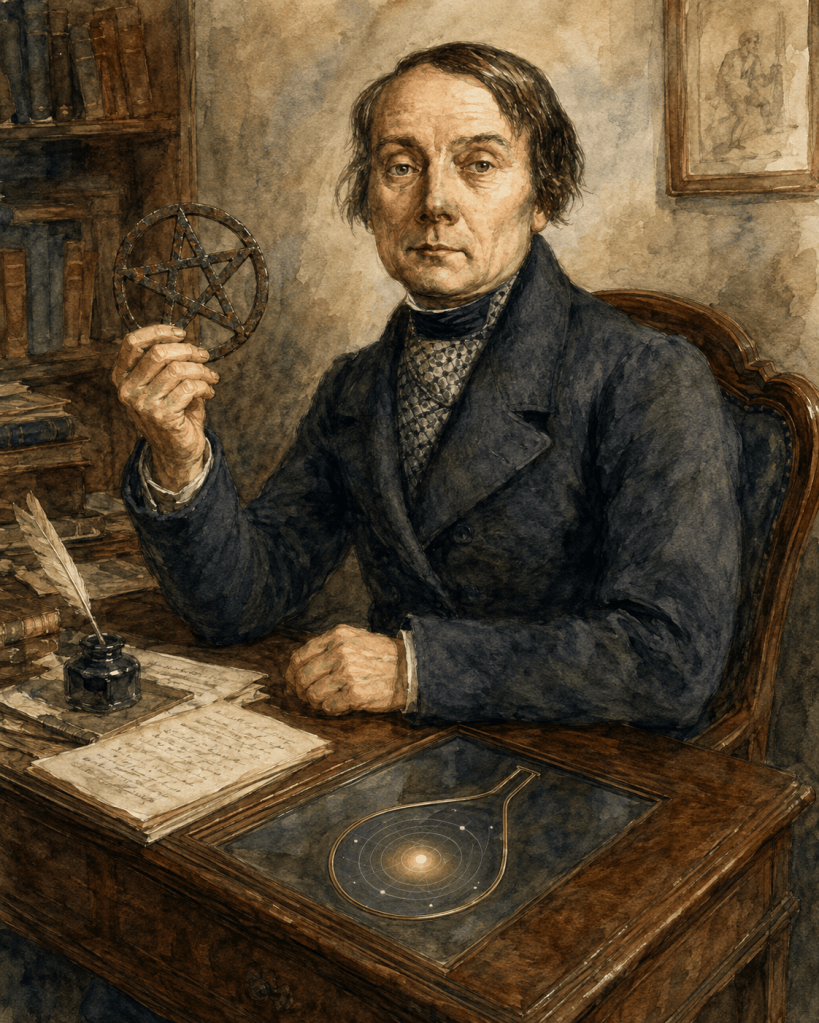
In the preface to his Geschichte der Magie of 1844, the physician and magnetic practitioner Joseph Ennemoser formulates what may be read as the central premise of his entire work:
“Die wahre Magie liegt in den geheimsten innersten Kräften unseres Geistes.”
True magic, he argues, lies in the most hidden and inward powers of the human spirit. He continues by stating that our spiritual nature has not yet been disclosed to us and that the apparent wonders of spirits ultimately resolve themselves into the wonder of our own spirit. The history of magic thus becomes, in Ennemoser’s hands, more than a record of beliefs, rites, visions, and inexplicable phenomena. It becomes the history of a human nature that has not yet fully revealed itself.
This is a powerful idea. It is also a highly characteristic one. From antiquity to modern occultism, esoteric traditions have repeatedly claimed that ordinary consciousness represents only a restricted portion of the human capacity for knowledge. Beyond it lies another possibility: higher knowledge, hidden wisdom, gnosis, illumination, spiritual perception, direct cognition, or the recovery of faculties that have become dormant. Ennemoser’s formulation belongs to this long history, but gives it a specifically nineteenth-century shape. Magic is relocated from an external supernatural world to the still unknown interior of the human being.
His claim reflects the intellectual atmosphere of German Romanticism and Naturphilosophie. Nature and spirit were not treated as wholly separate domains, and the human being was understood as participating in a living process of development. Ennemoser’s table of contents explicitly connects the growing recognition of animal magnetism with the progressive development of the human spirit and with the rise of the natural sciences. He also distinguishes between the instinctive forms of perception attributed to antiquity and the more universal consciousness he associated with modernity.
This is development, but not yet evolution in the later Darwinian sense. Ennemoser was writing fifteen years before the publication of On the Origin of Species. His model is closer to the Romantic concept of unfolding: capacities that exist latently within humanity gradually become conscious, differentiated, and cultivated. The history of magic is therefore presented as evidence that human beings possess faculties that appear fragmentarily in prophecy, somnambulism, visions, healing, religious ecstasy, and magnetic phenomena, but may one day be understood and developed more systematically.
The attraction of this idea is easy to understand. It allows magic to survive the decline of traditional supernatural explanations. Spirits, miracles, and occult effects need not simply be rejected. They can be reinterpreted as manifestations of unknown laws or hidden capacities of the mind. What earlier generations attributed to gods, demons, angels, or disembodied spirits may eventually prove to belong to the unexplored nature of human consciousness itself.
Ennemoser was influential within a broader nineteenth-century current that joined Romanticism, Mesmerism, the history of religion, occultism, and emerging psychological speculation. His work was among the publications that helped shape the intellectual environment from which early Theosophy arose. Modern scholarship has shown that Ennemoser’s History of Magic, especially through William Howitt’s English translation of 1854, belonged to the literature used by later nineteenth-century occultists to construct universal histories of hidden wisdom and magical practice.
Yet Ennemoser’s sentence also exposes a problem that continues throughout the history of occult philosophy. The existence of higher or hidden capacities is asserted with great confidence, while their precise nature remains difficult to determine.
What Is Higher Knowledge?
The phrase higher knowledge appears to promise something recognizable, but its content changes whenever one moves from one tradition to another.
In some Neoplatonic traditions, higher knowledge means intellectual or contemplative participation in realities beyond the sensory world. In Gnostic contexts, it may mean knowledge of the divine origin of the human soul and liberation from the structures that keep it imprisoned. In Hermetic literature, it can refer to knowledge of the divine mind, the structure of the cosmos, and the regeneration of the practitioner.
For early modern natural philosophers and magicians, higher knowledge may include insight into hidden sympathies, correspondences, signatures, planetary influences, and invisible forces within nature. In Christian mysticism, it may mean experiential knowledge of God that exceeds discursive theology. In Mesmerism, it may appear as somnambulistic perception, clairvoyance, diagnosis at a distance, or access to knowledge unavailable to waking consciousness.
Theosophy expands the category further. Higher knowledge may involve lost civilizations, invisible planes, subtle bodies, reincarnation, cosmic evolution, occult hierarchies, and the contents of an ancient wisdom tradition. The early Theosophical movement inherited a widespread nineteenth-century narrative according to which a universal esoteric philosophy had existed since antiquity and could be recovered through the comparative study of religion, magic, Kabbalah, Hermetism, and purported Eastern wisdom.
In twentieth-century psychological interpretations, the content changes again. Hidden knowledge may become knowledge of the unconscious, archetypal structures, symbolic processes, or the development of a more integrated personality. In contemporary magical currents, particularly chaos magic, the emphasis may shift from discovering an objectively given occult cosmology to experimenting with belief, attention, symbolism, altered states, and their practical effects.
These traditions may share family resemblances, but they do not provide one consistent account of what higher knowledge contains. The term may refer to metaphysical truths, unusual perceptions, cosmological doctrines, transformative experiences, magical efficacy, moral development, or a changed relationship to the self. Sometimes it means knowing more. At other times, it means knowing differently. Occasionally it means becoming a different kind of knower.
This variation creates a serious historical and methodological problem. When occult authors speak of higher knowledge, are they referring to the same phenomenon under different cultural descriptions? Or does the apparent continuity arise mainly from the repetition of a promise whose content is repeatedly reinvented?
The Promise Remains, the Content Changes
One of the most striking features of the history of esotericism is the stability of the promise. Ordinary consciousness is incomplete. Hidden possibilities exist. Training is necessary. Progress occurs through stages. Those who persevere may eventually acquire access to a deeper order of knowledge.
The structure remains remarkably recognizable even when the doctrines change. There is an initial state of ignorance or sleep, followed by discipline, purification, initiation, graded instruction, symbolic death, rebirth, illumination, or mastery. The practitioner moves from the profane to the initiated, from fragmentation to unity, or from ordinary perception to spiritual sight.
Freemasonry offers a particularly clear institutional example. The candidate progresses through degrees whose symbolic structure suggests increasing insight, moral formation, and access to meanings concealed from the uninitiated. Yet possession of a high degree does not necessarily correspond to an observable superiority in cognition, character, judgment, or spiritual perception. Formal advancement and actual transformation may diverge considerably.
The same problem occurs outside initiatory organizations. Authors may claim access to secret teachers, ancient manuscripts, supersensible perception, clairvoyant investigation, revealed cosmologies, or traditions transmitted only to qualified pupils. The claim to hidden knowledge establishes authority, while the secrecy surrounding it protects the claim from ordinary examination. If outsiders cannot verify the knowledge because they lack the required development, disagreement itself may be interpreted as evidence of their lower level.
This does not prove that all claims to higher knowledge are false. It does show that the structure is epistemically unstable. The claim can become self-confirming. Those who accept it are regarded as sufficiently receptive, while those who question it are considered unprepared.
Moreover, the promised knowledge frequently recedes as one approaches it. Introductory texts point toward advanced instruction, preliminary degrees toward higher degrees, and published teachings toward oral or secret teachings. The final content is deferred. What remains continually visible is not the knowledge itself, but the path, the hierarchy, and the assurance that something more lies ahead.
This makes the concept function almost as an esoteric horizon. It gives direction to practice, sustains motivation, and organizes communities, but does not necessarily designate one clearly defined body of knowledge.
Is the Idea Merely a Fable?
It would be tempting to conclude that higher occult knowledge is simply a recurring cultural fiction: the esoteric equivalent of a religious promise of salvation. According to this interpretation, initiatory systems retain participants by suggesting that continued commitment will eventually grant access to a superior state unavailable to ordinary people.
There is undoubtedly some justification for this suspicion. The historical record contains abundant examples of inflated authority, fabricated lineages, inaccessible masters, secret documents, unverifiable revelations, and elaborate hierarchies whose senior members do not appear to display exceptional wisdom. The vagueness of higher knowledge can serve social and institutional purposes. It creates prestige, protects leaders from criticism, and makes disappointment appear to be a failure of the pupil rather than of the teaching.
Yet the hypothesis should not be reduced to deception alone. Many practitioners have clearly undergone experiences they understood as transformative, revelatory, or cognitively significant. Mystical absorption, changes in self-experience, unusual imagery, states of unity, heightened concentration, somatic phenomena, and spontaneous alterations of perception are genuine experiences in the elementary sense that people undergo them. The unresolved question concerns their interpretation and epistemic value.
A luminous experience may occur without proving the cosmology later attached to it. A figure may appear inwardly without establishing that an autonomous metaphysical entity has been encountered. A profound sense of unity may transform a life without providing reliable information about the structure of the universe. An experience can be real as an experience while the explanation built around it remains uncertain.
This distinction is often blurred in occult literature. The intensity of an experience is taken as evidence for the truth of its interpretation. Transformation is treated as confirmation of doctrine. Yet experiences with similar phenomenological features have been interpreted through mutually incompatible religious and metaphysical systems.
The historical variability of those interpretations does not invalidate the experiences, but it weakens the claim that they deliver one unambiguous body of hidden knowledge.
What Can Actually Be Trained?
Once metaphysical claims are temporarily suspended, a more modest but potentially more fruitful picture emerges. Esoteric, contemplative, and magical disciplines do train certain capacities.
Attention can become more stable. Thoughts and emotions can be observed with greater distance. Sensory imagery can be formed and sustained more deliberately. Automatic reactions can be recognized earlier. Bodily signals can be perceived more precisely. The practitioner may acquire a greater tolerance for ambiguity, a stronger ability to postpone action, and a clearer distinction between perception, interpretation, expectation, and fantasy.
Memory, concentration, emotional regulation, introspection, imagination, and metacognitive awareness are all susceptible to training. Ritual may coordinate attention, emotion, bodily posture, symbolic meaning, and intention. Repetition may make certain responses more available. A disciplined practice may change how a person relates to fear, desire, uncertainty, suffering, and mortality.
None of these capacities is necessarily occult. They belong to human psychology. This does not make them trivial. A capacity does not become less important because it can be discussed without metaphysical language.
The crucial question is whether occult training produces anything beyond such trainable psychological capacities. Does it generate accurate information that could not have been acquired through ordinary means? Does it reveal stable structures that can be independently recognized by trained observers? Does it improve judgment outside the ritual or contemplative setting? Does it produce lasting changes in conduct rather than temporary states or impressive narratives?
These questions are rarely addressed with sufficient precision. Traditions usually describe the expected stages in their own symbolic language, but do not clearly separate the experience, its interpretation, the proposed faculty, and its observable consequences.
From Higher Knowledge to Greater Reliability
A phenomenological and experimental approach can retain the valuable intuition behind esoteric training without accepting its claims in advance. The central question then becomes not whether the practitioner has entered a higher world, but what has actually changed in perception, consciousness, and conduct.
This requires several distinctions. What was experienced? Under what conditions did it occur? Can it be repeated? Which elements were directly perceived, and which were added through interpretation? Did prior expectations shape what appeared? Did the experience increase clarity, or merely conviction? What remained after the state had passed? Did the practitioner become less reactive, more truthful, more discerning, and more capable of acting consciously?
From this perspective, the goal need not be higher knowledge as an expanding collection of secret propositions. It may instead be a higher reliability of knowing: a more disciplined relationship between experience, interpretation, judgment, and action.
This shift does not refute Ennemoser. In one respect, it takes his intuition seriously. If true magic lies in the hidden capacities of the human spirit, those capacities must be investigated where they manifest themselves: within attention, perception, imagery, embodiment, interpretation, and conduct.
But the shift also introduces a criterion largely absent from the grand occult histories. A hidden capacity should not be inferred merely from the power of a narrative or the intensity of an experience. It should become recognizable through careful practice, comparison, repetition, and consequences that extend into ordinary life.
The history of occultism may therefore contain two intertwined histories. One is the history of claims about hidden worlds, secret masters, invisible forces, spiritual hierarchies, and superior forms of knowledge. The other is the quieter history of human beings attempting to train attention, imagination, self-observation, intention, and the capacity not to be carried away by every thought, image, emotion, or revelation.
The first history remains metaphysically unresolved. The second is directly available for investigation.
Perhaps the most defensible interpretation of Ennemoser’s sentence is therefore neither credulous nor dismissive. The human spirit may indeed contain possibilities that remain insufficiently understood. But their discovery requires more than declaring them secret, spiritual, or higher. It requires an inner laboratory capable of distinguishing what appears from what is claimed about it.
The lasting question is not whether humanity possesses a key to higher knowledge. It is whether we can develop an instrument reliable enough to discover what, if anything, that key actually opens.
Joseph Ennemoser, Geschichte der Magie, Vorrede, p. XXVII.
“Die wahre Magie liegt in den geheimsten innersten Kräften unseres Geistes; unsere Geisternatur ist uns aber noch nicht enthüllt. Alle Wunder der Geister lösen sich am Ende nur im Wunder unseres eigenen Geistes.”
“True magic lies in the most hidden and inward powers of our spirit; our spiritual nature, however, has not yet been disclosed to us. Ultimately, all the wonders of spirits resolve themselves into the wonder of our own spirit.”