A case study in narrative inflation, retroactive heroization, and the making of a modern god: read through the lens of the Inner Laboratory.
Somewhere in eighteenth-century Europe, a well-dressed, extravagantly gifted man moved through the courts of Paris, Vienna and St. Petersburg, speaking a dozen languages, composing music, dabbling in chemistry, and letting slip, with a small, knowing smile, that he might be rather older than he looked. He never confirmed it. He never quite denied it either. Two hundred years later, thousands of people around the world address prayers to him as an Ascended Master who once walked with pharaohs, guided Christian Rosenkreuz, and now radiates a violet flame of purification from a plane beyond death.
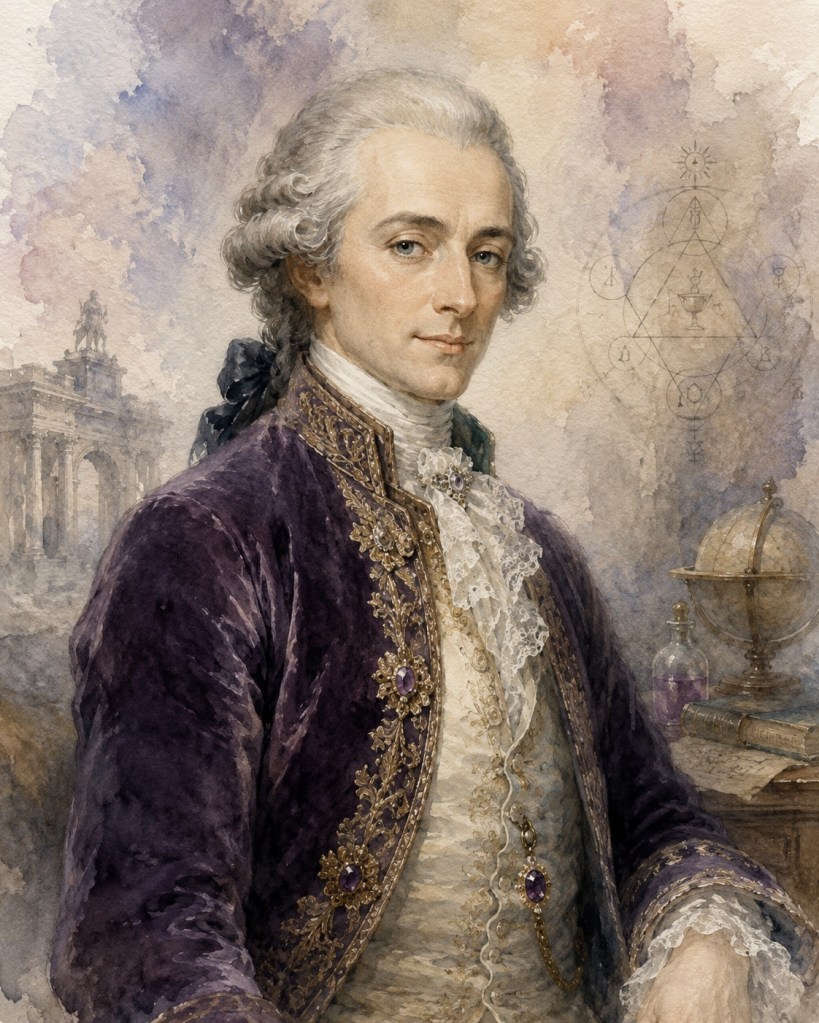
Somewhere between the smile and the flame, a man became a myth.
Most discussions of this transformation stop at the question that seems most urgent: was any of it true? Did the Count really live for centuries? Is there really a Master Saint-Germain sending guidance from the causal plane? That question is worth asking, but it is, in an important sense, the least interesting one. It assumes that the myth is a claim to be verified or falsified, like a fact in a courtroom. It isn’t. A myth is a process: a set of psychological operations that can be watched, named, and understood, regardless of what one believes about their ultimate object. And once you have watched the process happen once, in a documented case with a clear beginning, you start noticing it everywhere: in spiritual movements, in wellness culture, in politics, in the story you tell at dinner about the retreat that changed your life.
This is why the Saint-Germain case is worth more than historical curiosity. It is a slow-motion recording of something that also happens, in miniature, inside every one of us, every time an ordinary experience gets quietly promoted into a revelation, and we stop noticing the promotion ever took place.
The five stages of a myth
Strip away the specific content, the violet flame, the Great White Brotherhood, the channelled transmissions, and a repeatable architecture appears.
Stage one: self-mystification. The historical Count began the process himself. He refused to state his origins, hinted at extraordinary longevity, and performed feats — languages, chemistry, music — that his contemporaries could not easily explain. He did not need to lie outright. He only needed to leave gaps, and let other people’s imaginations do the rest. This is the seed: an ambiguous, striking phenomenon, deliberately or accidentally left open to interpretation.
Stage two: adoption by a community that needs a symbol. After his death, occult and Masonic circles — already primed by a culture that loved secret initiates and hidden brotherhoods — folded him into their existing symbolic furniture. He was linked to Cagliostro, to Rosicrucian lore, to the general nineteenth-century appetite for undying, all-knowing adepts. The community did not invent him from nothing; it recognized in him a shape it already wanted to see.
Stage three: systematization. Madame Blavatsky and the Theosophical Society did what institutions do with promising raw material: they organized it. Saint-Germain was placed within a hierarchy of “Masters of Wisdom,” assigned a cosmic function (the “seventh ray”), and given a fixed role in a larger architecture of belief. The ambiguous count became a load-bearing element of a system.
Stage four: personal revelation and canonization. In the 1930s, Guy Ballard claimed to have met Saint-Germain in person on Mount Shasta. This is the decisive move — not because it added new facts, but because it converted an abstract doctrine into a first-person testimony. The “I AM” Activity was built on that testimony, complete with rituals, teachings, and the now-famous violet flame. A symbol had become an experience someone could point to and say: it happened to me.
Stage five: institutional continuity. Later movements, notably the Church Universal and Triumphant, inherited and extended the figure, embedding him permanently in the vocabulary of modern spirituality — so thoroughly that today it is easy to forget he was ever an ambiguous eighteenth-century courtier at all.
Five stages: ambiguity, adoption, systematization, testimony, institution. Notice that at no point in this sequence does anyone need to be lying. Each step is a small, human, almost reasonable act — filling in a gap, organizing a pattern, sharing a powerful experience, building a community around it. The myth is not the product of one great deception. It is the accumulated residue of many small, ordinary acts of meaning-making, each one plausible on its own.
Naming the mechanism: narrative inflation
The Inner Laboratory tradition — the framework this website draws its practice from — has a precise name for the engine that drives stage four onward: narrative inflation. The idea is simple, and once seen, hard to unsee.
An experience happens. It is, in itself, neutral raw material: a felt sense of warmth, a vivid image, a coincidence, a moment of unusual clarity. Then a story is laid over the experience — and the story is not the same thing as the experience, even though it feels, from the inside, exactly as real. “I felt warmth in my chest” quietly becomes “my heart chakra opened.” “I had a vivid, emotionally charged encounter in an altered state” becomes “I met an Ascended Master.” The gap between what actually happened and what got said about it disappears from view, because the story arrives dressed in the same emotional intensity as the original event.
Guy Ballard’s testimony on Mount Shasta is narrative inflation on an institutional scale. Whatever happened to him — and something evidently did, powerfully — the leap from a profound personal experience to a verified encounter with a specific historical entity possessing a specific cosmic biography is not a small step. It is the whole distance the myth needed to travel, taken in a single act of interpretation. And once that interpretation was spoken aloud to a community ready to receive it, it stopped being treated as an interpretation at all. It became the event itself.
This is not a phenomenon confined to nineteenth-century occultists. It is the same mechanism at work when someone comes out of a breathwork session and says “I released my childhood trauma,” when the actual, verifiable content of the experience was heat, tears, and a loosening in the chest. It is the same mechanism when a single striking coincidence becomes, within a week, “proof that I am on the right path.” The story is not necessarily false. But it is a second layer, built on top of the first, and very few people ever go back and separate the two.
Naming the second mechanism: retroactive heroization
There is a subtler companion process, one that explains why myths tend to get grander the longer they are told rather than fading with time. Call it retroactive heroization: memory does not simply store an experience — it keeps quietly reshaping it to fit whatever framework became available afterward.
Someone has an intense, ambiguous meditation experience: heat, light, an inexplicable trembling. Months later they encounter kundalini literature. From that point on, the memory itself changes. What was once strange and formless is now recalled as “the beginning of my kundalini awakening” — recalled with the same confidence as if that had been obvious all along. Nobody is lying. The brain is doing what memory does: reconsolidating the past in light of present understanding.
Apply this to Saint-Germain and something interesting appears. The historical count’s own carefully cultivated ambiguity was, at the time, almost certainly a form of aristocratic theater — a fashionable, faintly mischievous performance of mystery, common enough in eighteenth-century salons. But once later generations needed him to be something else — an immortal adept, a guardian of humanity, a being who had walked with Christ — his biography was retroactively reread through that lens. Stray remarks became prophecies. Ordinary showmanship became proof of hidden power. The count did not become more mysterious after his death. The story about him did, and the story quietly absorbed the authority of memory itself.
This is worth sitting with, because it means a myth is never finished consolidating. Every retelling is a small opportunity for the story to grow a little more certain, a little more dramatic, a little further from whatever ambiguous kernel started it.
Why the crowd matters: the four stages of system-identification
No myth survives on the strength of one person’s inflated story. It survives because a community forms around it — and communities have their own, entirely predictable trajectory of capture. Our Inner Laboratory framework describes this as a progression through four recognizable stages.
The system as help. A person is confused, searching, in pain, or simply hungry for meaning, and a framework arrives that finally organizes the chaos. This stage is genuinely valuable — early Theosophists finding in Saint-Germain a way to think about wisdom traditions across cultures were not doing anything foolish.
The system as home. The framework stops being merely useful and starts providing belonging. People who use the same vocabulary, tell the same stories, and revere the same figures recognize each other, and the isolation of searching alone dissolves into community. This, too, can be a genuine good.
The system as identity. Somewhere along the way, “I use this framework” quietly becomes “I am this kind of person.” A student of Theosophy becomes a Theosophist. A person exploring the I AM teachings becomes, simply, “someone who is I AM.” The framework has stopped being a tool one picks up and put down, and become part of who a person is — which means any challenge to the framework now feels like a challenge to the self.
The system as filter. This is the terminal stage, and it is the one worth watching for most carefully, because from the inside it feels like the opposite of what it is — it feels like clarity. Every experience is now automatically read through the system. Doubt becomes “resistance.” Criticism becomes evidence that the critic “doesn’t understand the deeper transmission.” Departure becomes proof that the person “wasn’t ready.” At this stage, the system can no longer be corrected by reality, because reality itself is only ever perceived through the system.
This trajectory explains something that puzzles outside observers of any devoted movement built around a mystified figure: why does evidence never seem to matter? The answer is not that believers are unusually credulous. It is that, by stage four, there is no longer a vantage point from which evidence could register as evidence. The filter has become the eyes themselves.
The self-immunizing system
Stage four produces a structural feature worth naming on its own: the framework becomes self-immunizing. A healthy belief can be wrong, and when confronted with disconfirming reality, it bends or breaks. A self-immunizing belief absorbs every possible outcome as further confirmation. If followers feel something powerful in a channelling session, that confirms the transmission is real. If they feel nothing, they are “not yet open.” If a critic raises a documented historical problem, the critic “hasn’t done the inner work to perceive higher truth.” There is no longer any outcome the system cannot explain in its own favor — which means, precisely because it explains everything, it has stopped being able to teach anything new. It has become a closed loop wearing the clothing of an open path.
This is the single most useful diagnostic question available, and it applies equally to a two-hundred-year-old myth and to a belief you are holding about your own life right now: can this framework be wrong? What outcome, if it occurred, would count as evidence against it? If no answer comes, you are not looking at a living understanding. You are looking at a closed system.
Why this belongs in your own practice
It would be easy to leave this as an entertaining piece of history — a curiosity about credulous Theosophists and their immortal count. But the entire point of naming these mechanisms is that they are not specific to occultism. They are specific to mind. The same architecture — ambiguous experience, narrative inflation, retroactive heroization, group identification, self-immunization — runs quietly through ordinary life: through the story you tell about the coach who “changed everything,” through the meaning you retroactively assign to a difficult year once you have a framework that makes it make sense, through the way criticism of a teacher, a technique, or a community you belong to can start to feel, physically, like a threat to your own body.
This is exactly the terrain the inner laboratory approach at the heart of this practice is built to work with. Its central instrument — often called the Witness — is nothing more or less than the capacity to notice the moment a story is being laid over an experience, before the two have fully fused. Watching your breath is training precisely this: watching a sensation arise — warmth, tension, a wave of feeling — and staying with the sensation itself for a beat longer than usual, before the mind supplies its interpretation. It is the same muscle, applied at a smaller scale, that would have let an eighteenth-century courtier remain an interesting man rather than becoming a metaphysical claim.
None of this requires cynicism. The alternative to naive belief is not dismissal — it is precision. You do not need to decide, once and for all, whether there is “really” something to the idea of an Ascended Master, any more than you need to decide, once and for all, what a wave of warmth in your chest “really” means. What you can do, every time, is ask the laboratory’s question: what actually happened here, and what did I — or someone before me — add to it afterward? That single habit, practiced patiently, is the difference between a mind that can be quietly annexed by any sufficiently compelling story, and a mind that can meet a powerful experience, let it be as large as it is, and still ask what it is made of.
The count never asked to become a myth. But every myth, once you learn to read its stages, turns out to be teaching the same lesson twice — once about history, and once, more quietly, about you.
 breath4balance