Where analytical psychology meets a modern esoteric psychology
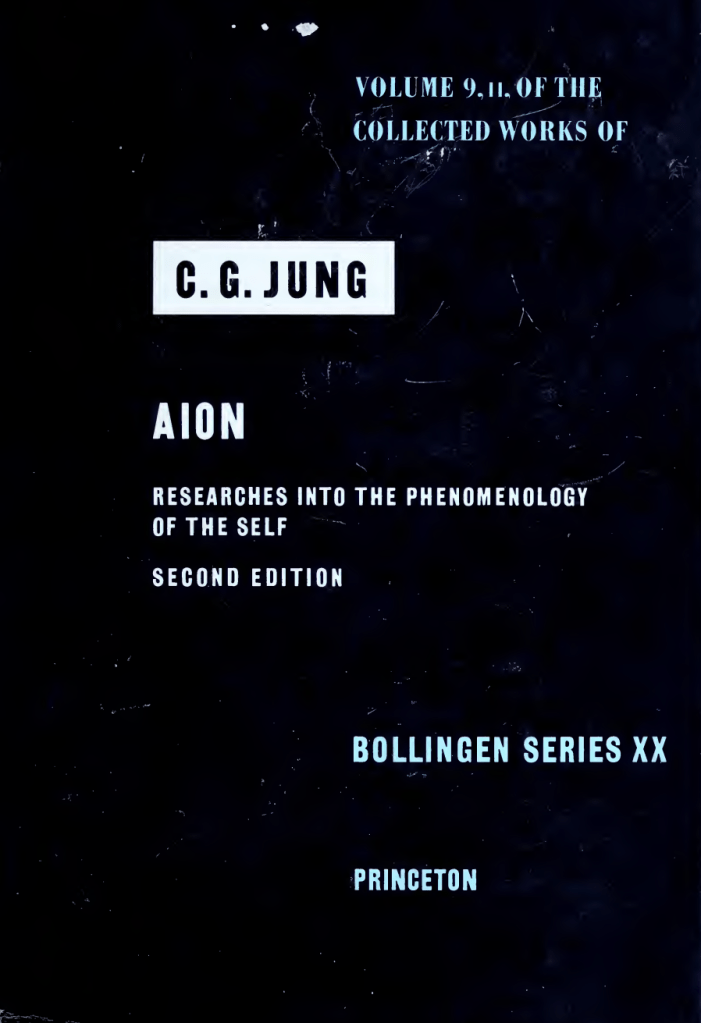
Carl Gustav Jung’s Aion is one of his most difficult and ambitious works. Its subject is not merely the unconscious, nor even the familiar Jungian themes of shadow, anima, animus, and projection. Its deeper concern is the Self: the elusive psychic totality that includes the conscious personality but cannot be reduced to it.

This makes Aion especially relevant to the esoteric psychology developed in The Inner Laboratory. Jung and the Inner Laboratory do not offer the same system, and their terminology should not be treated as interchangeable. Yet they converge around a fundamental question:
How can a human being develop a conscious relationship with dimensions of the psyche that exceed the ordinary ego, without either reducing them to fantasy or surrendering critical judgment to them?
Jung provides a phenomenology of the Self and of the symbols through which psychic totality has historically expressed itself. The Inner Laboratory offers a practical instrumentarium for approaching such phenomena from within. It trains the faculties needed to observe, differentiate, interpret, test, and eventually integrate what appears in consciousness.
Jung gives us a map of the territory. The Inner Laboratory attempts to develop the navigator.
The ego is not the whole person
One of Jung’s central distinctions is that between the ego and the Self.
The ego is the centre of ordinary consciousness. It is the organising point from which we say “I”: I think, I decide, I remember, I desire. It provides a degree of continuity and identity, and without it no coherent psychological life would be possible.
But the ego is not the whole psyche.
For Jung, the Self includes both the conscious and unconscious dimensions of the person. It is not simply a deeper layer of the ego, a more authentic personality, or an ideal version of oneself. It represents the totality of the psyche, including contents, tendencies, and possibilities that have never entered consciousness.
This totality cannot be fully surveyed from the standpoint of the ego. The ego is contained within the Self, much as a smaller field is contained within a larger one. It can enter into relationship with that larger totality, but it cannot stand outside it and comprehend it completely.
For this reason Jung treats the Self as a transcendent concept. This does not necessarily mean supernatural. It means that the Self exceeds the limits of what consciousness can directly grasp.
We cannot place the Self before us as an object. We can investigate only the forms through which it appears: dreams, projections, symbolic figures, numinous experiences, conflicts, synchronicities, inner images, and prolonged processes of transformation. Aion is therefore explicitly a study in the “phenomenology of the Self.” Jung studies not the Self as such, but the manifestations through which its presence may be inferred.
This already brings us close to the basic method of the Inner Laboratory.
The laboratory does not reveal a hidden essence
The phrase “inner laboratory” might initially suggest that somewhere beneath conditioning and social identity lies a pure, fixed essence waiting to be uncovered. But the model presented in The Inner Laboratory is more subtle.
The purpose is not to dig through the personality until we discover a final, uncontaminated core. It is to develop the capacity to investigate what appears within us:
- What exactly is arising?
- How does it arise?
- Is it a thought, an emotion, an image, a bodily impulse, a memory, or a symbolic configuration?
- What interpretation is immediately being attached to it?
- What part of the personality is speaking?
- What remains excluded from awareness?
- Does the experience produce greater freedom and integration, or inflation, narrowing, and dependency?
The central issue is not simply the content of experience, but our relationship to it.
In the Inner Laboratory, the human being is simultaneously researcher, instrument, and material of the investigation. The book’s alchemical framing makes this explicit: transformation is not performed upon an external substance. The experimenter is part of the experiment.
This is also why the method must begin with the development of reliable faculties. Before exploring inner light, symbolic figures, magical gestures, or altered states, we must learn to observe a single thought without immediately becoming it.
The Witness is not the Self
One of the most important concepts in the Inner Laboratory is the Witness.
The Witness is the capacity to observe thoughts, feelings, images, and impulses without immediately identifying with them. It creates a small but decisive interval between an appearing psychic content and the statement “this is me.”
This sounds simple, but it marks a radical psychological shift.
Ordinarily, a thought does not announce itself as a thought. It appears as truth. An emotion does not present itself as one possible response among others. It colours the entire field of experience. An inner image may be taken as revelation, a bodily sensation as a command, and a spiritual intuition as proof of personal election.
The Inner Laboratory begins by weakening this automatic identification. Instead of “I am angry,” we gradually learn to recognise: “anger is appearing.” Instead of “this vision tells me the truth,” we can say: “a powerful symbolic image has appeared, and I do not yet know how it should be understood.”
The Witness is therefore not the Self in Jung’s sense. It is a function of consciousness that makes a relationship with unconscious contents possible.
In Jungian terms, it enables several differentiations:
- the ego becomes recognisable as an ego;
- a psychic content becomes recognisable as a content;
- the initial fusion between observer and content is loosened;
- a conscious relationship between ego and unconscious becomes possible.
This last point is crucial.
As long as I am completely identical with my rage, my conviction, my vision, or my spiritual calling, no real dialogue can occur. There is only possession. A psychic content has occupied the centre and speaks in the first person.
The Witness opens a space in which the content can be encountered rather than enacted.
This gives the Witness a significance beyond contemporary mindfulness. It is not only a technique of emotional regulation or decentring. It is a prerequisite for individuation: the process through which consciousness becomes differentiated enough to enter into relationship with the greater psychic totality from which it arises.
The Operator as the conscious response of the ego
The second foundational faculty in the Inner Laboratory is the Operator.
The Witness opens a space. The Operator determines what is done within that space.
The Operator is the capacity for deliberate response after observation. It can choose to act, refrain, wait, speak, remain silent, formulate, imagine, establish a boundary, or perform a symbolic gesture. It is not simply willpower in the conventional sense. It is conscious direction made possible by prior differentiation.
A concise formulation would be:
The Witness makes encounter possible. The Operator shapes the conscious response to that encounter.
Yet here Jung provides an important warning.
The unconscious is not inert material waiting to be programmed by the conscious mind. It possesses relative autonomy. Dreams surprise us. Complexes interrupt us. Images appear that the ego did not intentionally create. Symbolic developments often possess a logic that cannot be reduced to conscious planning.
The Operator must therefore not be imagined as an omnipotent controller of the psyche.
It does not manufacture the Self. It does not impose total order upon the unconscious. It creates a conscious relationship with what emerges from a larger psychic field.
This distinction protects the Inner Laboratory from becoming a technology of subtle self-domination. The goal is not total control, but conscious participation.
That participation may sometimes involve action. At other times it requires restraint. A mature Operator must know not only how to intervene, but when not to intervene.
The soul mirror and Jung’s shadow
The convergence between Jung and the Inner Laboratory becomes especially clear in the practice of the soul mirror.
In Aion, Jung moves from the ego to the shadow, then to anima and animus, and only afterwards to the Self. This sequence is psychologically meaningful. The way toward psychic totality does not lead directly upward into light. It first passes through what the conscious personality excludes.
The shadow consists of qualities, impulses, capacities, and tendencies that do not fit the conscious self-image. Some are morally disturbing. Others are simply incompatible with the role the ego has learned to play.
A gentle person may repress aggression. A rational person may exile imagination. A spiritual person may refuse sexuality, envy, ambition, or hatred. A powerful person may remain unaware of tenderness and dependency. What is rejected does not disappear. It continues to act indirectly, often through projection.
Jung repeatedly shows how projection inserts unconscious material between the subject and the world. We no longer encounter another person as they are. We encounter our own unrecognised psychic content in them.
The soul mirror in the Inner Laboratory offers a practical method for observing this process.
Its black mirror identifies recurring weaknesses, automatisms, defensive reactions, and rejected traits. Its white mirror identifies strengths, capacities, and possibilities that may be equally unconscious or insufficiently embodied.
This second dimension is important because the shadow is not merely a collection of negative qualities. It may also contain vitality, courage, creativity, sensitivity, and intelligence that the conscious personality has never claimed.
What we condemn and what we idealise may both be projections of something not yet integrated.
The soul mirror therefore does more than classify character traits according to the traditional elements. It makes visible the one-sidedness of the ego.
Its purpose is not self-accusation. It is increased psychological completeness.
When a pattern says “I”
One of the most practical bridges between Jung and the Inner Laboratory lies in the phenomenon of identification with complexes.
A complex is not merely an idea. It is an emotionally charged organisation of memories, expectations, bodily responses, and interpretations. When activated, it can temporarily behave like a partial personality.
A person who is abandoned may not simply experience sadness. An entire inner configuration may take over: “I am unlovable,” “everyone leaves,” “I must cling,” or “I need no one.” The complex speaks as “I,” even though it represents only one part of the psyche.
The Inner Laboratory’s formulation, “when a pattern says ‘I’,” captures this with great precision.
The Witness allows the person to recognise that a pattern has become active. The Operator makes it possible to respond differently. The work journal records repetitions over time, making visible what otherwise disappears into the immediacy of each episode.
This is where the laboratory metaphor becomes concrete. The individual is no longer merely suffering a recurring state. The state becomes observable, comparable, and testable.
What triggers it? How quickly does identification occur? Which bodily signs appear first? Which story follows? What action normally results? What happens when the sequence is interrupted?
The process is no longer understood only through interpretation. It becomes an experiment in consciousness.
The Self appears symbolically, never directly
Perhaps the most important contribution of Aion to the later sections of the Inner Laboratory is Jung’s account of symbols of the Self.
Jung examines Christ, the fish, the quaternity, Gnostic figures, and alchemical images not merely as theological doctrines. He studies them as historical symbolic expressions of psychic totality.
A symbol, in Jung’s sense, is not simply a sign with a fixed meaning. It gives form to something not yet fully understood. It mediates between conscious and unconscious, known and unknown.
This is directly relevant to the Inner Laboratory’s exploration of inner light, active imagination, sigils, symbolic figures, and near-death experiences.
A powerful inner image should neither be dismissed as meaningless fantasy nor accepted uncritically as literal revelation.
It may possess psychic reality without offering a direct metaphysical statement about the structure of the universe.
This middle position is difficult to maintain. Modern reductionism tends to say: “It is only brain activity.” Esoteric literalism tends to say: “It is exactly what it appears to be, an objective being or higher world.”
The Inner Laboratory proposes a more disciplined approach:
- describe the experience before explaining it;
- distinguish the appearing image from the interpretation attached to it;
- observe its emotional and behavioural effects;
- examine whether it expands or narrows consciousness;
- do not grant authority merely because an experience is powerful;
- test its value by what it produces in ordinary life.
This yields a precise epistemological principle:
An inner image is neither merely unreal nor automatically a literal window into a supernatural realm. It is a psychic reality in which something exceeding the ordinary ego may assume symbolic form.
That is very close to Jung’s phenomenological stance.
Why light is not enough
The symbolism of light plays an important role in mystical and esoteric traditions. It also occupies a significant place in the Inner Laboratory. Yet Jung’s analysis in Aion warns against identifying psychic totality with light, goodness, purity, or spiritual elevation alone.
Jung’s discussion of Christ and Antichrist addresses a central psychological problem. If the divine image represents only goodness and perfection, what happens to darkness, aggression, destructiveness, contradiction, and evil?
They do not disappear. They are displaced into the shadow and projected elsewhere.
A one-sided image of spiritual perfection can therefore produce its opposite. The more a person identifies with light, the more likely it becomes that darkness will be seen only in other people, other groups, or the supposedly unenlightened.
The psychological Self, by contrast, refers to totality. It includes conscious and unconscious, accepted and rejected, luminous and obscure.
This does not mean that good and evil become morally equivalent. Nor does it justify destructive behaviour. It means that psychological wholeness requires recognition of the capacity for both.
For the Inner Laboratory, this insight is fundamental:
The aim is not to make a person increasingly “full of light,” but increasingly capable of perceiving what is actually active within them.
This is why the practical path begins not with visions or mystical illumination, but with thoughts, emotions, will, patterns, bodily reactions, and ordinary identification.
Light becomes meaningful only when the one who perceives it has also been examined.
Otherwise, light itself becomes a mask worn by the shadow.
Abraxas and the refusal of premature division
This is also where the figure of Abraxas acquires psychological significance.
Abraxas should not be understood simplistically as an endorsement of good and evil alike. In the context of the Inner Laboratory, the figure can be read as symbolising a totality that precedes our premature division of reality into pure light and pure darkness.
The ego prefers clear moral and conceptual divisions. They offer orientation and security. But the deeper psyche often presents us with paradox: attraction and fear, creation and destruction, spirit and instinct, order and chaos.
Abraxas symbolises the tension of these opposites before they have been reduced to a comfortable formula.
The combined sigil on the title page of The Inner Laboratory can therefore be read as a condensed representation of the whole method:
- water signifies receptivity, connection, movement, and adaptability;
- Abraxas signifies a totality that cannot be reduced to one pole of an opposition;
- the designed sigil represents the formative activity of the Operator;
- the capacity to contemplate the symbol without confusing it with ultimate reality represents the Witness.
The practitioner receives, forms, observes, and then refuses to mistake the formed symbol for the totality itself.
From symbolic history to practical training
The most important difference between Jung and the Inner Laboratory is also the reason they complement one another.
Aion is primarily a phenomenological and historical investigation. Jung examines how the psyche has represented the Self in religious, Gnostic, astrological, and alchemical symbolism.
The Inner Laboratory asks a more practical question:
Which faculties must a person develop in order to encounter such phenomena without being overwhelmed, inflated, deceived, or possessed by them?
Jung describes the unknown centre and the symbols that gather around it.
The Inner Laboratory attempts to train:
- observation without immediate identification;
- deliberate response;
- tolerance of ambiguity;
- recognition of projection;
- disciplined imagination;
- symbolic literacy;
- behavioural testing;
- the capacity to integrate experience into ordinary life.
This is why the Inner Laboratory should not be understood as a catalogue of esoteric techniques. Breathwork, autosuggestion, imagination, elemental work, sigils, and inner light are secondary. They become meaningful only when placed within a reliable structure of observation and discrimination.
Without the Witness, esoteric experience becomes identification.
Without the Operator, insight remains passive.
Without the soul mirror, spiritual practice remains vulnerable to projection.
Without testing in life, numinous experience becomes self-confirming mythology.
Individuation as a practical process
Jung’s concept of individuation is often misunderstood as self-expression or becoming a unique personality. It is more demanding than that.
Individuation involves becoming conscious of the limited and partial nature of the ego, encountering excluded psychic contents, withdrawing projections, tolerating opposites, and gradually developing a more conscious relationship to the Self.
The Inner Laboratory translates this into four practical movements.
Differentiation
I am not automatically identical with what appears in me.
A thought is a thought. An emotion is an emotion. A vision is a vision. A symbolic figure is a symbolic figure. Each may be important, but none should immediately take possession of the whole personality.
Encounter
What appears is not simply suppressed, rationalised away, or reduced.
The Witness does not create distance in order to avoid experience. It creates sufficient space to encounter experience more fully.
Discrimination
Experience, interpretation, and authority must be distinguished.
Something may feel numinous without being infallible. A symbol may be psychologically profound without being literally true. A bodily impulse may contain information without issuing a command.
Integration
The value of an experience must eventually become visible in ordinary life.
Does the person become more truthful, more capable of relationship, more resilient, less compulsive, less inflated, more able to act? Or does the experience merely generate a more impressive story about the self?
Integration is the final test.
A modern esoteric psychology
The convergence of Jung and the Inner Laboratory makes possible a modern esoteric psychology that avoids two opposite failures.
The first is reductionism. Here mystical, symbolic, and numinous experiences are dismissed as nothing more than error, pathology, or neurological noise.
The second is inflation. Here every powerful image, synchronicity, energetic sensation, or altered state is granted immediate metaphysical authority.
A mature esoteric psychology must preserve the phenomenon without surrendering judgment.
It must be able to say:
“This experience is real as an experience.”
“We do not yet know what it ultimately means.”
“Its interpretation must remain provisional.”
“Its value must be tested by its consequences.”
This is where Jung and the Inner Laboratory most clearly meet.
Both take symbolic and numinous experience seriously. Both recognise that the ordinary ego is not the whole person. Both insist that unconscious material can possess autonomy. Both warn, directly or indirectly, against identification and inflation.
But the Inner Laboratory adds a systematic practical curriculum. It seeks to make the first stages of this work accessible beyond the consulting room and beyond exclusive initiation into a single religious or esoteric system.
The final convergence
The deepest purpose of the Inner Laboratory is not the acquisition of extraordinary experiences.
It is not simply the cultivation of the Witness, the Operator, or a repertoire of inner techniques.
Its deepest purpose is the creation of a conscious relationship between the limited ego and the unknown totality in which that ego participates.
Jung helps us understand that this totality cannot be possessed as knowledge. It appears indirectly, symbolically, and fragmentarily. The Inner Laboratory asks how we can become capable of receiving those appearances without becoming their servant.
The result is neither blind belief nor sterile scepticism.
It is disciplined participation.
Jung gives us the language of ego, shadow, projection, symbol, Self, and individuation. The Inner Laboratory translates these themes into a sequence of trainable capacities: witnessing, conscious response, self-observation, symbolic engagement, testing, and integration.
The essence of the work can therefore be stated as follows:
The Inner Laboratory does not tell us what our deepest being is. It trains us to become more reliable observers, dialogue partners, and co-participants in the processes through which that being gradually, symbolically, and never completely reveals itself.
That is where Jung’s analytical psychology and our esoteric psychology converge: not in a final doctrine about the Self, but in the disciplined formation of a human being capable of entering into relationship with it.

