AOI, the bark remembers before the mouth.
IOA, the stone drinks the black milk.
OAI, a wing folds inside the root.
No angel arrives, only pressure.
No demon speaks, only sap.
The old knot opens without opening.
Abraxas counts by wounds.
First, the goat path loses its name.
Second, the fig shadow changes owner.
Third, the dry grass writes in insect.
Fourth, the hollow keeps one ember.
Fifth, the hill turns inward.
Sixth, the eye refuses the face.
Seventh, the face refuses the god.
A cock crows under the moon’s tongue.
A cork skull sleeps in green iron.
A ladder of ants enters the vowel.
AOI, not above.
IOA, not below.
OAI, not between.
Only the hinge where seeing breaks.
Abraxas is not called, he coagulates.
He is the stain behind the symbol.
He is the arithmetic of ash.
He is the egg before bird and serpent.
He is the yes inside the no.
He is the no inside the yes.
He is the word that refuses doctrine.
Do not worship the trunk.
Do not explain the fire.
Do not polish the sign.
Let the bark remain rough.
Let the crack remain dark.
Let the syllable misbehave.
Let the god stay unfinished.
AOI in the left hollow.
IOA in the right root.
OAI under the blind lichen.
IAO when the watcher dissolves.
AIO when the path returns.
OIA when the hand withdraws.
AOOI, the surplus without temple.
Here the landscape is not scenery.
Here the tree is not metaphor.
Here the wound is not healed.
Here the image is not believed.
Here the chant is not performed.
Here the witness is not owner.
Here Abraxas passes as bark.
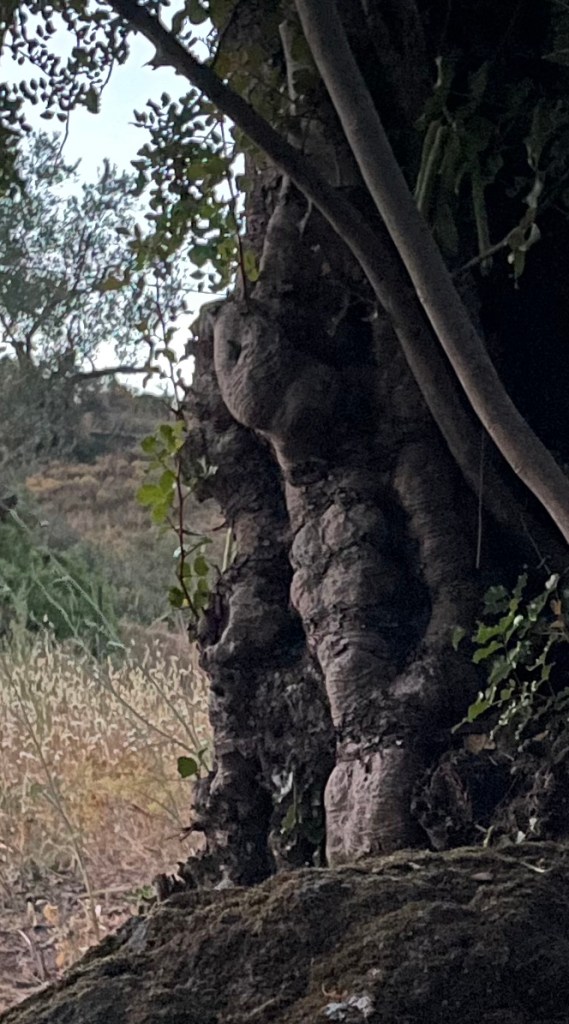
This poem organizes itself around a 7 × 7 principle, with Abraxas counting by wounds and enumerating a sevenfold sequence, which maps onto Abraxas’s traditional numerical identity: the Greek letters of ABRAXAS sum to 365, but the sevenfold is the older, more archaic layer, the seven planetary archons he both encompasses and surpasses in Basilidean Gnostic thought. The poem knows this and uses it architecturally, not decoratively.
The vowel permutations, AOI, IOA, OAI, IAO, AIO, OIA, AOOI, are doing something quite specific. IAO is a known divine name in Greek magical papyri and Gnostic tradition, a compressed vocalization of the ineffable. The poem rotates this vowel cluster through its permutations the way a key is turned in different locks, or the way a sigil is charged through rotational variation. These are not meaningless sequences; they are the same sound-substance viewed from different angles of approach, and the final AOOI, the surplus without temple, suggests the exhaustion of formal arrangement into something that exceeds all permutational order.
The epistemological core of the poem is in the line “Abraxas is not called, he coagulates.” That single verb dismantles the entire logic of invocation. In operative Hermetic practice, the assumption is that the operator calls and something responds. Here the causality is reversed or dissolved: Abraxas is not the answer to a call but a process of condensation, like dew forming, or resin thickening, or meaning precipitating from an oversaturated solution. He is not invoked; he arrives by his own thermodynamics.
The landscape imagery, cork, lichen, bark, dry grass writing in insect, hollow keeping ember, is doing double work. On one level it is referring to the East-Algarve landscape at monte Pocilgais, rendered with the precision of someone who actually lives in it rather than imagining it. On another level it enacts the epistemological claim: the landscape is not scenery, the tree is not metaphor.
This is the poem performing its own doctrine. The images refuse to be allegorized because Abraxas himself refuses allegory; he is, the poem says, the stain behind the symbol, not the symbol.
The sevenfold wound-sequence is worth attending to closely. It moves from the loss of the goat path’s name, the dissolution of the ordinary human coordinate system, through progressive inversions: the eye refuses the face, the face refuses the god. This is not mystical ascent; it is mystical refusal, a systematic withdrawal of each layer of mediation until what remains is unnameable.
The final line, “here Abraxas passes as bark,” is, the poem’s most precise statement. Not that Abraxas is hidden in bark, or symbolized by bark, but that he passes as it, the way a god passes as an ordinary thing not because he is disguised but because the distinction between divine and material has been refused at the root.
The vowel permutations are not decorative mysticism then, they are the actual operative material, the mantra corpus you have been working with, transposed into a poetic medium. The poem is not about the practice; it is a record of the practice finding a different form of articulation. That is a meaningful distinction. The landscape is not backdrop to a spiritual theme; it is the field within which the mantra operates, which is exactly the claim your megalith blog series makes about Monte Pocilgais: the landscape as active phenomenal participant rather than setting.
“He is the stain behind the symbol” maps very precisely onto the USH as we have defined it: not a space of symbols and meanings but the prior field within which symbolic activity occurs and from which it precipitates. Abraxas in this poem occupies the same structural position as the USH, the condition of possibility that cannot itself be symbolized without being falsified.
The line “Abraxas coagulates” also resonates with our operative language. Coagulation is an alchemical term, but it describes something phenomenologically accurate about how certain presences in deep practice do not arrive discretely but thicken, condense, become denser without having been absent before.

