Elemental Encounter, Bardon’s Soul Mirror, and the Ethics of Landscape Magick
From Stone Phenomenology to Elemental Encounter
This series (now with 6 parts) began with a simple but difficult decision: not to decide too quickly what the stone formation at Monte Pocilgais is. It may be a natural accumulation, an agricultural clearance cairn, a collapsed retaining structure, an archaeological remnant, or something still unnamed. From the beginning, therefore, the project has deliberately stood at the boundary between hard and soft values.
The dimensions, orientation, geology, trees, slope and relation to the seasonal river had to be documented as precisely as possible, but at the same time we did not want to exclude what happens when people sit quietly inside the place and notice that the atmosphere changes.
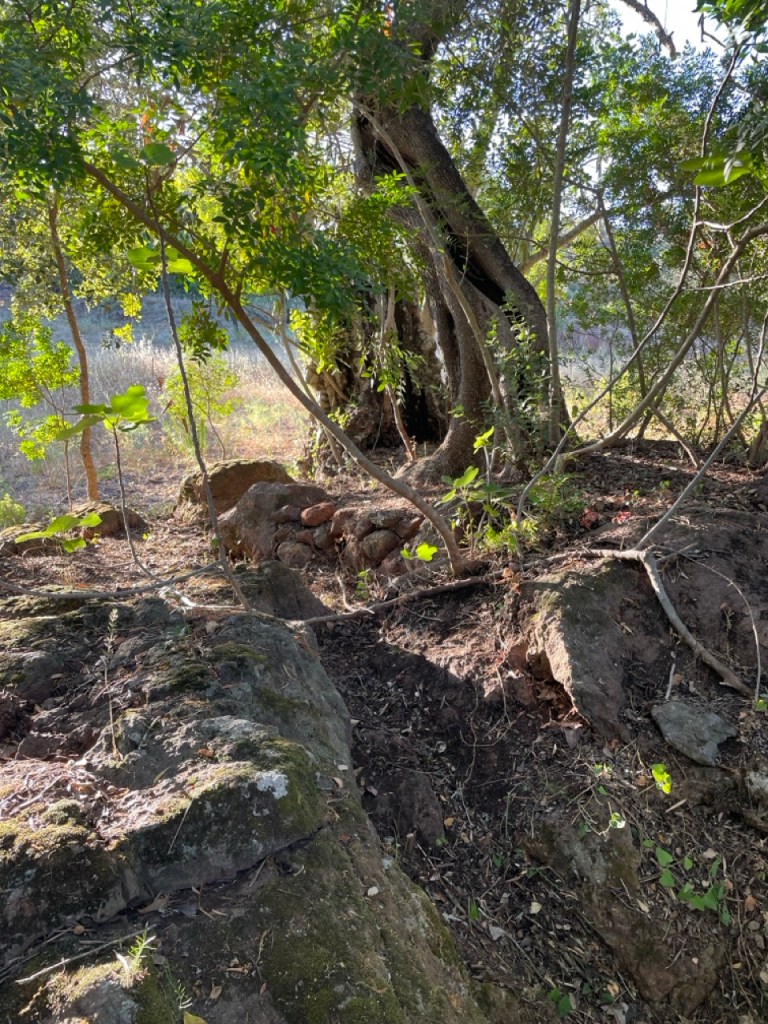
The first part of the series introduced the site as a charged landscape feature on the south-facing slope of Monte Pocilgais, in the eastern Algarve, between São Brás de Alportel and Moncarapacho.
The grey stones, materially distinct from the softer red sedimentary hills around them, form a semi-oval structure bound together with old carob trees and stone oaks. The site lies near a seasonal river, but above the floodline, and the first question was not whether it could be proven to be sacred, but whether it could be approached as a place where tangible and intangible landscape values meet.
The following parts widened the frame. The old Portuguese tradition of the Moura Encantada brought the stone into relation with a much older Iberian pattern: certain stones, springs, hills and underground places are not empty, but inhabited. The moura is not simply a fairy-tale woman, nor merely a projection of romantic folklore. In the eastern Algarve material collected by Ataíde d’Oliveira, she appears as a presence bound to stone, spring, hill and hidden treasure. She belongs to a landscape in which the visible and invisible are not separated as sharply as modern rationality assumes.
The second and third parts then placed Monte Pocilgais between two documented zones of moura tradition. São Brás de Alportel contributes the Fonte do Mouro, the spring in which the enchanted moura lives in a palace at the bottom of the water. Moncarapacho contributes its own stories of mouras, treasure, white figures and dangerous thresholds. The stone oval at Monte Pocilgais lies between these two fields of tradition. It is not necessary to claim that this proves anything archaeologically. The point is subtler. The site stands within a landscape already saturated with narratives of hidden presences, thresholds, stones, water, treasure and encounter.
The fourth part of the series offered the theoretical centre. It proposed a three-stage development: first, the raw chthonic force of the Neolithic stone, dense, prepersonal and not yet narrated; then the Celtic or pre-Christian personalisation of the dead and the hidden ones as keepers of the megalithic landscape; and finally the more accessible image of the Moura Encantada, the beautiful and sorrowful feminine figure who guards treasure and appears at thresholds. In that frame, the moura became the anima of the stone, not in the reductive sense of a private fantasy, but as a mediating image through which an ancient chthonic presence becomes perceptible to human consciousness.
The fifth part moved from theory to practice. It developed a six-phase protocol for approaching the stone formation: arriving at the threshold, walking the perimeter, sensing the difference between inside and outside, choosing the most charged point through bodily attention, entering the stone through gaze and soft focus, opening into the ultra-subjective hyperspace, and finally returning to ordinary perception through deliberate closing and documentation. That protocol was important because it refused both credulity and dismissal. It did not say: believe in the spirit of the place. It also did not say: reduce everything to psychology. It said: slow down, observe, enter carefully, and notice what the place does before you interpret it.
Now this sixth part now adds a further layer. If the previous parts explored stone, moura, anima and practice, this one asks about the elements. Not the elements as abstract occult categories, but the elements as they are present at Monte Pocilgais itself: stone and earth, wood and root, open air, fierce summer sun, and the seasonal river that in summer has withdrawn into absence.
A Helpful Distinction: Encounter and Evocation
A recent article by Tjalling D. Janssen, published in Correspondences in 2024, offers a useful historical distinction for this work. Janssen compares two early modern treatments of elemental beings: Paracelsus’s Liber de nymphis and the later English Treatise on Angel Magic, associated with the Rudd tradition. His central distinction is between two modes of contact: encounter and evocation.
In Paracelsus, elemental beings such as undines, sylphs, gnomes and salamanders are not primarily summoned by a magician. They belong to the natural world. They inhabit rivers, forests, caves, mountains, fiery places and subterranean domains. The direction of contact is therefore not first from human to spirit, but from elemental being to human. The elemental appears, approaches, crosses over, seduces, warns, assists or disturbs. It comes from the place.
This is what Janssen calls the mode of encounter. Its importance is not merely technical, as if we were comparing two different ritual procedures. It carries an entire attitude toward nature. In the encounter model, the natural place retains agency. The river is not just a symbol of water. The cave is not just a ritual backdrop for earth. The forest is not merely scenery. The elemental being belongs to a specific ecology of appearance. It is tied to location, atmosphere, materiality and danger. The human being does not own the threshold.
In the Treatise on Angel Magic, by contrast, the Paracelsian material is taken up into a more evocatory magical framework. The elemental spirits become part of a ritual and cosmological system in which the practitioner may call, arrange, command or consult spiritual powers. The direction of contact changes. It is now primarily human to spirit. The magician acts, summons, orders the space, and expects response.
Janssen does not present this simply as decline or corruption. The later magical tradition has its own coherence. But the shift is significant. As the elemental becomes more easily summonable, it also becomes more detached from the living texture of the landscape. The element becomes portable. Earth no longer needs this stone, this slope, this soil, this cave. Water no longer needs this spring, this river, this seasonal absence. Fire no longer needs this heat, this glare, this summer dryness. Air no longer needs this valley, this openness, this wind. The element becomes a category that can be invoked anywhere.
For landscape magick, this distinction is decisive. If we begin with evocation, we risk treating the place as a resource. We come to the land with our ritual vocabulary and ask it to perform. We name it, charge it, activate it, open it, and perhaps also unknowingly colonise it with our own imagination. But if we begin with encounter, the first discipline is different. We do not ask how to summon the spirit of the place. We ask whether we have become quiet enough to notice whether the place is already addressing us.
The Elemental Grammar of Monte Pocilgais
Monte Pocilgais is not an abstract four-element diagram. It has its own elemental grammar.
Earth is the most obvious. The formation is stone-heavy, resistant, dense. The grey stones do not visually or materially belong to the softer red sedimentary hill around them. Whether they are natural, moved, accumulated, cleared or arranged remains uncertain, but phenomenologically they do something. They collect weight. They hold silence. They change the pace of walking. They draw the body downward and inward.
Wood is equally present, not as the lush green wood of northern forests, but as Mediterranean endurance. The carob trees and stone oaks have rooted themselves into the structure over time. They do not decorate the stones. They participate in them. Their roots enter between the rocks, their trunks mark duration, and their survival speaks of adaptation to heat, drought and poor soil. Wood here is not romantic forest-symbolism. It is persistence under pressure.
Air is present in openness, orientation and distance. The site is not enclosed like a cave. It lies in relation to slope, valley and sky. Air moves through the formation, over the stones, through the dry grasses and around the trees. It carries sound differently inside and outside the oval. It opens the attention horizontally. In this place, air is not simply thought or intellect, but spacing, listening, exposure and relation.
Fire, in summer, is everywhere. Not as candle flame or ceremonial fire, but as sun, glare, heat and desiccation. The fire element presses on the skin. It hardens the ground, dries the river, bleaches the grasses and concentrates the life of the place into bark, root, seed and stone. It is not spectacular. It is relentless. It is not something one needs to invoke. It is already acting.
Water is the most interesting because in summer it is mostly absent. The local river is not running. It remains as a line in the landscape, a memory of flow, a seasonal promise, perhaps a hidden underground presence. This absence matters. In a Mediterranean landscape, water often speaks not by abundance but by withdrawal. A dry riverbed is not the absence of water in the symbolic sense. It is water in another mode: remembered water, withheld water, future water, water that has shaped the valley and then disappeared from the surface.
So the elemental field at Monte Pocilgais is asymmetrical. Earth, stone, wood, air and sun are dominant. Water is background, the river s mostly dry.
To impose a perfectly balanced four-element scheme onto such a place would already be a small falsification. The land does not present itself as a diagram. It presents itself as a specific configuration. That specificity is the beginning of respect.
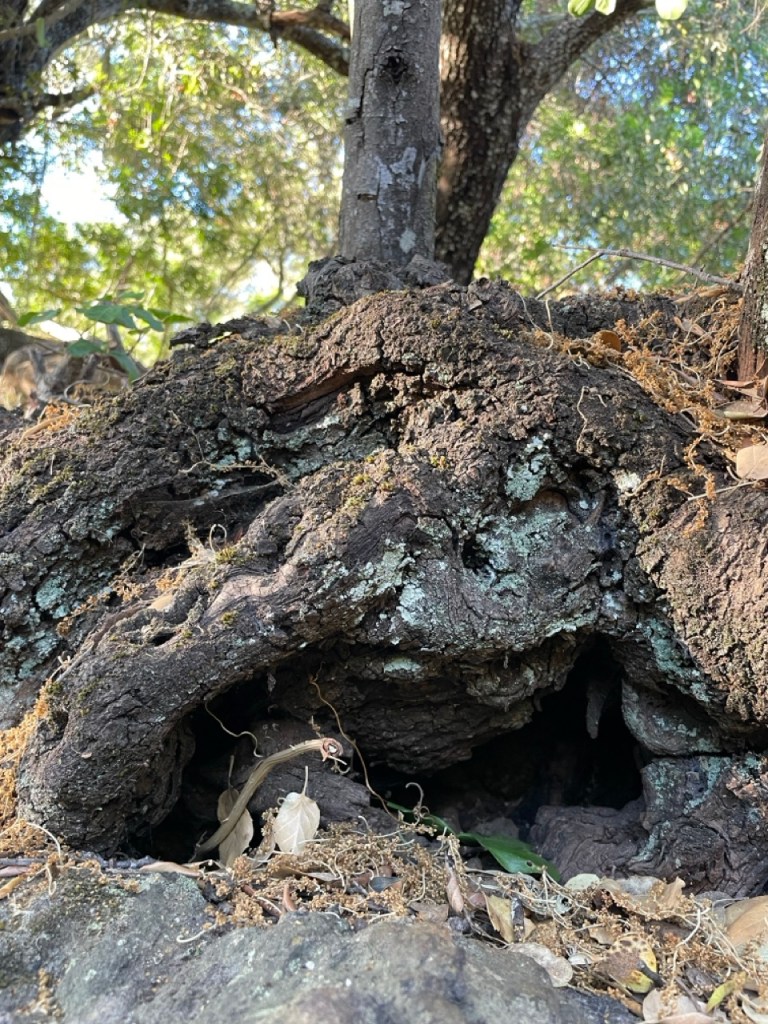
Bardon Before Evocation: The Soul Mirror
This is where Franz Bardon becomes useful, but only if read in the right order. Bardon is often associated with magical training, concentration, will, elemental equilibrium and eventual evocation. Yet in his system, serious work does not begin with spirits. It begins with the soul mirror.
The soul mirror is the disciplined observation of one’s own character according to the four elements. Fire, air, water and earth are not first treated as external powers to be summoned, but as tendencies within the practitioner. Fire appears as will, courage, intensity, anger, impatience and force. Air appears as thought, mobility, fantasy, lightness, distraction and speed. Water appears as feeling, receptivity, longing, melancholy, devotion and emotional permeability. Earth appears as steadiness, inertia, reliability, attachment, heaviness and resistance.
This means that Bardon’s first elemental work is not theatrical. It is diagnostic. Before the practitioner can work responsibly with the elements outside, he or she must learn how the elements are already operating inside.
For landscape magick this is crucial. Without the soul mirror, the practitioner will almost certainly project an inner imbalance onto the place. A person dominated by restless air will see signs everywhere and move too quickly from one association to the next. A person dominated by fire will want to activate the site, claim its power, do something, force a result. A person dominated by water may dissolve too quickly into dream, grief, longing or mythic identification. A person dominated by earth may reduce the whole place to material fact and miss the imaginal opening altogether.
In each case, the place has not yet appeared. The practitioner has appeared in front of the place and mistaken that appearance for revelation.
The soul mirror therefore protects the landscape from our own occult impatience. It asks us to become accountable for the elements in ourselves before we speak too confidently about the elements in the world. It does not make experience less magical. It makes it cleaner.
The Witness and the Operator in the Landscape
In the language of the Inner Laboratory, the same point can be made differently. The operator may only act from within the witness. If there is no witness-consciousness, the so-called operator is usually only an old program wearing the costume of spiritual discipline. In that case, magical action becomes reactivity. It may look ritualised, but inwardly it is still compulsion, fantasy, inflation or control.
A charged landscape site intensifies this risk. Such a place invites meaning. It wants interpretation, or perhaps more precisely, it awakens the interpreter in us. One person feels awe, another fear, another scepticism, another excitement, another desire to prove something. The first task is not to suppress these responses, but to see them clearly.
The witness stands before the place and notices. The body slows down here. The eyes are drawn there. The feet avoid this stone. The chest tightens near that tree. The imagination wants to produce a figure. The mind wants to call it a moura, a guardian, a gnome, a chthonic presence, a memory of the dead. All this may be meaningful, but it is not yet encounter. Encounter begins only when perception has become quiet enough to distinguish between what we bring and what arrives.
This distinction can never be made with absolute certainty. There is no laboratory test for the spirit of a place. But there is a discipline of phenomenological honesty. One can learn to recognise the tone of projection, the speed of fantasy, the pressure of desire, the heaviness of fear, and the more surprising quality of something that seems to arrive from beyond the already known self.
The question is not: is this objectively real or merely subjective? The better question is: what kind of event is this, and how does it ask to be met?
A Four-Element Field Practice at Monte Pocilgais
The practical consequence is simple. Before any ritual naming, before asking for signs, before trying to contact the genius loci or the moura of the stone, the practitioner should first let the place work elementally.
Stand at the edge of the formation and begin with earth. Feel the soles of the feet, the slope, the hardness of the stones, the difference between the grey rocks and the red hill. Notice whether the body becomes heavier, more stable, more resistant, more silent, or more defended. Do not interpret too soon. Let earth become bodily fact before it becomes symbol.
Then attend to fire. In summer this will not be difficult. Feel the sun on the skin, the dryness in the mouth, the glare in the eyes, the demand the heat makes on the nervous system. Notice whether fire awakens clarity, irritation, urgency, courage, impatience or purification. The question is not what fire means in an occult table. The question is what fire is doing here, now, in this body, at this site.
Then attend to air. Listen. Notice the openness of the place, the direction of the wind if there is wind, the acoustic difference between standing outside the structure and sitting within it. Let the eyes soften and allow the field of perception to widen. Air may bring thought, but it may also bring spaciousness, distance and a less possessive form of attention.
Finally, attend to water precisely through its summer withdrawal. Where is the river? Where would flow be in winter? What does the dry riverbed do to feeling? Does it evoke thirst, memory, melancholy, patience, hiddenness, expectation? In this place water is not absent in a simple sense. It is latent. It has shaped the valley and then retreated. It teaches that an element can be present through lack.
Only after this elemental reading of the place should the soul mirror be brought in. What in me responded most strongly? Was I immediately claimed by earth, fire, air or water? Did I want to see signs? Did I want to master the site? Did I become dreamy, sceptical, impatient, heavy, reverent, distracted? Which element in me began to speak before the place had spoken? This is the actual threshold.
The Question After the Soul Mirror
After the elemental reading and the soul mirror, a more subtle question can be asked: What appears here that does not seem to come only from me?
This question is careful. It does not claim too much. It does not reduce too much. It leaves room for the imaginal without abandoning discrimination. The answer may not be a vision. It may not be a figure. It may be a shift in the atmosphere, a pressure in the body, a remembered story, a sudden sense of being watched by the stones, or the feeling that the dry river is more important than it first seemed.
If the image of the Moura Encantada arises, she should not be forced onto the site as folklore decoration. She should be allowed to appear only if the place, the body, the stones, the trees, the dry river and the field of attention begin to constellate around her. In that case, she is not merely a fantasy added to the landscape. She becomes a mediating figure at the border of place and psyche. She is the form in which the chthonic presence becomes humanly legible.
The same would apply to any elemental being. A gnome is not useful if it is merely imported from an occult manual. A salamander is not useful if it is only a word for heat. An undine is not useful if the actual condition of water at the site is ignored. A sylph is not useful if air has not first been felt as openness, listening and exposure. Elemental beings, if they are to mean anything in landscape magick, must arise from the actual elemental grammar of the place.
This returns us to Janssen’s distinction. Encounter preserves the dignity of the place. Evocation can be meaningful, but only after encounter. Without encounter, evocation easily repeats the extractive gesture of modernity. We come to the land, name its powers, arrange them in our system and ask them to serve our development. But the land may not wish to serve. It may wish first to correct.
The Ethics of Not Summoning Too Soon
Perhaps the first rule of elemental landscape magick is therefore this: do not summon what you have not first learned to encounter. And the second: do not interpret the place before you have examined the elements in yourself.
At Monte Pocilgais, this means that the work begins without drama. One arrives. One stands outside the stone formation. One feels the heat, the ground, the dry air, the old trees, the absent river. One notices the impulse to name, to explain, to spiritualise or to dismiss. One lets that impulse become visible. This is already the soul mirror opening in the landscape. Only then can the place begin to differentiate itself from our expectations.
The stone may remain stone. That is not a failure. The dry river may remain dry. That is not a lack of magic. The trees may offer no message beyond their endurance. The sun may give no initiation beyond heat. But sometimes, when the practitioner stops demanding an answer, the whole configuration begins to shift. The stones, trees, air, sun and absent water no longer feel like separate objects. They become one field. The place gathers itself.
Encounters, Evocations and Elemental Beings: Modes of Contact and the Natural World in the “Liber de
nymphis” and “A Treatise on Angel Magic” https://correspondencesjournal.com/ojs/ojs/index.php/home/article/view/208


Pingback: New Landscape Holistic Project: The Magick Megalithic Circle Phenomenology | breath4balance