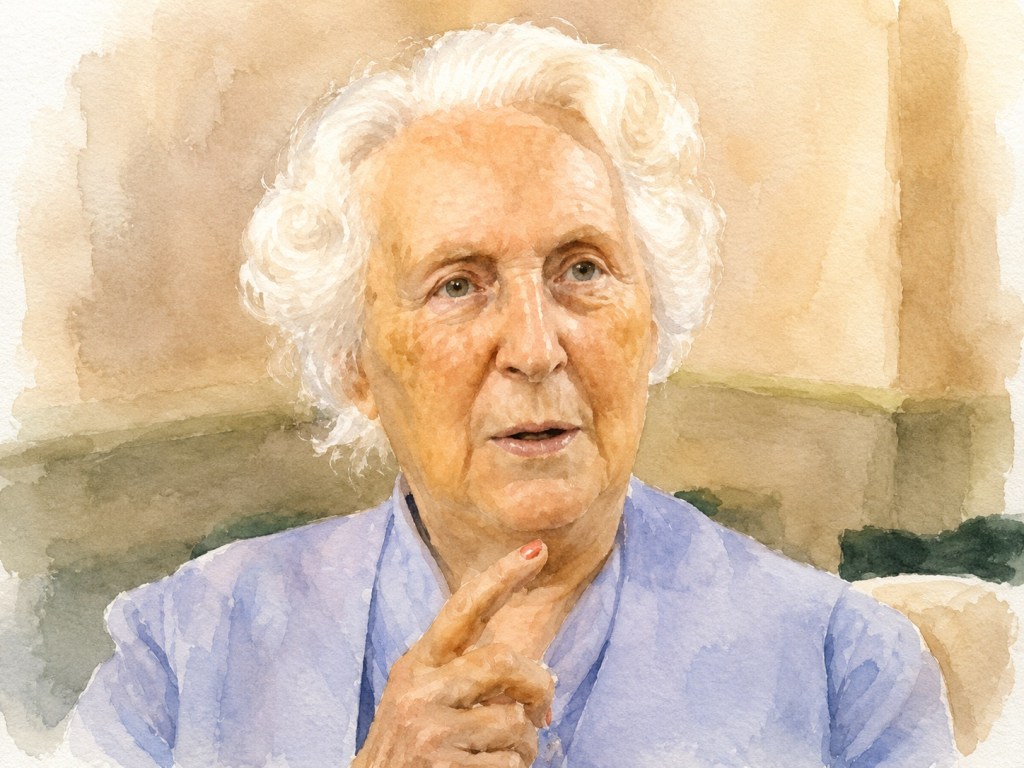
Jeanne de Salzmann was born in 1889, met G. I. Gurdjieff in 1919 and remained his closest pupil until his death in 1949. She subsequently guided the international continuation of his work until her own death in 1990, at the age of 101. The recordings discussed here therefore show not merely an elderly teacher recalling a system, but a woman approaching the end of a lifetime devoted to a single practical question: can a human being become inwardly present enough not to be governed entirely by habit? (Gurdjieff International Review)
At one hundred years old, Madame de Salzmann does not offer a consoling philosophy. She speaks slowly, sometimes searching for words, but the direction is exact. The body is here. The mind is here. Feeling is here. Yet these parts do not ordinarily form a coherent whole. Each proceeds according to its own habits. Thought associates, the body performs familiar movements, and feeling reacts. We call their combined activity “myself”, although there may be little conscious relationship between them.
Her central claim is that a new quality of intelligence can appear when these normally separate functions enter into a conscious relationship. She calls this a new energy, a different level of consciousness or an intelligent vision. We need not immediately accept this language as a literal account of subtle energies. What matters first is the phenomenological observation behind it: when bodily sensation, thought, feeling and sustained attention are simultaneously present, the quality of experience changes.
The person is no longer wholly taken by any one part.
That is the beginning of freedom.
The body is here, but am I here?
One of the simplest statements in the recording is also one of the most radical:
“My body is here. My mind is here and my feeling is here.”
This sounds self-evident. Yet Madame de Salzmann immediately questions whether these functions are actually related. The body may be sitting in a room while the mind is replaying a conversation. Feeling may be absorbed in resentment, anticipation or unease. Each part is present in one sense, but there is no unified presence.
Ordinarily, the body acts largely according to habit. We rise from a chair, walk across a room, speak, gesture and reach for objects without needing to experience the movement in any depth. This automation is essential. We could not function if every movement had to be consciously calculated.
The problem is not automatism itself. The problem is that it tends to appropriate the whole of us.
The message of Madame de Salzmann repeatedly returns to this tension. She observes that the body follows habit when it is not heard. Thought moves in its own direction. Feeling has its own recurring reactions. Without sufficient conscious attention, one is again “taken” by these automatic movements.
This is close to the foundational observation of the Inner Laboratory: we usually do not act from a stable centre of awareness. An impulse arises, a thought interprets it, the body prepares a response, and the action follows. Only afterwards does the mind explain why “I” chose it.
The first task is therefore not to control the body or suppress thought. It is to establish contact.
Can I sense the body while thinking?
Can I hear my words while speaking?
Can I remain aware of the whole organism while beginning to move?
Can I feel an emotion without allowing it to become the entire field of consciousness?
These are not abstract philosophical questions. They can be investigated directly.
The double movement
A particularly important phrase in the recording concerns what Madame de Salzmann calls a double movement.
One movement is automatism. It is already present and operates continuously. The second is a movement of conscious attention, difficult to obtain and even more difficult to sustain.
This is a remarkably precise description of inner work. Freedom is not created by making the automatic movement disappear. It emerges when another movement becomes present at the same time.
A person may feel irritation while also knowing that irritation is occurring. The body may prepare to withdraw while the person remains aware of the pressure in the chest, the tightening of the jaw and the thought that demands escape. The habitual reaction is still active, but it no longer occupies the whole field.
This simultaneous awareness is essential. When the automatic process is merely replaced by a new command, there is no guarantee of freedom. “Do not be angry,” “relax,” “be spiritual,” or “control yourself” may simply be other automatic programmes. They often originate in fear, self-judgement or internalised authority.
The second movement must have a different quality. It is not another thought fighting the first thought. It is an attention capable of including thought, feeling and bodily sensation without immediately becoming identical with any of them.
In the language of our own the Inner Laboratory, this is the emergence of the witness.
The witness does not eliminate automatism. It sees it.
The witness is not a detached spectator
The word witness can easily create the wrong impression. It may suggest an observer standing at a distance from life, calmly watching the body and emotions as though they belonged to somebody else. This can lead to emotional detachment, intellectualisation or even dissociation.
That is not what Madame de Salzmann demonstrates.
Her attention is strongly embodied. She repeatedly asks participants to sense the weight of the body, the position of the head, the solidity of the hands and the distribution of force through movement. Attention is not withdrawn from the body. It enters into a more exact relationship with it.
Nor is feeling excluded. The aim is not to become a neutral surveillance system. Thought, sensation and feeling are all required, but they must cease functioning as disconnected and competing centres.
The witness is therefore not a separate inner person. It is a quality of consciousness in which more of the present situation can be included without one fragment taking over.
When this quality is absent, thought says, “I am right,” and we become the thought. Fear arises, and we become fear. The body contracts, and its contraction becomes an instruction. When witnessing is present, the same processes can occur, but something remains available that is not completely captured by them.
Madame de Salzmann describes the resulting freedom negatively and precisely: she is not taken by thought, body or feeling, and not carried away by an automatic movement that ordinarily occurs by itself.
That is already a great deal. Freedom does not initially mean that one can do anything one wishes. It means that one is no longer entirely compelled to continue the movement that has already begun.
Attention must enter movement
It is relatively easy to experience a degree of awareness while sitting quietly. The environment is controlled, the task is simple and external demands are limited. But the real test begins when movement starts.
Madame de Salzmann tells the participants that they must remain open to attention while the body moves. The two things must be present together. The movement should not displace the attention, and the effort to remain attentive should not freeze or distort the movement.
This is one of the central purposes of the Gurdjieff Movements. The pupil may be required to coordinate unfamiliar positions, rhythms, directions and sequences. Habit is deliberately made insufficient. The body cannot perform everything mechanically, but conscious thought alone is also too slow. A different coordination is required.
In the recording, she asks the group to experience the same force in the feet, arms, head and rhythm. The emphasis is not on aesthetic performance. The exercise exposes where attention disappears, where one part dominates and where bodily habit resumes command.
She repeatedly corrects the participants:
You lose yourselves.
Begin again.
The same force is not present everywhere.
Stop.
Resume.
These interruptions are not failures of the exercise. They are the exercise. The practitioner discovers the precise moment at which an intention ceases to be alive and becomes mechanical.
This insight is directly relevant outside formal movement practice. We may decide to listen carefully during a conversation, only to discover that within seconds we are preparing our reply. We may intend to remain aware of the breath during a difficult interaction, but the bodily anchor disappears as soon as we feel criticised. We may begin a task consciously and wake up twenty minutes later inside habitual distraction.
The essential skill is not uninterrupted perfection. It is the capacity to notice the loss and return.
From the witness to the operator
The Inner Laboratory makes explicit a distinction that is already latent in Madame de Salzmann’s teaching. Conscious attention must not remain only receptive. At a certain point it must participate in action.
We call this active function the operator.
The witness recognises what is taking place. The operator chooses the next non-automatic movement.
The witness may register:
My breathing has become shallow.
My jaw is tightening.
I am preparing to defend myself.
The familiar thought is returning.
I want immediate relief.
The operator then introduces a small action:
Remain for one breath.
Feel both feet.
Do not send the message yet.
Ask one question before answering.
Speak more slowly.
Allow uncertainty to remain for another minute.
The operator is not a heroic will that conquers the organism. It is the capacity to give direction while remaining in contact with what is actually present. It can act only when the witness is awake. Without witnessing, what appears to be willpower may simply be perfectionism, fear or another compulsive programme.
Madame de Salzmann’s instruction about getting out of a chair illustrates this. She does not simply say, “Stand up.” She asks for a different energy or quality of attention to be present before and during the movement. The act of rising is no longer allowed to take the attention away. The person rises, walks or speaks without surrendering completely to habitual execution.
This clarifies the distinction between reacting and acting.
A reaction is not defined merely by speed. A slow response may be thoroughly automatic. An action is not defined by forcefulness. A decisive gesture may still be driven by fear. Acting begins when an automatic movement is perceived and another direction is consciously inserted.
What does “energy” mean here?
The word energy appears throughout the recording. For contemporary readers it creates a problem. In scientific language, energy has a precisely defined physical meaning. In therapeutic and spiritual discourse, the same word is often used so vaguely that it can explain almost anything.
We should therefore resist both credulity and premature dismissal.
When Madame de Salzmann speaks of different energies becoming related and producing a new energy, she may be using the specific cosmological language of Gurdjieff’s teaching. The transcript itself does not provide an empirical demonstration of a new measurable physical energy. We should not pretend that it does.
At the same time, the term may point to a genuine experiential distinction. A scattered person experiences thought, emotion and bodily impulse as competing tendencies. When these functions become coordinated through sustained attention, the person may experience increased coherence, vividness, availability and agency.
This need not be dismissed merely because the traditional vocabulary is difficult.
Within the Inner Laboratory, we would separate three levels:
- Immediate observation: bodily sensation, attention, feeling and thought become simultaneously present.
- Close phenomenological description: the person experiences greater coherence and is less completely captured by automatic reactions.
- Traditional interpretation: the relationship between ordinarily separate energies produces a new or higher energy.
The first two can be investigated directly. The third belongs to the interpretive framework of the Gurdjieff tradition. It may be meaningful, but it should not be presented as a scientifically established mechanism.
This distinction protects the practice from mystification without stripping it of depth.
The body as instrument, not ultimate authority
Current somatic discourse often claims that “the body knows” or that the body “stores the truth.” Such phrases may encourage people to attend to sensations that have long been ignored. But they can also turn bodily reactions into unquestionable messages.
Madame de Salzmann’s position is subtler.
The body is indispensable, but it is not the sole authority. Associative thought is indispensable, but it is also an instrument. Feeling is indispensable, but it too can be conditioned and automatic. None of these parts, taken separately, provides the whole truth.
This contrasts sharply with contemporary cathartic approaches in which trembling, crying, shaking or muscular release is immediately interpreted as the discharge of stored trauma or old emotional material. A bodily response is real as a bodily response. The meaning attributed to it remains an interpretation.
For the Inner Laboratory, the question is not merely, “What did my body express?” It is also:
Was I present?
Could I remain in contact with sensation without constructing an immediate story?
Did the experience alter my subsequent behaviour?
Did I acquire a capacity that remains available outside the session?
A dramatic release may provide relief. It may even mark an important transition. But an experience is not yet a transformation.
Madame de Salzmann’s work is demanding precisely because it does not seek release alone. It seeks a stable relationship among the different functions of the person.
The need to remain
In the recording, attention repeatedly weakens. The group cannot maintain the required quality indefinitely. Madame de Salzmann acknowledges this without sentimentality. One can sustain the work for a time, then the necessary tension diminishes and automatism returns.
This is important. Inner work does not progress through uninterrupted ascent. The ability to remain present develops gradually.
The word tension here should not be confused with muscular strain or psychological stress. It refers to the active relation required to keep several elements together: bodily sensation, direction, awareness and movement. If that relation collapses, the habitual organisation resumes.
The practitioner therefore learns to recognise two opposite errors.
The first is laxity. Attention becomes vague, dreamy or passive. The body proceeds by habit while the mind imagines that it is observing.
The second is force. The practitioner tightens the body, narrows the mind and tries to manufacture presence through control. This may create intensity, but not necessarily awareness.
The required state lies between collapse and coercion. It is active without being rigid, receptive without becoming diffuse.
Breath can become a valuable bridge here. Not because breathing exercises automatically produce higher consciousness, but because breath lies at the meeting point of voluntary and involuntary activity. It continues by itself, yet it can also be sensed, shaped and coordinated with movement.
A bodily anchor, such as the sensation of the feet, lower abdomen or respiratory movement, can help the witness remain embodied. A short formula can help the operator introduce direction. But neither instrument should replace observation. The anchor is not a refuge from experience, and the formula is not a magical command.
They are means of returning.
“We are here for something”
Near the end of the transcript, Madame de Salzmann tells the group that they are together for something, and that everyone shares responsibility for allowing this “something” to appear.
The phrase could easily be inflated into a grand spiritual declaration. Yet its practical meaning emerges from everything that precedes it. People are not assembled merely to perform movements correctly, preserve a tradition or admire a teacher. They are attempting to make possible a quality of human presence that ordinary life does not reliably sustain.
The collective setting matters because individual attention is unstable. Rhythm, shared movement and the presence of others can support a level of engagement that is difficult to maintain alone. But the group can also become another source of identification. One may imitate intensity, conform to the teacher’s language or confuse collective emotion with transformation.
Madame de Salzmann points towards something more exact: the ensemble can support the work only when each participant assumes responsibility for attention.
No one can be present on another person’s behalf.
A new education
She describes the work as a new education.
This does not mean acquiring new information. It means educating functions that ordinarily remain poorly related. The body must learn to participate consciously rather than merely execute. Thought must learn to see rather than endlessly associate. Feeling must become available without taking possession of the whole person.
This is also the central ambition of the Inner Laboratory.
The aim is not simply symptom reduction, although the practices may have therapeutic relevance. It is not the pursuit of unusual states, although altered states may occur. It is not self-optimisation, spiritual status or obedience to a metaphysical system.
It is the gradual construction of inner capacity.
To see without immediately disappearing into what is seen.
To return deliberately after attention has been lost.
To act while remaining in contact with body, thought and feeling.
To interrupt a habitual pattern without replacing it with violence against oneself.
To transform a temporary glimpse into a repeatable ability.
Madame de Salzmann’s words at one hundred years old have force because they do not present completion. Even after a lifetime of work, the demand remains immediate: sense the body, observe the automatic movement, establish the relation, do not lose the attention.
Begin again.
From traditional teaching to the Inner Laboratory
The Gurdjieff tradition provides a rich and demanding training architecture, but the Inner Laboratory cannot simply reproduce its vocabulary and cosmology. Our task is to distinguish practice from doctrine and observation from interpretation.
From Madame de Salzmann’s teaching we can retain several essential principles:
Human functioning is divided. Thought, feeling and bodily activity do not ordinarily form a conscious unity.
Automatism is necessary but dominant. Habit allows life to proceed, yet it also governs reactions that we mistakenly experience as free choices.
Attention can create a second movement. The habitual process may remain, but it can be perceived without occupying the whole field.
Embodied awareness is indispensable. Presence is not an idea in the head. It includes sensation, posture, breathing and movement.
Freedom requires action. Awareness becomes transformative only when it allows a different movement to enter at the decisive moment.
Capacity develops gradually. A temporary state must be distinguished from a stable acquisition.
To these principles, the Inner Laboratory adds explicit instruments: the witness, the operator, the bodily anchor, the formula, the soul mirror and a progressive programme of attention and concentration exercises.
The witness establishes conscious space.
The operator introduces direction.
The bodily anchor keeps awareness from becoming purely conceptual.
The formula condenses the chosen direction into a brief, embodied instruction.
The soul mirror reveals the recurring patterns in which these capacities are most needed.
The exercises gradually make attention more stable and action less dependent on favourable circumstances.
This is not a rejection of the old school. It is an attempt to translate its operational core into a form that can be practised, questioned and evaluated without requiring unquestioning allegiance to its entire metaphysical structure.
The experiment
A simple experiment can convey more than a long theoretical explanation.
Sit quietly for a moment and sense the weight of the body. Do not imagine the body. Feel the contact with the chair and floor.
Notice the movement of breathing without changing it.
Become aware of thought at the same time. Do not follow its content. Simply recognise that thinking is occurring.
Include the emotional tone of the moment, however faint: calm, impatience, expectation, resistance or uncertainty.
Now slowly rise from the chair.
Can the bodily sensation, the awareness of thought and the chosen direction remain present while the movement takes place?
At what moment are you taken?
Does attention disappear before movement begins, during the effort of standing, or as soon as the next goal enters the mind?
Sit down and repeat the experiment.
The purpose is not to perform it perfectly. The exact moment of loss is the most valuable observation. It reveals where automatism resumes command.
Then the work begins again.
Madame de Salzmann’s enduring message is neither mystical consolation nor bodily romanticism. It is a disciplined proposition: another quality of life may become possible when attention is strong enough to relate what habit keeps separate.
The body is here.
Thought is here.
Feeling is here.
The decisive question remains:
Am I here in relation to them?
#Breath4Balance #JeanneDeSalzmann #Gurdjieff #TheFourthWay #InnerLaboratory #ConsciousAttention #EmbodiedAwareness #SelfObservation #WitnessConsciousness #InnerFreedom #Breathwork #Meditation
Source of her talk on Youtube: https://youtu.be/ElwVw1gQjec?si=3IRaTFUlNUrILHpT

