Breath, Vowels, Abraxas, and the Gestural Phonology of Altered States
Some esoteric formulas are not meant to be translated. They are meant to be voiced.
This is the point modern readers often miss. We approach ancient magical words as if they were damaged sentences. We ask which language they belong to, whether they are Greek, Hebrew, Egyptian, Aramaic, Coptic, or corrupted fragments of all of these. We ask whether they can be restored, decoded, normalised or traced back to an original divine name. That work is necessary. Without philology, the study of esotericism dissolves too easily into fantasy.
But there is another question, and for the practitioner it may be the more important one.
What do these words do to the breathing body when they are voiced?
That question opens a different field. The so-called voces magicae of the Greek magical papyri are not merely failed language. They are ritual sound-forms. They shape the mouth, regulate the breath, vibrate the throat and chest, interrupt ordinary speech, focus attention and place the practitioner at the threshold between human language and divine utterance. Their meaning cannot be reduced to translation because part of their function is precisely to move beyond normal semantic speech.
This is what I propose to call gestural phonology.
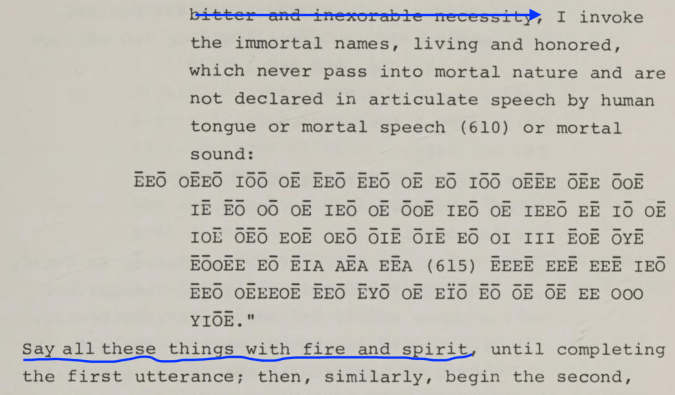
Articulatory phonetics has always known that vowels and consonants are bodily acts. A vowel is a posture of the vocal tract. A consonant is a closure, strike, friction, release or vibration. But this insight has rarely been applied systematically to voces magicae as ritual technology. Instead of asking only what the voces mean, we may also ask what gestures they make, what respiratory pattern they impose, what bodily resonance they create, and what kind of altered state they help stabilise.
In that sense, a sacred formula is not only a word.
It is a gesture of breath.
The Seven Vowels as a Sonic Cosmos
The first correction to make is important. The Greek magical papyri do not work primarily with a neat A-I-O triangle. They work overwhelmingly with the seven Greek vowels: Α Ε Η Ι Ο Υ Ω.
These seven vowels were not random letters. In late-antique speculation they could be correlated with the seven planetary spheres, the tones of the cosmic scale, and the architecture of the heavens. A vowel sequence could therefore function as a sonic image of the cosmos. The idea of a “sonic mandala” is not merely a modern metaphor imposed on ancient material. It is close to the ancient theory itself: the cosmos can be sung as a sequence of vowels.
There is also independent testimony for this practice outside the magical papyri. Demetrius, in On Style, reports that Egyptian priests, when hymning the gods, used the seven vowels in succession, and that their sound was so pleasing that people preferred it to flute and lyre. That passage is crucial because it shows that vowel-sequence chanting was not only a scribal oddity inside magical texts. It was recognised as a sung religious practice, a form of sacred sound whose power lay in the sequence and euphony of the vowels themselves.
This means that vowel-chanting belongs to a broader ancient sound-world. The vowels were not merely letters on a page. They were voiced, prolonged, ordered, heard and felt. They were sung as cosmic sound.
Franz Dornseiff’s Das Alphabet in Mystik und Magie remains one of the classic studies for this broader field of alphabetic and vocalic mysticism. Its importance is precisely that it places letters, vowels, alphabetic sequences and magical practices in the same historical frame.
So the larger picture is sevenfold. The full ancient field is not A-I-O, but ΑΕΗΙΟΥΩ: the seven-vowel body of the cosmos.
The A-I-O triangle should therefore be understood more modestly, but also more precisely. It is not the whole system. It is a minimal cell within a larger sevenfold vocalic universe. It is the small rotating seed of a broader vowel mandala.
From Sevenfold Cosmos to Threefold Cell
Why, then, pay special attention to A, I and O?
Because these three vowels form a simple and powerful bodily triad. They are not the entire ancient system, but they are phenomenologically transparent. Anyone can test them.
A opens the mouth and releases the breath into a broad field.
I narrows the vocal tract and concentrates the sound toward a bright, axial line.
O rounds the lips and gathers the sound into a more enclosed, spherical resonance.
These descriptions are not symbolic inventions added later. They are bodily facts. The mouth opens, narrows or rounds. The breath expands, concentrates or returns. The sound moves through different spaces of the vocal tract.
Here the A-I-O cell becomes useful. It allows us to study the ritual logic of vowel permutation in a minimal form. If the seven vowels form the full cosmic scale, A-I-O gives us a smaller laboratory in which the relation between sound, breath and attention can be observed more clearly.
The six permutations of A, I and O produce different vocal gestures:
AIO opens, concentrates, then rounds.
AOI opens, rounds, then sharpens.
IAO begins with the axis, expands, then completes.
IOA begins with the axis, enters rounded containment, then opens.
OAI begins from the rounded field, opens, then narrows.
OIA begins from enclosure, becomes axial, then opens again.
These are not translations. They are practice-readings. They describe what the mouth, breath and attention do when the sequence is actually voiced.
A sonic mandala is a pattern of such gestures. It is a mandala not drawn in space, but breathed in time.
IAO: Name and Gesture
IAO needs a philological guardrail.
Historically, IAO is almost certainly connected with the Greek rendering of the Hebrew divine name, the Tetragrammaton YHWH. In Jewish, Greek, Egyptian and magical contexts, Ιαω became one of the most powerful divine names. Ancient Greek evidence includes forms such as ΙΑΩ in relation to the divine name, and later magical papyri use IAO repeatedly as a supreme or powerful name.
That history must not be erased. IAO is not originally a vowel exercise. It is a divine name with a Jewish root and a complex afterlife in Greek-Egyptian magic, gnostic speculation and late-antique ritual.
But philology and gestural phonology answer different questions.
Philology asks: where did the name come from?
Gestural phonology asks: what does the name do when voiced?
The two answers do not compete. They coexist. IAO can be historically related to the divine name and at the same time function in ritual as a powerful vocal gesture. When spoken slowly, I-A-O moves from a narrow axial sound, into an open expansion, into a rounded completion. It is name, breath-form and sonic movement at once.
That is precisely what makes such formulas powerful. They do not operate on only one level.
They carry history.
They carry theology.
They carry the body.
The Mithras Liturgy: Sound at the Threshold
The so-called Mithras Liturgy gives one of the clearest examples of this functional differentiation of voice. The practitioner does not simply pray. He breathes, hisses, pops, bellows, speaks silence, utters names and moves through vocal registers as he ascends.
The text instructs the practitioner to draw breath from the rays of the sun. This is already a transformation of respiration. Breath is solarised. The body inhales light. The practitioner then ascends beyond ordinary perception, encounters cosmic powers, passes doors and heavenly guardians, and approaches the highest solar god.
At crucial moments, the voice becomes the tool that stabilises the threshold. When the divine powers rush toward the practitioner, he places a finger on his mouth and invokes silence. He then produces non-ordinary sounds and voces magicae. The visionary field changes. The powers no longer threaten him but move in their proper order.
The hissing and popping sounds are not just colourful details. Betz’s commentary discusses them under their Greek technical names, syrigmos and poppysmos. This matters because it shows that such sounds were recognised categories of ritual utterance. They were not accidental noises. They were part of the technical vocabulary of magical performance.
The hiss, syrigmos, is a controlled line of breath. It is thin, serpentine, continuous, almost wind-like. It stretches exhalation and narrows attention.
The pop, poppysmos, is percussive. It interrupts. It marks a threshold, like a small rupture in the sound-field.
The bellow is deep and animal. It brings belly, chest and throat into the ritual voice.
The vowel opens resonance.
The divine name focuses it.
The silence contains it.
The Mithras Liturgy therefore gives us not just a text of ascent, but an instrument panel of the voice. Each vocal action has a different function at a different threshold.
That may be the missing dimension in much modern mantra practice. We often receive a formula as sacred and repeat it faithfully, but the Mithras material suggests a more differentiated vocal technology: hiss, pop, bellow, vowel, name, silence. The voice is not one instrument. It is an entire ritual apparatus.
Patricia Cox Miller and the Praise of Nonsense
The idea that voces magicae are meaningful as sound rather than as ordinary semantic language is not without scholarly support. Patricia Cox Miller’s essay “In Praise of Nonsense” is especially important here. She argued that the apparently nonsensical language of ancient spiritual and magical texts should not be dismissed as meaningless debris. Such language can disclose another dimension of meaning, where sound, rhythm, materiality and the breakdown of ordinary discourse become religiously significant.
This is exactly where gestural phonology can add something.
Miller helps us understand that nonsense may be meaningful as nonsense. It may work because it disrupts ordinary speech. Gestural phonology then asks how that disruption is embodied. What happens to the breath? What happens to the mouth? What happens to attention when speech stops being conversational and becomes sound-gesture?
The voces magicae do not fail to become normal language. They refuse normal language because the ritual situation demands another mode of speech.
At the threshold of divine appearance, ordinary language may be too human.
Abraxas as Sonic Seal
This brings us to Abraxas, or Abrasax.
Abraxas is not merely a word with a hidden dictionary meaning. It is a condensation of power. In late-antique magical and gnostic materials, the name is associated with cosmic totality, solar force, the number 365, and hybrid divine-daemonic imagery. On gems, Abrasax often appears alongside IAO, vowel sequences, solar symbols and the famous anguipede figure with rooster head and serpent legs. Scholarship on magical gems has repeatedly noted the association between IAO, Abrasax and the seven vowels or planetary powers.
This is exactly the field in which sonic mandala becomes useful.
Abrasax functions as a seal-name, a compressed totality. Around it, vowel permutations are not decorative. They are rotations of breath around a centre. The name holds the field. The vowels move through it.
In this sense, the Abraxas cycle can be understood as a small ritual machine. Not because we claim to have decoded its secret “meaning,” but because we can observe how it operates when voiced.
IAO gives one axis.
AOI gives another.
OAI gives another.
Each permutation changes the route through opening, narrowing and rounding. Each changes the order of expansion, concentration and return. The same three vowels produce a different bodily gesture depending on their sequence.
Abrasax is the seal.
The vowels are the turning.
The breath is the vehicle.
A Practice Protocol for the Inner Laboratory
This must be approached experimentally and slowly. The point is not to run through all six permutations in one excited session. That would blur the observations. One gate at a time is enough.
The Inner Laboratory protocol would be simple.
Sit quietly. Establish the witness. Let the body settle and allow the breathing to become natural. Before chanting anything, notice the baseline: the rhythm of breath, the felt sense of the mouth and throat, the quality of silence, the closed-eye visual field, the emotional tone, the degree of inner pressure or spaciousness.
Choose one permutation only.
For example: IAO.
Chant it slowly on a long exhalation. Do not force volume. Let each vowel have its own full gesture. Feel the I as a narrow bright line. Let A open the field. Let O round and gather the sound. Repeat for a fixed span, perhaps three, seven or twelve repetitions, but keep the number constant across sessions.
Then stop.
Return to silence.
This return is essential. The after-silence is part of the experiment. Notice whether the breath has changed. Notice whether the body feels more vertical, open, rounded, pressured, calm, charged or empty. Notice whether the closed-eye field has shifted: more light, more darkness, more movement, more stillness, more geometric tendency, more depth. Record before interpreting.
On another day, take a different permutation.
AIO.
Then, on another day, AOI.
Each permutation receives its own session. Only after several sessions should comparisons be made. Otherwise the mind invents a system too quickly.
This is the practical heart of gestural phonology. The formula is not treated first as a belief-object. It is treated as a reproducible vocal gesture whose effects can be observed in the body, breath, attention and inner field.
Why This May Induce Altered States
There is no need to mystify the mechanism too quickly. Several processes converge.
Slow vocalisation extends exhalation and regulates breathing. Repetition narrows attention. Vowel resonance gives the body a felt centre. Non-semantic sound interrupts ordinary discursive identity. Ritual expectation gives the experience direction. Silence after sound amplifies contrast. If visual attention is also inwardly stabilised, the closed-eye field may become more active, ordered or luminous.
This does not mean that every vowel chant produces a profound altered state. It does mean that vowel practice has plausible psychophysical pathways into altered consciousness.
The ancient practitioners did not need our vocabulary of autonomic regulation, interoception, attentional absorption or predictive processing. They had another language: divine names, vowels, planetary spheres, rays, gods, doors and immortalisation. But they clearly knew that sound, breath and vision can be made to work together.
That is the forgotten sophistication of the material.
The Mithras Liturgy does not treat voice as ornament. It treats voice as threshold technology.
Silence as the Necessary Seal
The formula of silence in the Mithras Liturgy is one of its most beautiful paradoxes. Silence is spoken. The practitioner uses voice to invoke the field beyond voice.
This should be retained in any modern experimental adaptation. Sound without silence becomes stimulation. Chant without listening becomes performance. The purpose of the vocal act is not merely to produce more sound, but to alter the quality of the silence that follows.
The most important observation may therefore come after the vowel has ceased.
What is the silence like now?
Is it thicker, brighter, deeper, more vertical, more spacious, more charged?
Has the ordinary inner monologue resumed immediately, or is there a gap?
Does the silence feel empty, or inhabited?
These are not theological questions. They are phenomenological questions.
And they are exactly the questions ancient vocal ritual seems designed to provoke.
Toward a New Esoteric Phonology
“Magic words” is too crude a term.
“Mantra” is too tradition-specific.
“Glossolalia” is too narrow.
“Voces magicae” is historically correct for the Greek magical material, but it does not by itself explain the bodily operation.
Gestural phonology may help because it names the missing layer: sacred utterance as embodied action. A vocal formula is breath shaped by the mouth, directed by attention, charged by imagination and placed within a ritual field. Its power lies not only in what it means, but in what it does.
A sonic mandala is a patterned sequence of such gestures. It is a mandala not seen in space, but sounded in time.
The seven vowels give the full cosmic frame.
IAO gives a historically charged divine name and a compact vocal gesture.
A-I-O permutations provide a minimal experimental cell.
Abrasax provides the seal around which the vocal field can turn.
The Mithras Liturgy shows the broader ritual apparatus: breath from the rays, silence, hiss, pop, bellow, vowel, name, revelation.
This is not a replacement for philology. It is its complement. Philology tells us where the words came from. Gestural phonology asks what they did, and may still do, when a breathing body gives them voice.
That inside-out question may be one of the keys to a renewed esoteric psychology.
The ancient formulas are not only to be decoded.
They are to be sounded, paused, listened into, and observed.

