Sigilization as a Process
A sigil does not always begin as a finished symbol. More often, it emerges gradually through concentration, research, experimentation and repeated drawing. The final sign is only the visible result of a longer movement in which intention, imagination and gesture are brought together.
There are several established ways of creating a sigil, but no single method is sufficient for every purpose. Traditional systems can provide structure, while a personal process can make the sign more intimate, embodied and functional.

The Modern Letter Method
One of the best-known modern methods of sigilization was developed during the twentieth century. A sentence expressing a clear intention is reduced to its essential letters. Repeated letters are removed, and the remaining forms are combined, simplified and rearranged until they become a new abstract figure.
The original sentence gradually disappears into the design. What remains is a compact symbolic structure that carries the intention without stating it directly.
This method is useful because it transforms language into image. It begins with a precise formulation and ends with a sign that can work below the level of ordinary verbal thought.
The Classical Magical Approach
A more traditional approach begins not with letters, but with the inherited vocabulary of ceremonial magic. The maker studies older elemental signs, planetary symbols, magical alphabets, seals and geometric figures.
For a water sigil, this may include the downward-pointing triangle of the water element, lunar forms, wave patterns, vessels, circles and symbols connected with receptivity, flow and reflection.
Planetary signs may also be incorporated when they support the purpose of the work. In this case, the older seals attributed to Sachiel became an important source of study.
Studying the Sigils of Sachiel
The process began by examining earlier seals associated with Sachiel, traditionally linked with Jupiter, wisdom, generosity, expansion and benevolent order.
The aim was not to copy an existing seal. Instead, the older forms were observed as a visual language. Their crossings, curves, circles, directional lines and internal balances were allowed to settle into the imagination.
By looking at several examples, one begins to notice recurring principles rather than isolated designs. A seal can suggest movement, containment, ascent, relation or transmission without representing any of these things literally.
Undines and the Nature of Water
The study of Sachiel was combined with reading about undines, water beings and water spirits.
Water connects. It receives, carries, adapts, dissolves and restores movement. It may be calm or forceful, transparent or obscure. It joins separate places without losing its own continuity.
The purpose was therefore not simply to create a decorative sign for the element of water. The intention was to develop a practical symbol for connection and restored flow.
Embodied Research Through Qigong
The process did not remain purely intellectual. Slow qigong practice became part of the research.
Qigong can have a strongly fluid quality. Its gradual, continuous movements provide a physical experience of transition without abruptness. The body learns how one movement enters another, how tension can soften without collapse, and how direction can change without breaking the flow.
This embodied experience helped shape the character of the sigil. The lines needed not only to look fluid, but also to feel fluid when drawn.
Developing the Form on Paper
After study and movement came drawing.
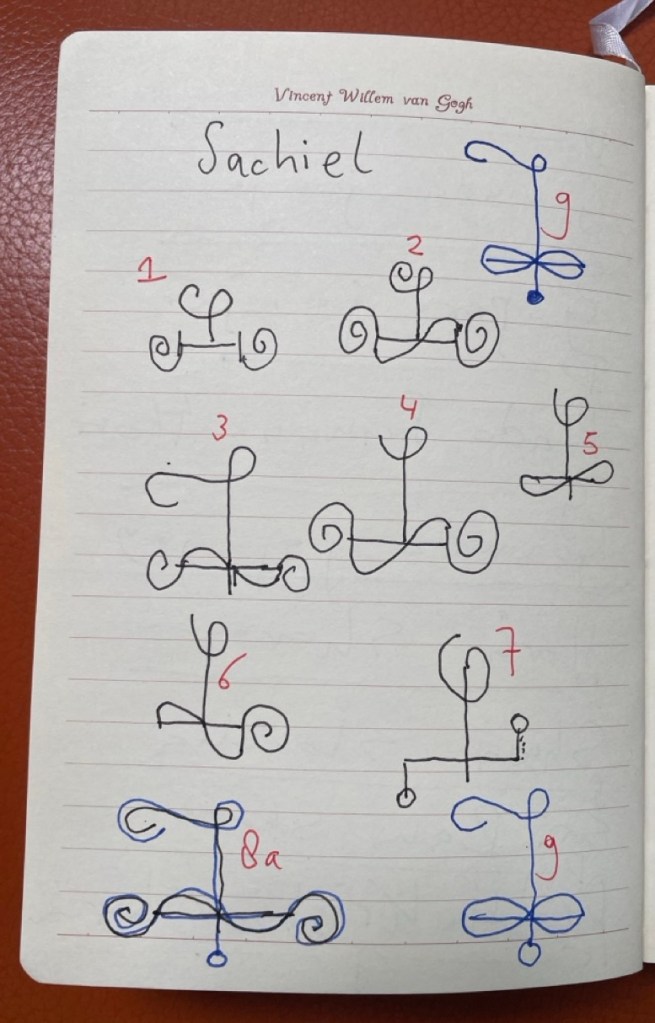
Lines were placed on paper without demanding an immediate result. Some forms were too elaborate. Others felt borrowed, rigid or merely ornamental. The process continued through sketches, reductions and variations.
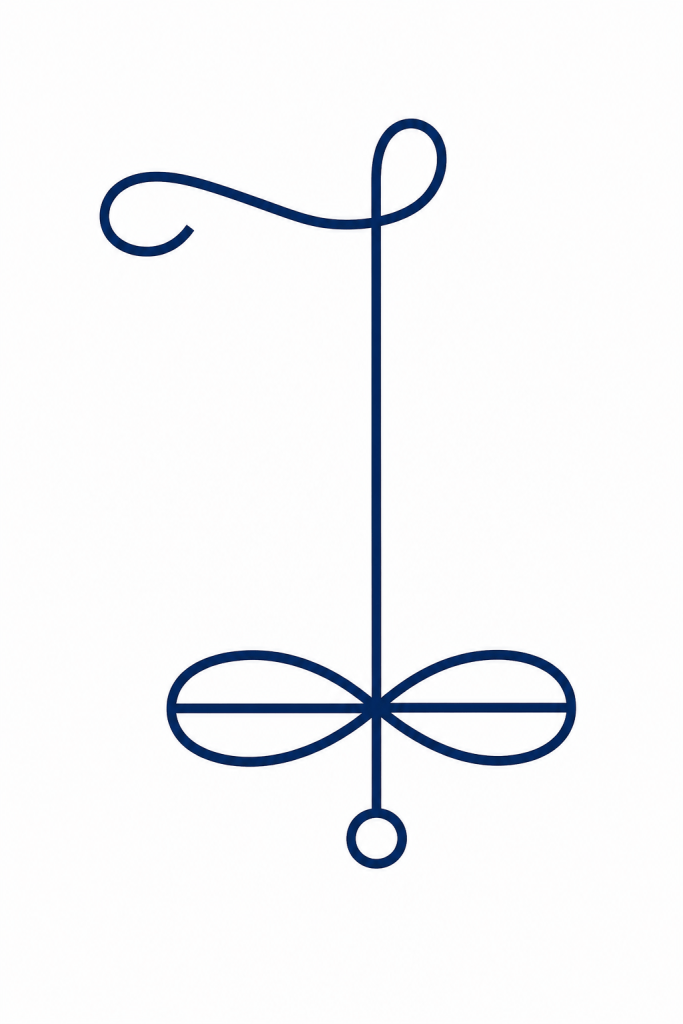
Gradually, a particular structure began to stand out:
- a long central line;
- an open curving movement above;
- two connected loops below;
- and a small circle at the base.
The accompanying handwritten notes show this stage of development. They preserve the uncertainty of the first attempts and reveal how the final sign emerged from repeated adjustments rather than from a single moment of inspiration.
From Drawing to Gesture
Once the form had become recognisable, another question became important:
Could the sigil exist not only on paper, but also as a gesture?
A working sigil should be capable of movement. Its lines should be traceable in the air with one finger, with the left hand, with the right hand or, in a more ceremonial form, with both hands.
The hand does not merely reproduce the drawing. It activates its rhythm.
The upper curve opens and reaches.
The central line establishes direction.
The lower loops join two sides through one centre.
The circle completes and contains the anchor and condensation point.
The Short Formula
Once the sign had become stable, it was joined to a simple verbal formula:
I connect.
The formula gives language to the gesture without overloading it with explanation.
The sigil can be traced silently in a small everyday practice, especially when connection is needed during disagreement, conflict or emotional distance. In this context, the gesture may be made discreetly with one finger.
It marks the moment when the witness becomes present and chooses connection rather than automatic reaction.
The Ceremonial Evocation
The same sigil can also be used in a broader ceremonial evocation.
In that setting, the sign is drawn more deliberately in the air while an undine is called to appear as an external symbolic presence. The formula is embedded within the evocation:
Come, Great Undine, come.
I call upon you, Sachiel, angel of water.
Through this sigil I call you forth.
Appear before me.
Inspire me,
so that I may connect.
I connect.
The language remains direct. The ceremony does not require excess. The sigil, the gesture and the spoken words are sufficient.
One Operation, Three Forms
The sigil, gesture and formula form one operation.
The drawing establishes the structure.
The movement gives it rhythm.
The words direct its purpose.
Together they transform an abstract intention into something visible, embodied and repeatable.
A Personal Method of Sigilization
This process shows that personal sigilization does not have to reject tradition. It can begin with traditional sources, study their principles and then move through direct experience, movement and repeated drawing toward an individual sign.
The result is personal, but not arbitrary.
It has a history, a structure, a gesture and a function.
The Function of the Water Sigil
The essential purpose of this sigil is simple:
to restore flow, to cross distance and to connect.
The first sketches reveal the process.
The finished blue sigil reveals the form.
The spoken formula reveals the action.
I connect.