Jan M. Keppel Hesselink, MD, MSc, PhD
There is a story told in Tibetan Buddhism that sounds, to the Western ear, like pure mythology.
When a great meditation master dies, the body does not decay in the ordinary way. Instead, it dissolves into colored light. Witnesses describe rainbows appearing around the place of death. The physical form shrinks over days, sometimes disappearing almost entirely, leaving behind only hair and nails. This is called the rainbow body, jalü in Tibetan. It is considered the highest sign of realization, the ultimate proof that a practitioner has truly understood the nature of mind.
Most people hear this and think: beautiful story. Probably symbolic. Let’s move on.
I think that response is too quick.
What I Have Been Researching
For years I have been studying a specific phenomenon that appears in deep meditation across virtually every serious tradition in the world. Tibetan Buddhism calls it inner light. Christian mystics call it lux divina. The Vedantic traditions call it jyotir. Modern neuroscience calls it phosphenes.
Phosphenes are the lights you see when you press on your closed eyes, or when you sit in deep silence for a long time and the visual system begins to generate its own imagery from within. Flickers, colors, geometric patterns, expanding fields of brightness. Most meditators experience them. Most dismiss them as noise.
I think they are something much more interesting than noise. And my research paper on the rainbow body, now available on PhilArchive with nearly 900 downloads from researchers and practitioners worldwide, proposes something that connects these two things directly.
The paper is called The Rainbow Body and the Inner Light: Phosphenes in Tibetan Mysticism. You can read it here: [https://philpapers.org/rec/KEPTRB-2]
What it argues, carefully and step by step, is this: the visual experience of the rainbow body, the light that advanced meditators encounter and that is described so vividly in Tibetan texts and depicted in Tibetan paintings, is not merely symbolic. It is a real inner experience that we can study, map, and begin to understand through both the contemplative tradition and our current knowledge of how the brain and awareness work together.
What Dzogchen Actually Teaches
Dzogchen is the highest teaching of the Tibetan Nyingma tradition. Its name means something like the Great Perfection. Its central claim is deceptively simple: awareness, in its natural state, is already luminous. It is already light. The entire path of practice is not about achieving something new, but about recognizing what is already the case.
Most of us are not aware of this luminosity because we are too busy. Our minds are full of thoughts, plans, reactions, fears, memories. The light of awareness is there behind all of it, the way the sun is there behind clouds, but we do not experience it directly.
What advanced Dzogchen practice does, through specific techniques of stillness, attention, and what the tradition calls rigpa, pure awareness, is thin out the clouds until the light becomes visible. And then, in the most advanced stages, until the light is all there is.
The rainbow body is what happens at death when a practitioner has completed this process. The physical body was always, at its deepest level, nothing but light. When the practitioner fully realizes this during life, at death the illusion of solid form simply dissolves, and what remains is what was always there: light itself.
The Inner Cinema
What my research examines is the middle ground between this extraordinary endpoint and ordinary experience. Specifically: what do meditators actually see during the years and decades of practice that lead toward such realization?
The answer is: a great deal. And it follows a recognizable pattern.
In the early stages of deep meditation, you encounter simple phosphene phenomena. Flickering light. Colored patches. Geometric forms that appear and dissolve. Most meditators notice these and wonder whether they mean anything.
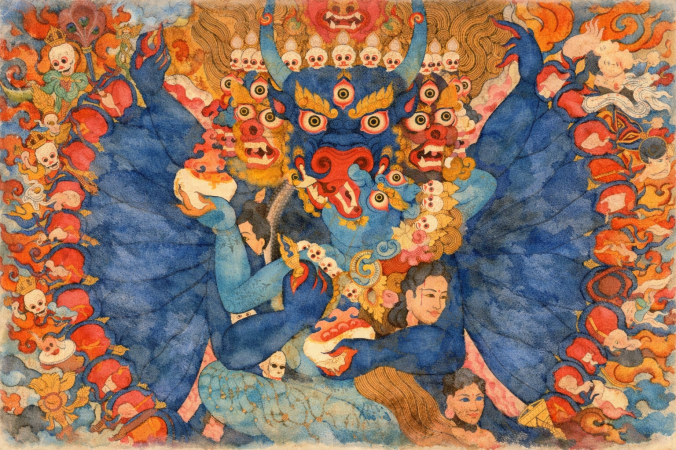
In deeper states, these phenomena become richer, more structured, more vivid. Colors intensify. Forms begin to organize themselves into something that resembles the imagery described in Tibetan texts and depicted in Tibetan thangkas, those large ornate paintings of Buddhas, deities, and mandalas that hang in temples and meditation rooms.
I propose in the paper that these paintings are not primarily decorative. They are maps. They encode, in visual form, what meditators at advanced stages actually encounter in the inner landscape of sustained practice. The geometry of the mandala, the radiating light around the central figure, the concentric circles of color, all of this corresponds to what the visual system produces when awareness turns inward with sufficient depth and steadiness.
The paper introduces a six-phase taxonomy, a description of six stages through which inner light experiences develop, from the first simple flickers to what I call the ultrasubjective hyperspace, a state of pure luminous awareness in which the boundary between perceiver and perceived dissolves entirely.
Not Just Seeing, Also Feeling
One of the more unusual contributions of the paper is the emphasis on what I call the haptic dimension of these experiences. Haptic simply means relating to touch and body sensation.
Meditators who go deep into inner light states do not only see light. They often feel themselves expanding, floating, becoming weightless. Sensations of the body dissolving its ordinary boundaries. The sense of being simultaneously very large and very still. Of occupying space differently.
These sensations are not separate from the visual phenomena. They are part of the same process. The paper proposes that the body’s way of sensing itself, its proprioception, its sense of boundary and location, participates in what the tradition describes as the luminous field. You do not only see the light. In a certain sense, you become it.
This is what the tradition means when it says the practitioner merges with the deity, or becomes the ascending light form. It is not a metaphor. It is a precise description of a specific type of experience that arises in sustained contemplative practice and that has physiological correlates we can study.
Check my playlist on this topic!
What This Has to Do With Authenticity
This paper connects directly to the series on authentic spirituality that I am developing on PhilArchive.
The rainbow body has become, in contemporary spiritual culture, one more exotic concept to sell. Workshops promise rainbow body activation. Teachers claim to transmit rainbow body frequencies. The imagery appears on merchandise, in YouTube videos, in online courses that have nothing to do with the decades of actual practice the Tibetan tradition requires.
This is exactly the pattern of pseudo-spirituality that the series on authentic spirituality is designed to critique. The symbol is taken, emptied of its actual context, and sold as an experience that can be delivered quickly.
What my research does is restore the context. The rainbow body is not a marketing concept. It is the endpoint of a specific and demanding tradition that begins with ethics, continues through years of concentrated practice, passes through recognizable stages of inner experience, and arrives, for the very few who complete the journey, at a state of awareness that is genuinely beyond what ordinary language can capture.
Understanding what the inner light experiences actually are, what they feel like, what stages they move through, and what they require of the practitioner, is one of the most important ways of distinguishing authentic practice from its imitations.
Why 864 Researchers Chose to Read This
When I uploaded this paper to PhilArchive in November 2025, I did not expect it to be read widely. It sits at the intersection of several fields that do not usually talk to each other: Tibetan Buddhist studies, neuroscience, phenomenology, and philosophy of mind.
And yet it has been downloaded 864 times, with 786 of those downloads in the last six months alone. Something in this question is alive. People who study consciousness, people who study religion, people who meditate, and people who simply wonder what the great traditions were actually pointing at, are all drawn to the same question.
What is the light that appears in deep meditation? What does it have to do with the light that the traditions describe? And what would it mean to take that question seriously, neither dismissing it as neurology nor inflating it into a marketing campaign?
Those are the questions this paper tries to answer. And they are, I believe, among the most important questions anyone can ask right now.
You can read the paper here, for free: The Rainbow Body and the Inner Light, PhilArchive
Jan M. Keppel Hesselink Quinta Quixote, Algarve, 2026

