Long before the vocabulary of psychogeography, phenomenology, or esoteric psychology existed, the people of Portugal knew that certain stones were inhabited.
The figure at the centre of this knowledge is the Moura Encantada, the Enchanted Moura, one of the oldest and most persistent beings in Portuguese and Galician folk tradition. She is beautiful, she is powerful, and she lives inside megalithic stones. She did not merely visit them. She built them, carrying enormous grey boulders on her head while spinning thread at her waist, and when the building was done, she remained. The stones became her dwelling. The oval, the dolmen, the standing stone: all are, in this tradition, her house.
The word moura does not derive from “Moor,” as is sometimes assumed. Philological research traces it to the Celtic root mrvos, meaning “the dead,” cognate with the Latin mortuus. The Moura Encantada is thus a folk memory of the pre-Roman builders of the megalithic landscape, those who erected the great stones of the Iberian peninsula from around 5,000 BCE onward. When the Celtic peoples arrived in western Iberia around 700 BCE, they encountered these ancient stone structures and wove their own mythological understanding around them. The builders became the enchanted dead. The stones became their bodies and their homes.

This places the Moura tradition in a much wider Atlantic context. She belongs to the same stratum as the Galician mouros, the Basque mairu who also built dolmens, and the Irish sidhe, the fairy dead who live inside ancient mounds. Across Atlantic Europe, wherever the great stones stand, the folk imagination has placed beings inside them. The stones are not monuments to the dead. They are the dwelling places of a presence that persists.
A Primary Source from the Algarve Itself
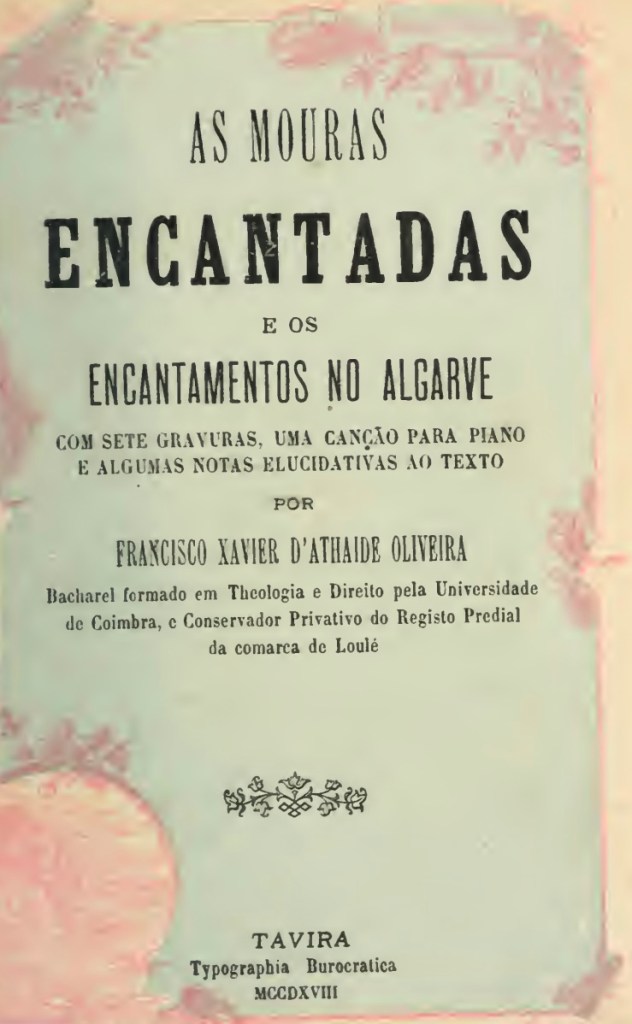
We are fortunate to have a remarkable primary source bearing directly on this landscape. Ataíde d’Oliveira (1842–1915), a scholar born and settled in the Algarve, spent years travelling the villages of the province collecting oral traditions from elderly locals before those traditions dissolved entirely. His book As Mouras Encantadas e os Encantamentos no Algarve, published in Loulé and dedicated to that town as his adopted homeland, is the most important ethnographic record of the Moura tradition specifically in this region. It documents what grandmothers told their daughters and what daughters remembered into old age, gathered at the last moment when living memory still carried the tradition.
What Oliveira found in Loulé, the municipality that encompasses the eastern Algarve hills where Monte Pocilgais stands, is extraordinary. His informants described an entire enchanted world existing just beneath the visible surface of the landscape. Below the town of Loulé itself, they told him, lay a subterranean villa, a complete underground settlement populated by enchanted mouras and mouros who continued to live, speak to one another, and organise their affairs seven fathoms beneath the ground. At the Torrejão, a moura and a young mouro met regularly in an underground hall beneath the property of D. Victoria Faisca. They were cousins, enchanted by their desperate parents who had wished them to marry. They could speak to each other but not love each other. A moura aunt, enchanted nearby solely to keep the young woman company, attended their meetings. The enchanted community persisted, organised, and sorrowful, immediately beneath the feet of the living.
Oliveira also records a first-person sighting of a moura on the walls of a castle in Martim Ennes, recounted to him by the witness’s daughter. Her father, returning from the Guia fair on a stormy October night, saw at twenty metres distance a female figure on the castle walls carrying a burning torch. The light it cast was bluish. The air around it smelled of sulphur. He arrived home pale as a corpse. Both parents immediately bolted the door. It was the kind of encounter, his daughter told Oliveira, that a man does not speak of lightly and does not forget.
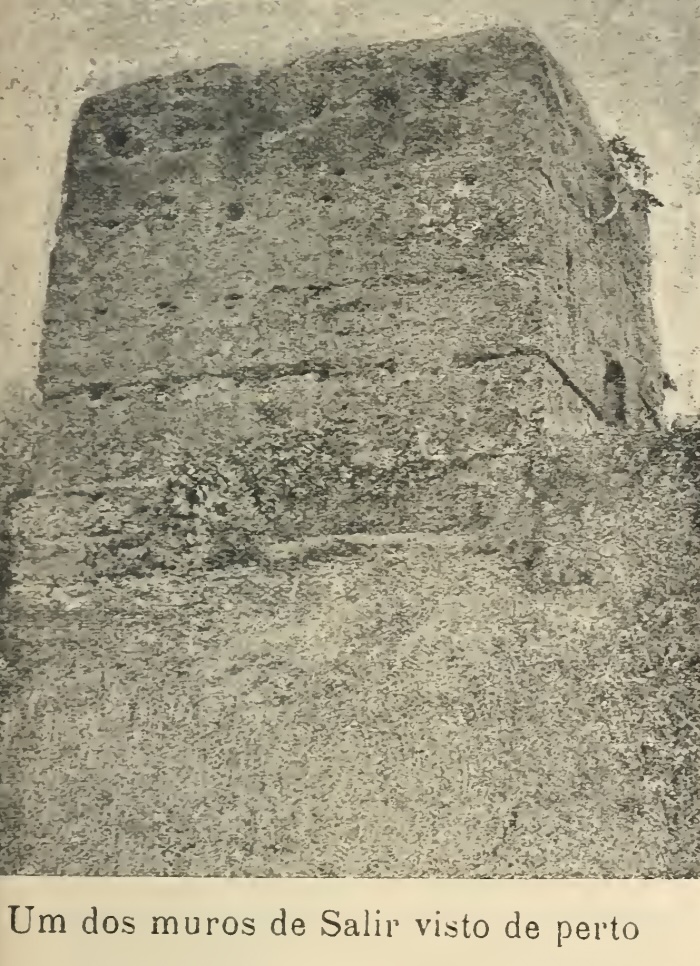
In the village of Benafim, in the municipality of Loulé, Oliveira found some of the richest surviving traces of moura tradition in the province, and he connects them explicitly to archaeological evidence: polished stone axes, neolithic remains, signs of a civilisation far older than the Moorish occupation that popular memory had collapsed everything into. He understood that the moura legends were not about medieval Islam. They were about something far older, a sacred relationship with stone formations, underground water, and the boundary between the living world and whatever lies adjacent to it.
The Pedra-Moura and the Pocilgais Oval
What is particularly striking for our purposes at Monte Pocilgais is a specific sub-type within the tradition: the pedra-moura, the moura who lives inside a particular stone. Local belief held that whoever sat on such a stone would become enchanted, drawn into the presence of the being who dwelt within it. This is not a cautionary tale designed to keep people away. It is a description of what happens when a sensitive person sits quietly on or among certain stones: something shifts. A contact is made. The boundary between the ordinary world and what lies behind it becomes permeable.
This is precisely what visitors to the Pocilgais oval stone circle report.
The Moura Encantada is also associated with liminality in a structural sense. She appears at thresholds: at cave entrances, at wells, at river crossings, at the edges between field and forest. She is most visible on St. John’s Eve, June 24, the night when the veil between worlds is at its thinnest. She guards the entrance to the world beyond, and she promises treasure to those who can break her spell through courage, patience, or the correct ritual act. The treasure is rarely described as gold alone. It is more often wisdom, vision, or passage to an otherwise inaccessible realm.
The eastern Algarve, where Monte Pocilgais stands, has its own deep megalithic history. The municipality of Alcoutim, in these same eastern hills, contains the megalithic complex of Lavajo, with menhirs dating to between 3,500 and 2,800 BCE, interpreted by archaeologists as territorial markers or sacred spaces. The roots of human sacred activity in this landscape reach back at least six thousand years. The grey stones of the Pocilgais oval stand in a landscape that has been perceived as inhabited, oriented, and meaningful since the Neolithic. The Moura did not arrive with the tourists. She was here long before the road.
There is also a second figure worth noting: the Duende, a smaller and more mischievous being of the rural interior, associated with forests, caves, and remote hillside places. The Duende inhabits the same ecological register as the Pocilgais site, wooded slopes, running water nearby, stone formations off the main paths, and is understood as a creative and sometimes disorienting presence, one that leads walkers astray but may also inspire those who encounter it with unusual clarity or energy.
Where the Moura is ancient, chthonic, and associated with the deep memory of the stone, the Duende is quick, local, and atmospheric, more the spirit of a particular afternoon than of a geological era.
Together, these two figures give us a vernacular map of what the esoteric practitioner might encounter in a place like the Pocilgais oval: a deep, stone-bound presence of ancient origin, and a more immediate, atmospheric animation of the living landscape around it.
The Stone as Key, the USH as Door
What the folk tradition describes in narrative form, our esoteric psychology restates in phenomenological terms. The beings in the stone are not disproved by modernity. They are simply no longer named. When we sit inside the oval and something shifts, when the atmosphere thickens, when attention is gathered by an invisible organising principle, the tradition says: that is the Moura. She is still here. The stone is still her house. And the treasure she guards is the same one it has always been: access to the world that dwells just on the other side of the visible, inextricably bound to it, neither separate from the physical nor reducible to it.
In the framework of our esoteric psychology, this intermediate realm, the space where the Moura becomes perceptible, where the enchantment of the pedra-moura takes hold, is what we call the ultra-subjective hyperspace, the USH. The Moura does not live in the physical stone. She lives in the USH that the stone opens. The stone is the key. The USH is the door.
After the foundation paper is this the second part of 4 articles on genius loci-based ecological landscape practice
References
Lindström, H. (2014). Casas das Mouras Encantadas: A study of dolmens in Portuguese archaeology and folklore. Master’s thesis, University of Helsinki. Available at academia.edu.
Frazão, F., & Morais, G. (2009). Portugal, Mundo dos Mortos e das Mouras Encantadas I & II. Apenas Livros.
Oliveira, A. d’ (1905). As Mouras Encantadas e os Encantamentos no Algarve. Loulé. [Digitised by Internet Archive, 2009.]


Pingback: New Landscape Holistic Project: The Magick Megalithic Circle Phenomenology | breath4balance