Forest bathing and ecopsychology have done something important. They have helped restore our capacity to slow down, step out of the relentless cognitive machinery of modern life and become present in nature again. That sounds simple, but it is not. Much of the time we move through landscapes without really perceiving them. A forest becomes a recreational space, a mountain becomes a view, a river becomes a photograph. Even when we deliberately seek out nature, we often remain trapped in the same structure of experience: we arrive, we consume the setting, we feel better, and we leave.
Forest bathing interrupts that pattern by changing the quality of attention. We begin to notice light, scent, temperature, texture, birdsong, the movement of air through leaves, the feel of the ground under the feet. The body settles, attention widens, and the surrounding world begins to recover some of the depth that ordinary hurried perception strips away from it. Ecopsychology takes this further by reminding us that human psychological life is not sealed inside the skull. We are embedded in environments, shaped by seasons, animals, weather, vegetation, geography and the ecological systems on which our lives depend.
Yet once that basic relationship with nature has been restored, another question becomes possible. What happens if we do not stop there?
From Presence to Relationship
There is a difference between being present in nature and entering into a sustained relationship with a particular place. You may walk through a forest with exquisite sensory awareness and still experience it primarily as an environment through which you are moving. The trees are more vivid, the sounds are richer, the body is calmer, but the structure remains familiar: there is you, and there is the landscape you are perceiving.
That structure begins to shift when a place becomes specific. You return to the same path and notice that your attention is repeatedly drawn toward one opening between the trees. You sit beside a certain rock and discover that your breathing changes there in a way it does not twenty metres away. One part of a valley feels expansive, another produces a subtle unease. A particular bend in a track repeatedly slows your pace. You notice where animals cross, where water collects after heavy rain, where one kind of vegetation gives way to another. Old walls, ruins, paths and place-names begin to acquire significance because they reveal how earlier generations also lived in relation to the terrain.
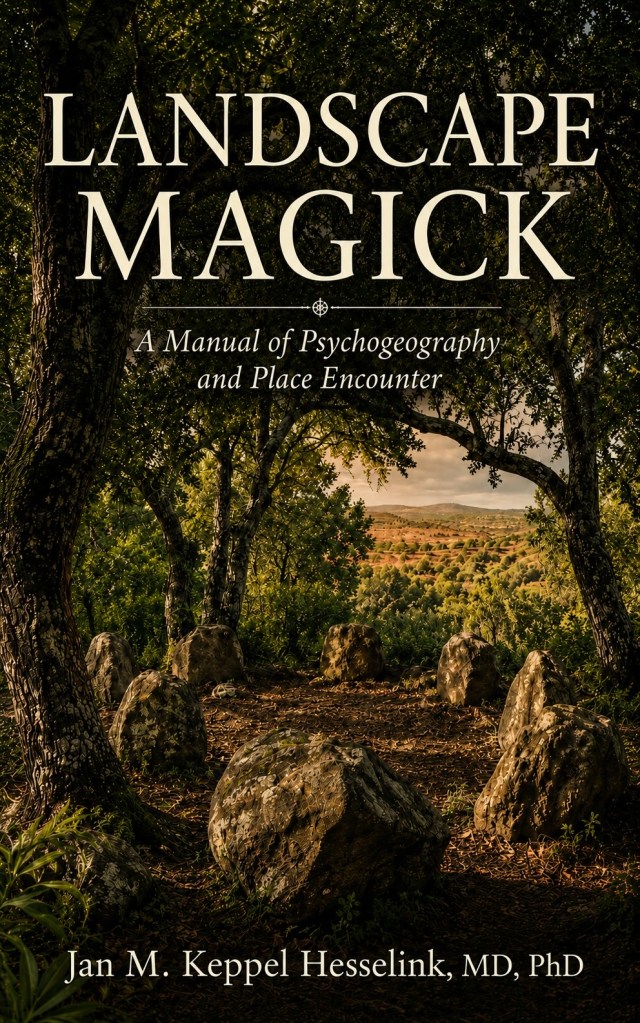
At that point the landscape ceases to be generic. It becomes this landscape, with its own history, rhythms, pressures and recurring effects on perception. That is where Landscape Magick begins.
The Landscape as an Active Field of Perception
The word magick can easily lead the imagination in the wrong direction. It may suggest fantasy, superstition or the projection of invisible forces onto the natural world. The approach I have in mind begins much more soberly. Before deciding that a place has a spirit, energy, presence or message, we can first ask what is actually happening.
What changes in the body when you enter a certain area? Does your walking pace alter? Does the breath become deeper or shallower? Do you repeatedly look in the same direction? Do you become more alert, relaxed, uneasy or unexpectedly still? Does this happen once, or does it recur over time? Does it return under different weather conditions? Does it arise before you consciously expect it? If another person enters the same place without being told what you usually experience there, do they notice anything similar?
These are simple questions, but they change the nature of the encounter. Instead of moving immediately from sensation to interpretation, they allow the experience to develop a structure of its own. Over time, patterns can begin to emerge. This is where phenomenology, psychogeography, animism and magick begin to overlap.
Beyond Scenery
Modern culture has trained us to treat landscapes as scenery with remarkable efficiency. We photograph sunsets, collect viewpoints, follow marked routes and review destinations. Even nature connection can become another form of consumption. We travel somewhere beautiful, receive an experience, and move on. A relationship with place develops differently because it depends on return.
When you return, memory enters the landscape. You remember where the water rose in winter, where a certain bird nested, where the grass remained green longest into summer, where an old path disappeared into scrub. You begin to understand the terrain not as a static image but as a living sequence of changes. Historical place-names may reveal earlier uses of the land, preserving references to springs, animal enclosures, grazing areas, rocks, presses or settlements that are no longer obvious to the eye. The place becomes layered in time as well as space.
This temporal depth matters because it gradually undermines the assumption that landscape is simply a neutral background to human activity. It starts to behave more like a counterpart.
When Place Becomes a Counterpart
Animist traditions have long described mountains, rivers, trees and other elements of the world as persons or presences. Contemporary approaches to animism have helped move beyond the old caricature that people simply believed every object contained a soul. A more useful starting point is relational. You do not need to decide immediately whether a tree or hill is conscious. You can first observe what happens when you begin treating the place as something with which you are in relationship rather than something you merely observe or use.
That change in attitude has consequences. You approach differently. You become more attentive to repetition. You notice what you take from the place, what you disturb, what you bring into it and what you leave behind. A spring is no longer merely a source of water. A grove is no longer simply vegetation. A path begins to carry memory because you have crossed it repeatedly under different conditions. The place acquires a continuity that begins to meet your own.
Why Interpretation Must Wait
This is also where caution becomes important. Once landscapes begin to feel meaningful, interpretation can become seductive. A bodily sensation can quickly turn into an “energy vortex”, an unusual coincidence into a message, a striking tree into a guardian spirit. Sometimes such interpretations may prove meaningful, but if they are imposed too quickly they can actually diminish the experience by replacing observation with expectation.
Landscape Magick therefore depends on restraint. Record first, interpret later. If you feel uneasy beside an old well, note the unease before deciding what it means. If one area of woodland repeatedly attracts your attention, describe the pattern before naming it. If an image, word or inner figure appears while you sit somewhere, allow it to remain provisional. Meaning does not become less powerful because it is given time to develop.
What Comes After Forest Bathing?
This is the point at which forest bathing and ecopsychology can become the beginning of something rather than the endpoint. Forest bathing restores sensitivity. Ecopsychology restores context. Landscape Magick asks what becomes possible when attention is sustained long enough for a place to acquire memory, character and relational depth.
From there, practice can deepen. You may begin to work with repeated routes, particular times of day, changes in weather, symbols, gestures or small acts of marking. The form of the terrain itself can begin to shape contemplative or magical practice. A hill, spring, tree line or ruined wall becomes part of a living map in which perception, memory, body and meaning continually interact.
The important shift is that nature is no longer approached only as something that regulates us, heals us or makes us feel better. The landscape becomes a participant in the work.
Perhaps that is what comes after forest bathing. We move from presence toward relationship, and from relationship toward participation. At that point, landscape is no longer merely scenery around us. It begins to enter the structure of our inner life.
Buy the book (for a symbolic price of 7.77 and let me know what you think of it on the Amazon website! Thanks.

